Does Face Yoga Actually Work? What the Research Says
Face yoga — structured facial exercises targeting specific muscle groups — sits in an unusual position for a wellness practice: it has genuine peer-reviewed evidence supporting real but modest effects, while also being surrounded by significant marketing exaggeration. A 2018 clinical study published in JAMA Dermatology found that participants who practised a 30-minute facial exercise programme for 20 weeks showed measurable improvements in upper and lower cheek fullness, and were estimated to look 3 years younger by dermatologist raters. That is a real finding from a real study. What the TikTok-promoted face yoga content tends to omit is the exercise duration (30 minutes daily), the timeline (20 weeks), and the modest effect size. Here is what the evidence actually shows.
This article is for informational and educational purposes only and does not constitute medical, dermatological, or psychological advice. Consult a qualified professional before making changes to your health or skincare routine.
The Clinical Evidence for Face Yoga
The most cited study on facial exercise and appearance was conducted by Alam and colleagues at Northwestern University and published in JAMA Dermatology in 2018. The study enrolled 27 middle-aged women (ages 40–65) who practised 32 distinct facial exercises for 30 minutes daily for 8 weeks, then every other day for 12 weeks. Standardised photographs were taken before and after.
Dermatologist raters assessing the photographs blind to timing rated the post-exercise photos as showing significantly improved cheek fullness in both the upper and lower cheek regions. Using the Merz facial aesthetic scale, the mean estimated age decreased from 50.8 to 48.1 years — a 2.7-year apparent age reduction over 20 weeks.
The proposed mechanism is muscle hypertrophy — the same principle that causes body muscles to increase in volume with exercise. Facial muscles sit directly under the skin rather than under a fat layer, so increased muscle volume from exercise directly lifts the overlying skin and fat, producing more fullness and less sagging.
“Participants appeared approximately 3 years younger following the 20-week exercise programme, with significant improvement in upper and lower cheek fullness.”
What Face Yoga Actually Does to Your Face
The primary mechanism is muscle volume maintenance and growth. Facial muscles, like all skeletal muscles, are subject to age-related sarcopenia — gradual volume loss that contributes to the hollowing and sagging visible in older faces. Targeted exercise counters this, maintaining or slightly increasing the volume of trained muscles.
Secondary effects include improved circulation (exercise increases blood flow to trained tissue, improving skin oxygenation and nutrient delivery) and lymphatic drainage improvement (muscle contractions stimulate lymphatic flow, reducing fluid retention in the face). These effects contribute to the improved skin tone and brightness reported by many regular practitioners.
What face yoga does not do: it cannot change bone structure, restore lost subcutaneous fat, or undo significant UV-driven collagen degradation. It is most effective as a maintenance tool — preserving muscle volume and tone to slow the structural descent of the midface — rather than a reversal tool for established deep sagging.
Which Exercises Have the Best Evidence
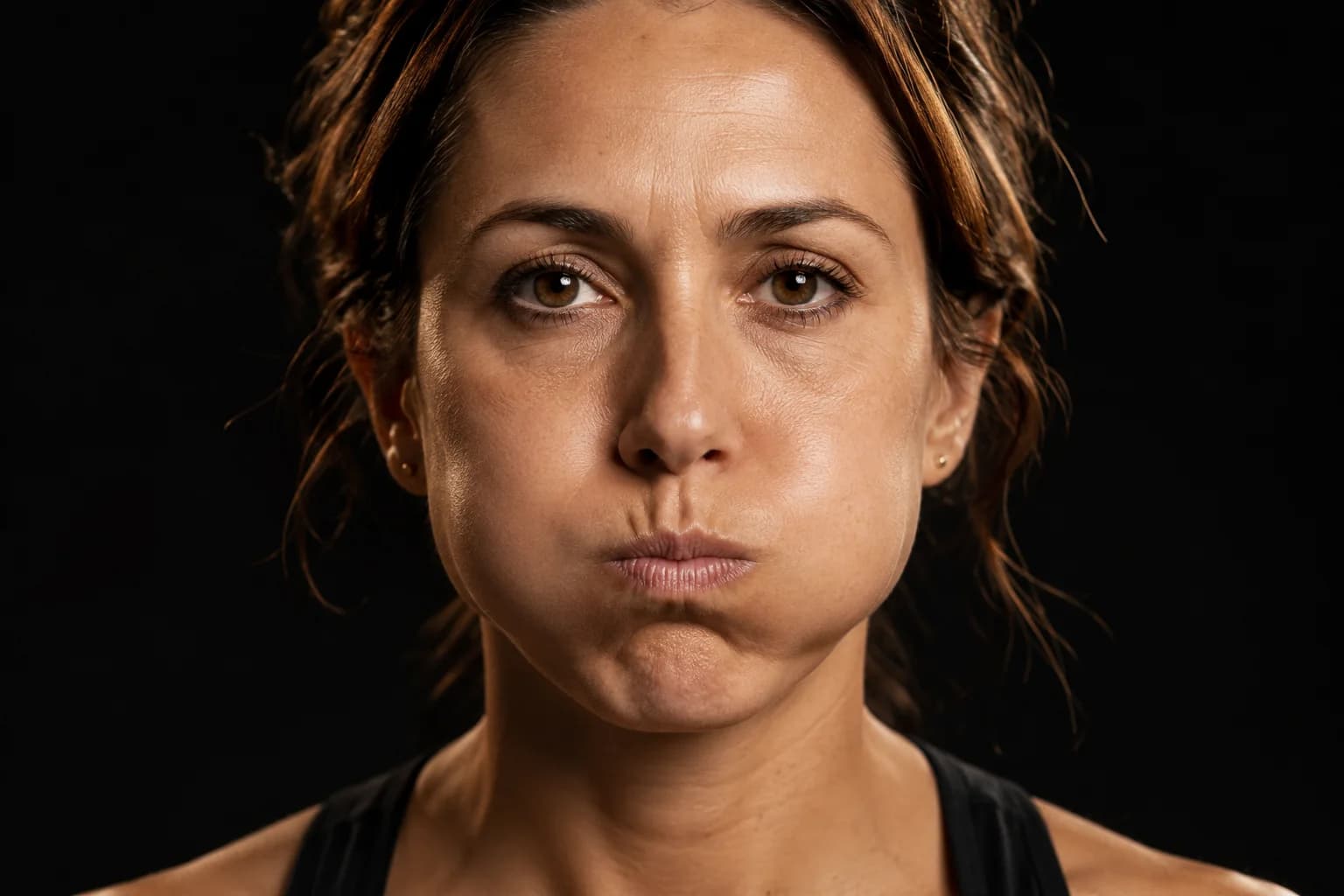
The cheek plumper: inflate your cheeks fully with air, then move the air from one cheek to the other. Hold each side for 5 seconds. This targets the buccinator and orbicularis oris muscles and contributes to cheek volume maintenance — the most evidence-backed outcome from the Alam study.
The upper eyelid strengthener: with two fingers gently holding the brow still, slowly close the upper eyelid while looking down. This targets the orbicularis oculi (same muscle activated in a Duchenne smile) and the levator palpebrae superioris. Research suggests it may help with mild upper lid heaviness through muscle strengthening.
The jawline definer: tilt your head back slightly, push the lower jaw forward, and hold for 10 seconds before releasing. This targets the platysma and digastric muscles in the lower face and neck. Consistent practice improves the definition of the mandibular border in people who have mild early laxity.
The Alam study participants exercised for 30 minutes daily. Shorter sessions produce proportionally smaller effects. Consistency over months matters more than intensity in any single session.
Advertisement
Realistic Expectations and Timeline
The honest timeline from the clinical evidence: measurable improvement in cheek fullness and apparent age after 20 weeks of consistent 30-minute daily practice. That is a significant time investment. Most people who try face yoga for two weeks and abandon it are not giving it a fair test.
The effect size is also important to contextualise. A 2.7-year apparent age reduction is real and meaningful but is not a transformation. Face yoga is best understood as one component of a broader appearance maintenance strategy — alongside sleep, SPF, body composition, and skincare — rather than as a standalone anti-aging solution.
AI apparent age estimation provides an objective way to track face yoga progress. Standardised photos taken before starting a programme and every 4 weeks thereafter, assessed with a consistent tool like Guess My Age, give you data-driven before-and-after evidence rather than relying on the unreliable self-assessment that the mere-exposure effect distorts.
Frequently Asked Questions
Does face yoga actually work?
Yes, with qualifications. A 2018 JAMA Dermatology clinical study found that 20 weeks of 30-minute daily facial exercises produced measurable improvements in cheek fullness and an average 2.7-year reduction in estimated age. The mechanism is muscle hypertrophy — increased facial muscle volume that lifts overlying skin and fat. Results require significant time investment and are modest rather than transformative.
How long does face yoga take to work?
The clinical study that produced the best evidence ran for 20 weeks (approximately 5 months) with 30 minutes of daily exercise. Measurable results were seen at 20 weeks but not assessed at earlier time points. Anecdotally, practitioners report improvements in skin tone and slight firmness within 4–8 weeks, with structural cheek volume improvements taking longer.
What are the best face yoga exercises?
The exercises with the strongest evidence focus on the muscles that contribute most to midface volume: the buccinator (cheek plumper exercise), orbicularis oculi (eye squeezing exercises), and platysma and digastric muscles (neck and jawline exercises). The Alam study protocol used 32 exercises targeting the full face, but the cheek region showed the most measurable improvement.
Is face yoga better than Botox?
They work by different mechanisms and are not directly comparable. Botox temporarily paralyses specific muscles to reduce dynamic lines (3–6 month duration, requires repetition, cannot restore volume). Face yoga builds muscle volume to lift and firm, with effects that accumulate over time and persist as long as practice continues. For volume restoration and anti-sagging, face yoga has a more logical mechanism. For reducing existing dynamic wrinkles, Botox is faster and more reliably effective.
Lena Whitmore
Science Writer · Facial Analysis & Appearance Psychology
Lena covers the science of smiles, facial aging, and AI-powered biometrics. She writes evidence-based guides grounded in peer-reviewed research, with a focus on making appearance science accessible and actionable. All tools on Smile Tracker run locally in your browser — your photo is never uploaded anywhere.
Put it to the test
See your results with AI
Upload a photo and get your AI facial proportion analysis, symmetry measurement, and feature breakdown — free, private, instant.
Analyse My Face Free →Advertisement
Sources