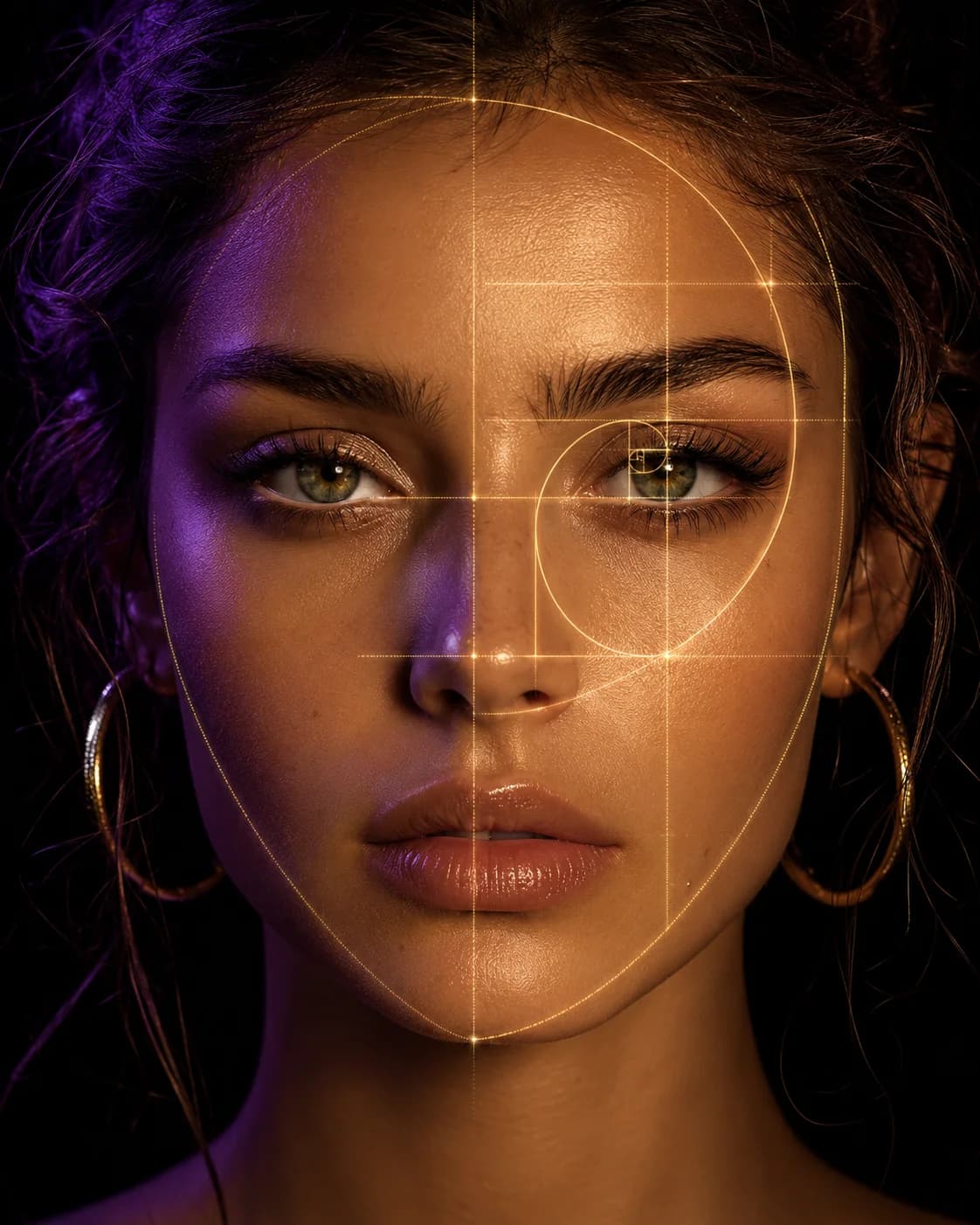
What Makes a Face Attractive? The Science Behind Facial Attractiveness
The question of what makes a face attractive has been studied rigorously by psychologists, evolutionary biologists, and AI researchers for decades — and the findings diverge significantly from popular assumptions. Symmetry helps, but less than most people believe. Averageness matters more than symmetry. Expression has a larger impact than any structural feature. And the factors that drive attractiveness in photos differ from those that drive it in person. Here is what the evidence actually shows.
The Four Main Factors in Facial Attractiveness
Research in facial attractiveness consistently identifies four main structural and perceptual factors: symmetry (bilateral balance between left and right facial halves), averageness (how closely a face's proportions match the population mean), sexual dimorphism (the degree to which facial features express gender-typical characteristics), and expression quality (how warm, genuine, and emotionally open the expression appears).
These four factors have different magnitudes of effect and different degrees of controllability. Symmetry has modest effects that are real but often overstated. Averageness has larger effects that are underappreciated. Sexual dimorphism has complex effects that depend heavily on context. Expression quality has the largest dynamic effects and is the most controllable.
Understanding the relative magnitudes is important because most people trying to improve their attractiveness focus on symmetry and structural features while overlooking the higher-impact expression and contextual factors.
Symmetry: Important, But Overstated
Symmetry preferences are real and cross-cultural. Studies using artificially symmetrised face composites consistently find that more symmetrical versions are rated slightly more attractive. The evolutionary hypothesis is that symmetry signals developmental stability — fewer genetic or environmental disruptions during growth.
However, the effect size is consistently modest in real-world attractiveness ratings — much smaller than popular media coverage suggests. People with highly symmetrical faces are not dramatically more attractive than people with moderate asymmetry. The preference for symmetry is strongest in brief, context-free exposures; in sustained social interaction, expression and warmth signals dominate.
Artificially perfect symmetry can also produce an uncanny effect: faces that are too symmetrical look subtly odd, as though produced by a mirror rather than natural development. Natural faces have small, authentic asymmetries that actually contribute to their appeal — particularly in expressions, where genuine Duchenne smiles are always slightly asymmetric.
Averageness: The Underrated Factor
Averageness in facial attractiveness refers to how closely a face's proportions approximate the mathematical average of the population. Counter-intuitively, faces closer to the population average are consistently rated as more attractive than faces with highly distinctive features — even when those distinctive features are considered beautiful in isolation.
The mechanism is partly perceptual fluency: average faces are processed more easily by the visual system, and processing ease is experienced as pleasantness. Average faces are also associated with genetic diversity (a large genetic pool tends to produce more average phenotypes) and lower pathogen load — both historically relevant attractiveness signals.
Averageness explains why computer-generated composite faces — created by averaging many individual faces — consistently receive high attractiveness ratings despite being no one's face in particular. It also explains why the most distinctive or unusual features that people think of as 'unique' often do not increase attractiveness ratings in empirical studies.
Advertisement
The Smile: The Highest-Impact Dynamic Feature
Expression quality — particularly smile quality — has the largest dynamic effect on perceived attractiveness of any factor measured. A genuine Duchenne smile (with full orbicularis oculi engagement) increases attractiveness ratings significantly more than any static structural feature change. In photo-based studies, the same person smiling genuinely is consistently rated substantially more attractive than the same person with a neutral expression.
The mechanism is multi-factorial: a genuine smile signals positive emotional state (health and wellbeing indicator), warmth and social engagement (approachability signal), and genuine interest in the observer (affiliation signal). All three are attractive signals independently; their combination in a genuine smile produces a powerful aggregate effect.
This is why a mediocre-looking person with a genuinely warm, expressive smile is often experienced as more attractive than a structurally beautiful person with a cold or performed expression. The expression signal overrides the structural assessment in many real-world contexts.
“The attractiveness of a face is not fixed in its geometry — it is recreated fresh with every expression. A warm smile is not icing on the cake; it changes the cake entirely.”
Sexual Dimorphism and Feature Intensity
Sexual dimorphism refers to the degree to which facial features express gender-typical characteristics. In males, this means features associated with testosterone development: stronger jaw, prominent brow ridge, wider face. In females, it means features associated with oestrogen development: larger eyes relative to face size, fuller lips, softer jaw contour.
Preferences for dimorphism are context-dependent and not universal. High masculine dimorphism in male faces is associated with dominance and physical health, but also perceived aggression — which reduces attractiveness in contexts prioritising cooperativeness. Studies find that female preferences for male facial masculinity vary with hormonal status, cultural context, and relationship goals.
For practical purposes, sexual dimorphism is a structural factor that is difficult to alter significantly. Its effect on attractiveness is smaller and more context-dependent than the dynamic expression factors above.
What AI Facial Analysis Reveals About Attractiveness
AI facial analysis provides objective, quantified data on the expression signals that drive attractiveness ratings. Smile Tracker's blendshape analysis reads the specific muscle activations — eye squint, cheek lift, mouth smile asymmetry — that characterise a genuine versus posed smile. This gives you direct feedback on which expression signals you are producing and how strongly.
Comparing Smile Scores across multiple photos taken under different conditions gives you a precise map of which factors produce the most attractive-reading results for your specific face. Most people find that the score variance across their photos is larger than expected — the same face produces dramatically different readings based on expression quality and lighting.
The blendshape values that most strongly predict high attractiveness scores are the genuine smile indicators: cheekSquintLeft, cheekSquintRight, eyeSquintLeft, eyeSquintRight (orbicularis oculi engagement), and mouthSmileLeft, mouthSmileRight at high balanced values. These are all trainable.
What You Can Actually Change
Structural features — symmetry, proportions, dimorphism — are largely fixed. They can be altered surgically, but the effect sizes are modest relative to the effort and risk, and they do not address the expression quality factors that have larger attractiveness impacts.
What you can change, significantly and measurably: expression quality (developing genuine Duchenne smile through daily practice), lighting conditions (facing a window vs. overhead light), posture and framing (chin forward, upright posture), eye engagement (building orbicularis oculi control), and grooming (signalling health and self-care).
Among these, expression development has the largest and most lasting impact — because it improves attractiveness not just in photos but in every social interaction. A genuine, warm, engaged smile is the single most powerful tool for looking more attractive, and it is one of the most trainable skills on this list.
Frequently Asked Questions
What makes a face objectively attractive?
Research identifies four main factors: symmetry (modest effect, often overstated), averageness (faces closer to the population mean are rated more attractive — larger effect than symmetry), sexual dimorphism (gender-typical feature intensity, with context-dependent preferences), and expression quality (the largest dynamic factor — genuine smiles with full eye engagement substantially outperform neutral or posed expressions in attractiveness ratings).
Is symmetry the most important factor in facial attractiveness?
No — despite its prominence in popular coverage, symmetry has a modest effect size in empirical studies. Averageness (proportional match to the population mean) has a larger structural effect. Expression quality — particularly genuine vs. posed smile expression — has the largest dynamic effect. Real-world attractiveness judgments prioritise expression, warmth, and social signals over geometric perfection.
Does averageness make a face more attractive?
Yes — consistently across cultures and study designs. Faces closer to the mathematical average of the population are rated as more attractive than distinctive faces, even when those distinctive features are considered beautiful in isolation. The mechanisms include perceptual fluency (average faces are easier to process) and evolutionary signals (average phenotypes are associated with larger genetic diversity and lower pathogen load).
How does a smile affect facial attractiveness?
A genuine Duchenne smile — with full orbicularis oculi engagement (eye narrowing, cheek lift, outer eye crinkling) — substantially increases attractiveness ratings across virtually all study designs. It signals health, warmth, positive emotional state, and genuine social engagement simultaneously. The same person with a genuine smile is consistently rated as more attractive than the same person with a neutral expression or a posed smile. It is the highest-impact single change for attractiveness.
Can AI objectively measure facial attractiveness?
AI tools can measure the expression signals that research associates with attractiveness — eye engagement, genuine smile activation, facial muscle coordination — with high precision. These are real, research-validated attractiveness inputs. AI cannot fully replicate human social attractiveness judgments, which involve voice, movement, personality, and context. But for the static and expression factors that drive photo-based attractiveness, AI measurement is both objective and actionable.
Lena Whitmore
Science Writer · Facial Analysis & Appearance Psychology
Lena covers the science of smiles, facial aging, and AI-powered biometrics. She writes evidence-based guides grounded in peer-reviewed research, with a focus on making appearance science accessible and actionable. All tools on Smile Tracker run locally in your browser — your photo is never uploaded anywhere.
Put it to the test
See your results with AI
Upload a photo and get your AI facial proportion analysis, symmetry measurement, and feature breakdown — free, private, instant.
Analyse My Face Free →Advertisement
Sources