What Is Facial Harmony? The Science of Features That Work Together
Facial harmony is the degree to which your features work together as a coherent whole — rather than any single feature being objectively perfect. The most consistently attractive faces in attractiveness research are rarely those with individually flawless features. They are faces where the nose fits the cheekbones, the eyes fit the forehead, and the chin fits the jaw. This coherence — harmony — is what the eye actually evaluates when it judges a face as beautiful.
Why Harmony Predicts Attractiveness Better Than Individual Features
Attractiveness research has repeatedly found that the relationship between features matters more than the quality of any individual feature. A face with a large nose can score highly if that nose is proportionate to the jaw and cheekbones. The same nose on a smaller face looks disproportionate — and the attractiveness rating drops.
This finding has been replicated across cultures, suggesting it reflects a genuine perceptual mechanism rather than a cultural preference. Observers are sensitive to proportional coherence at a pre-conscious level — the feeling that something is off about a face often comes from harmony violations that cannot be consciously identified.
The practical implication is significant: improving a single low-scoring feature in isolation may not improve overall attractiveness if doing so disrupts the proportional balance between features. Rhinoplasty that makes a nose objectively smaller may produce a face that appears less harmonious if the nose was proportionally correct for that face.
The Five Principles of Facial Harmony
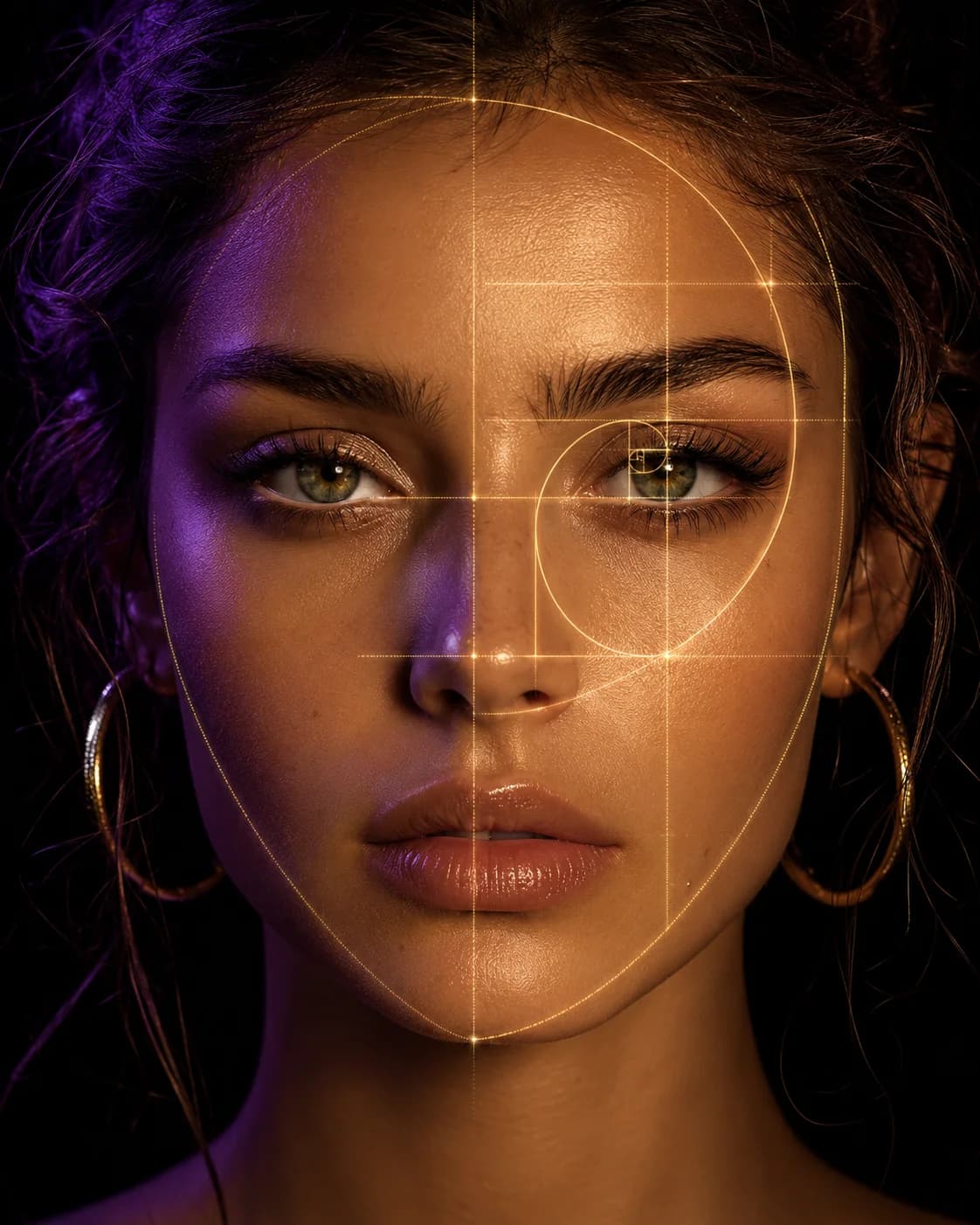
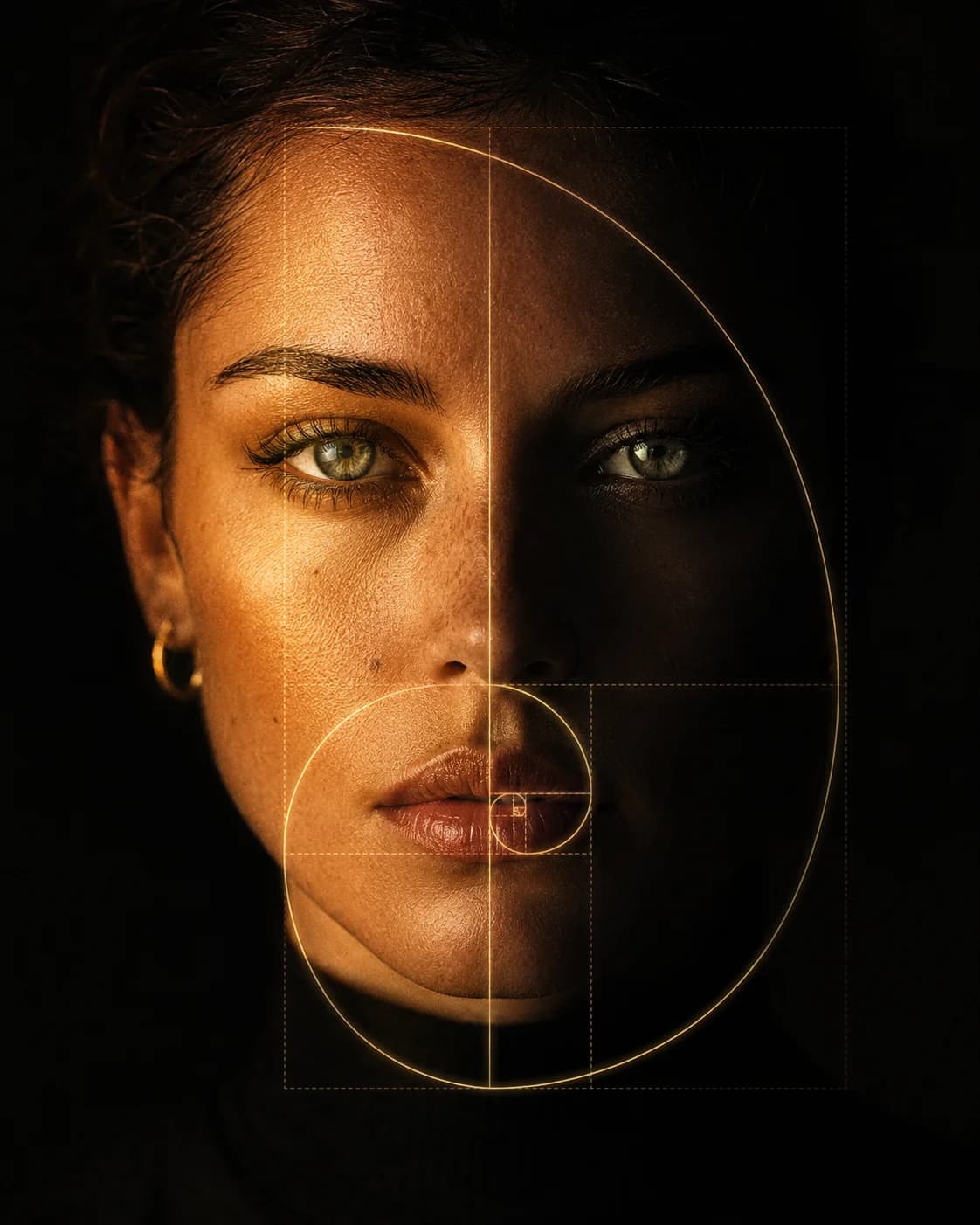
Aesthetic medicine identifies five core principles that define facial harmony: proportion (features sized appropriately relative to each other), balance (left-right symmetry), thirds (the face dividing into equal horizontal zones), fifths (the face dividing into equal vertical zones from ear to ear), and the relationship of specific features to the golden ratio.
The facial thirds principle — dividing the face into equal upper (hairline to brow), middle (brow to nose base), and lower (nose to chin) thirds — is one of the most studied and most predictive of attractiveness ratings. Faces where the lower third is proportionally smaller create a more feminine impression; equal thirds read as balanced and mature.
The facial fifths principle — five eye-widths across the face — predicts eye spacing and nose width attractiveness. Noses that occupy one fifth of the face width, and eyes that each occupy one fifth, consistently rate as more harmonious than faces that deviate significantly from this ratio.
Harmony vs Individual Feature Perfection
One of the most counterintuitive findings in attractiveness research is that averaging — the mathematical average of many faces — produces results that observers consistently rate as more attractive than most individual faces, including objectively beautiful ones. This is because averaging eliminates irregularities and produces harmony by default.
The implication is that striving for individually perfect features misunderstands what makes faces attractive. A nose that is ideal in isolation may be wrong for a particular face. The goal of both aesthetic medicine and personal grooming should be to enhance harmony — the fit between features — rather than optimise individual parts.
This is also why very symmetrical faces are generally rated as more attractive: symmetry is a proxy for developmental stability, and it produces harmony as a byproduct. Symmetry and harmony are related but distinct — a face can be symmetrical without being harmonious if the proportions themselves are mismatched.
Advertisement
What Disrupts Facial Harmony
Harmony is disrupted by features that are significantly out of proportion to the rest of the face — either too large or too small, or mismatched in visual weight. Common harmony violations include a nose that is wide relative to narrow-set eyes, a weak chin relative to a prominent nose, or a prominent forehead relative to a small lower face.
Age affects harmony in a specific way: as the face loses volume, the midface deflates faster than the lower face, disrupting the thirds balance. The lower third maintains its bone structure while the upper two thirds lose soft-tissue support — producing the heavy jaw, hollow cheeks appearance of significant facial aging.
Expressions also affect perceived harmony. Open, genuine expressions create visual harmony because they engage the whole face symmetrically. Strained or asymmetric expressions produce visible harmony violations even in otherwise harmonious faces.
Can Facial Harmony Be Improved?
Non-surgically, harmony can be improved by working with visual proportion tools: hairstyle, facial hair, grooming, and makeup all create visual adjustments to perceived proportions. A person with a long face can use hairstyle choices to reduce perceived face length. A person with a narrow jaw can use a beard to add visual width to the lower face.
Body composition affects harmony indirectly: losing excess facial fat makes underlying structure more visible, which either improves or disrupts harmony depending on underlying proportions. Some people find their face becomes more harmonious as they lean down; others find existing imbalances become more apparent.
The best approach before changing any single feature is to evaluate how it fits proportionally with your other features. Harmony is the goal — individual perfection is often a distraction from it.
Before changing any single feature, evaluate how it fits with your other features. Harmony is the goal — not individual perfection in isolation.
How AI Measures Facial Harmony
The Rate My Face tool measures five specific metrics that collectively describe facial harmony: face symmetry, eye alignment, facial thirds proportions, eye spacing, and jawline definition. These are all components of the same underlying question: how well do the parts of this face fit together?
A face with strong scores across all five metrics will have a high overall harmony score. The individual metric breakdown is useful for identifying which specific relationship is producing any visible imbalance — whether it is symmetry, proportions, or structural definition that is the primary driver.
Frequently Asked Questions
What does facial harmony mean?
Facial harmony refers to the degree to which your features are proportionally balanced and coherent as a whole. A harmonious face is one where each feature is sized and positioned in a way that works with the others — the nose fits the cheekbones, the eyes fit the forehead width, the chin fits the jaw. It is distinct from any individual feature being objectively perfect.
Is facial harmony more important than individual features?
According to research, yes. Studies consistently find that the relationship between features predicts attractiveness ratings more reliably than the quality of any single feature. Averaged faces — which have no outstanding individual features — rate as more attractive than most individual faces because averaging creates harmony.
Can you improve facial harmony naturally?
Yes, through several non-surgical approaches. Hairstyle, facial hair, and grooming create visual adjustments to perceived proportions. Body composition changes that reduce facial fat can improve underlying proportional structure. Expressions — particularly genuine, full-face smiles — create visual harmony by engaging the whole face symmetrically.
What causes facial disharmony?
Significant harmony violations typically come from features that are proportionally mismatched: a nose disproportionately wide for the face, a receding chin relative to a prominent nose, or uneven fat distribution creating visible structural imbalance. Minor asymmetry is universal and not perceived as disharmony at normal social distances.
Does facial harmony affect first impressions?
Yes, strongly. Studies using rapid-exposure paradigms (images shown for 100 milliseconds) find that observers form consistent attractiveness and trustworthiness judgments — and harmony violations are detected pre-consciously. First impressions are heavily influenced by facial harmony before any individual feature is consciously evaluated.
Lena Whitmore
Science Writer · Facial Analysis & Appearance Psychology
Lena covers the science of smiles, facial aging, and AI-powered biometrics. She writes evidence-based guides grounded in peer-reviewed research, with a focus on making appearance science accessible and actionable. All tools on Smile Tracker run locally in your browser — your photo is never uploaded anywhere.
Put it to the test
See your results with AI
Upload a photo and get your AI facial proportion analysis, symmetry measurement, and feature breakdown — free, private, instant.
Analyse My Face Free →Advertisement
Sources