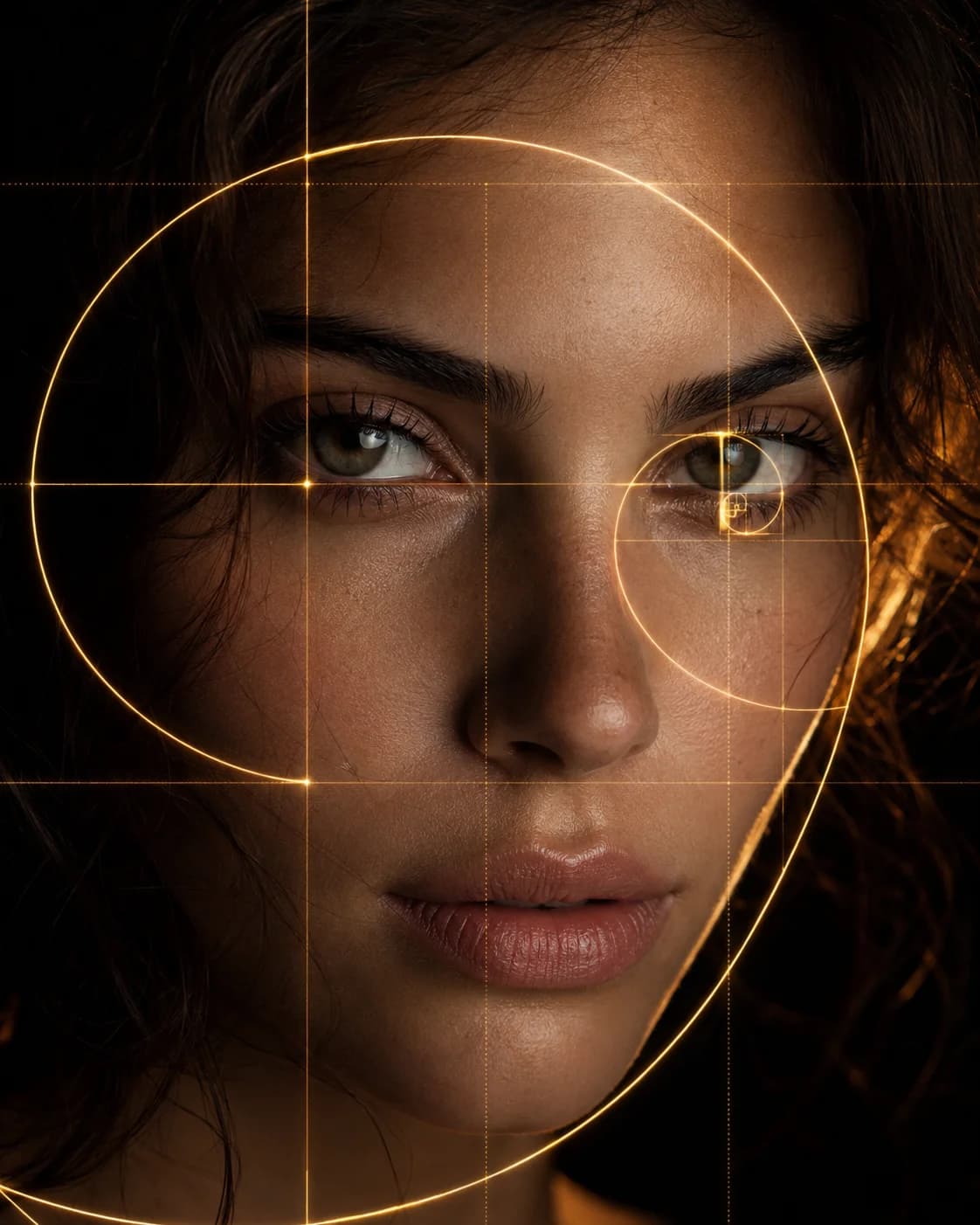
Golden Ratio Face: How to Measure Yours and What It Actually Means
The golden ratio face is one of the most searched topics in facial aesthetics — and for good reason. The idea that a single number (phi, approximately 1.618) can describe ideal facial beauty is genuinely fascinating, and measuring your own proportions against it is something you can do in under ten minutes. This guide walks you through the exact measurements, shows you how to interpret your score, tells you which famous faces score highest, and then gives you the full picture of what beauty research adds beyond the numbers.
What Is the Golden Ratio Face?
The golden ratio (phi, approximately 1.618) is a mathematical proportion that appears throughout nature, art, and architecture — in the spiral of a nautilus shell, the branching of trees, and the proportions of Renaissance paintings. Its application to facial beauty proposes that faces whose key measurements approximate 1.618 are perceived as most attractive.
The most widely used framework is the Marquardt Beauty Mask, developed by oral surgeon Stephen Marquardt. The mask overlays a precise geometric template — built entirely from phi-based proportions — onto a frontal face photograph. The closer your face fits the mask, the higher your theoretical golden ratio score.
The five core ratios that define the golden ratio face are: face length divided by face width (ideally 1.618); the width of three sections of the face being equal (eyes, nose, mouth zone); mouth width being 1.618 times nose width; nose width being roughly one-fifth of face width; and the distance from the outer eye corners to face edge being equal to eye width. Most people measure somewhere between 1.4 and 1.8 on the primary face ratio, with 1.618 as the theoretical ideal.
How to Measure Your Golden Ratio Face at Home
You need one frontal photo (taken at eye level, neutral expression, hair pulled back from the face) and a ruler or photo measurement tool. The most meaningful single measurement is the primary face ratio: divide your face length (hairline to chin) by face width (cheekbone to cheekbone, at the widest point). A result of 1.6–1.7 is considered close to ideal under the golden ratio framework.
For a fuller picture, measure these five additional ratios: (1) Nose width to mouth width — measure from the outer edges of each nostril and the outer corners of your relaxed mouth. Ideal phi ratio: mouth is approximately 1.618 times wider than the nose. (2) Eye width to inter-eye distance — the width of one eye versus the gap between both eyes. These should be roughly equal. (3) Face thirds — hairline to brow, brow to nose base, nose base to chin should be roughly equal thirds. (4) Lower face ratio — nose base to lip midpoint divided by lip midpoint to chin, ideally 1.618. (5) Nose height to nose width — nose height (bridge to tip) should be approximately 1.618 times nose width.
Score yourself by counting how many of the six ratios fall within 10% of phi (1.45–1.78). Most people score 2–4 out of 6. A score of 5–6 is exceptionally rare in any population. The goal is not to score perfectly — it is to understand which specific proportions you have and how they compare.
Use a photo taken at exactly eye level with a neutral expression — chin angle and expression change several of these measurements by 5–15%, so consistency matters.
What Your Score Actually Means
A high golden ratio score (5–6 out of 6) places you in a small proportion of the population and correlates with what is typically described as classically beautiful bone structure. Celebrities frequently cited for high golden ratio scores include Bella Hadid (often cited as 94.35% close to phi across multiple measurements), Beyoncé, Amber Heard, and Henry Cavill in Marquardt mask analyses.
A moderate score (3–4 out of 6) is where most people land — including the majority of conventionally attractive people. Many widely admired faces score in this range because attractiveness in practice is driven by a combination of factors, not a single geometry score. A score in this range does not indicate a 'less beautiful' face — it indicates a face whose appeal comes from a combination of proportional harmony and other factors.
A lower score (0–2 out of 6) simply means your face proportions sit outside the phi template — which is extremely common and has weak correlation with how others actually experience your attractiveness. The most important context for any score is what comes next: the research on what else drives facial attractiveness, and what proportion of that is actually trainable.
“Beauty is not a fixed geometric property — it is recreated with every expression. A warm genuine smile changes the entire calculation.”
Advertisement
Famous Faces and Their Golden Ratio Scores
Marquardt mask analyses of celebrity faces have become a popular genre of beauty content — and the results are genuinely interesting. Among women frequently cited as high-scorers: Bella Hadid (reportedly 94.35%), Beyoncé (92.44%), Amber Heard (91.85%), and Scarlett Johansson (90.91%). Among men: Robert Pattinson (92.15%), Henry Cavill, and Bradley Cooper appear frequently in high-scoring lists.
What is instructive about these rankings is who is missing. Many faces widely considered extraordinarily beautiful — and whose cultural and social impact vastly exceeds these scores — do not top the phi charts. Audrey Hepburn, often ranked among the most beautiful faces in history, scores modestly under the Marquardt mask because her proportions were distinctive rather than average-phi. This reveals something important about the limits of geometric scoring.
The celebrity data also reveals that attractive faces cluster in a relatively wide range (roughly 85–95%) rather than all converging on 100%. This suggests the golden ratio describes a region of proportional attractiveness rather than a single perfect point — and that a large range of proportions sits comfortably within that region.
What Research Adds Beyond the Numbers
The golden ratio gives you a structural snapshot — a measurement of your face at rest in a single photo. What it cannot capture is the factor research consistently identifies as the largest driver of real-world attractiveness: expression quality. A 2001 longitudinal study by Harker and Keltner found that genuine smile expression predicted social outcomes more powerfully than any static facial feature measured. Multiple studies since confirm that a genuine Duchenne smile increases attractiveness ratings more than any structural proportion change short of major surgery.
Research also identifies facial symmetry (modest but real effect) and averageness (closeness to the population mean proportions) as attractiveness predictors with better empirical support than phi-specific ratios. These findings are not contradictions of the golden ratio theory — they are complements to it. Together they paint a fuller picture: proportion matters, symmetry matters, and expression matters most.
The practical implication is empowering rather than deflating. Your golden ratio score describes your static geometry — which is largely fixed. Your expression quality, symmetry perception, and the social warmth signals you project are all trainable. People with modest phi scores and exceptional expression quality consistently outperform people with high phi scores and poor expression in real attractiveness ratings.
How to Improve What Is Actually Trainable
Your phi ratios are fixed without surgical intervention — and the evidence that moving closer to phi ratios improves actual perceived attractiveness is weaker than most people expect. What you can improve, with measurable and significant effects, are the dynamic signals that drive real-world attractiveness ratings: genuine smile expression, eye engagement, posture, and lighting awareness.
Developing a genuine Duchenne smile — the kind that activates both the zygomatic major (mouth) and orbicularis oculi (eyes) simultaneously — produces attractiveness improvements that multiple studies show outweigh structural proportion effects. This is trainable through the memory technique and daily mirror practice. Most people see visible improvement within two to three weeks.
Use the Rate My Face tool to get an AI assessment of your actual attractiveness signals — expression quality, facial harmony, and the dynamic markers that observers respond to. This gives you objective, actionable data on what to work on. Combined with your golden ratio measurement, it gives you the complete picture: your fixed geometry and your improvable expression quality.
Frequently Asked Questions
What is the golden ratio for a face?
The golden ratio face theory proposes that faces whose key proportions approximate phi (1.618) are most beautiful. The primary measurement is face length divided by face width — ideally 1.618. The Marquardt Beauty Mask extends this to five additional ratios across the face. Most people score 2–4 out of 6 on these measurements. A score of 5–6 is rare even among conventionally attractive faces.
How do I measure my face's golden ratio?
Take a frontal photo at eye level with a neutral expression and hair pulled back. Measure: (1) face length ÷ face width — ideal is 1.618; (2) mouth width ÷ nose width — ideal is 1.618; (3) whether the face divides into equal thirds vertically (hairline to brow, brow to nose, nose to chin); (4) eye width versus inter-eye gap (should be equal); (5) nose height ÷ nose width — ideal 1.618; (6) lower face sub-ratios. Count how many fall within 10% of phi.
What is a good golden ratio face score?
Most people score 2–4 out of 6 ratios within phi range, which is entirely normal and includes many widely attractive faces. A score of 5–6 is rare and correlates with what is described as classical bone structure. Importantly, your golden ratio score measures only static geometry — which research shows has a smaller effect on perceived attractiveness than expression quality, which is trainable regardless of your proportions.
Which celebrities have golden ratio faces?
Marquardt mask analyses frequently cite Bella Hadid (~94% match), Beyoncé (~92%), Amber Heard (~92%), and Scarlett Johansson (~91%) as high-scoring women. Robert Pattinson (~92%) and Henry Cavill appear frequently in men's rankings. Notably, many faces considered extraordinarily beautiful throughout history score modestly on the mask — suggesting that the golden ratio captures one dimension of attractiveness, not the whole picture.
Is the golden ratio the most important factor in facial attractiveness?
No — it is one factor among several. Research identifies expression quality (genuine smile with eye engagement) as the largest dynamic driver of attractiveness ratings, consistently outweighing static proportion effects in real-world judgments. Symmetry and averageness also have better empirical support than phi-specific ratios. Your golden ratio score tells you about your fixed geometry; your expression quality score tells you about what you can actually change — and the second matters more.
Lena Whitmore
Science Writer · Facial Analysis & Appearance Psychology
Lena covers the science of smiles, facial aging, and AI-powered biometrics. She writes evidence-based guides grounded in peer-reviewed research, with a focus on making appearance science accessible and actionable. All tools on Smile Tracker run locally in your browser — your photo is never uploaded anywhere.
Put it to the test
See your results with AI
Upload a photo and get your AI facial proportion analysis, symmetry measurement, and feature breakdown — free, private, instant.
Analyse My Face Free →Advertisement
Sources
Related reading

Asymmetrical Face: Is It Normal and Does It Actually Affect Attractiveness?
May 2026 · 6 min read
What Makes a Face Attractive? The Science Behind Facial Attractiveness
May 2026 · 7 min read

What Face Shape Do I Have? How to Find Out and What It Means
May 2026 · 7 min read
High Cheekbones vs Low Cheekbones: Attractiveness and What They Signal
May 2026 · 6 min read