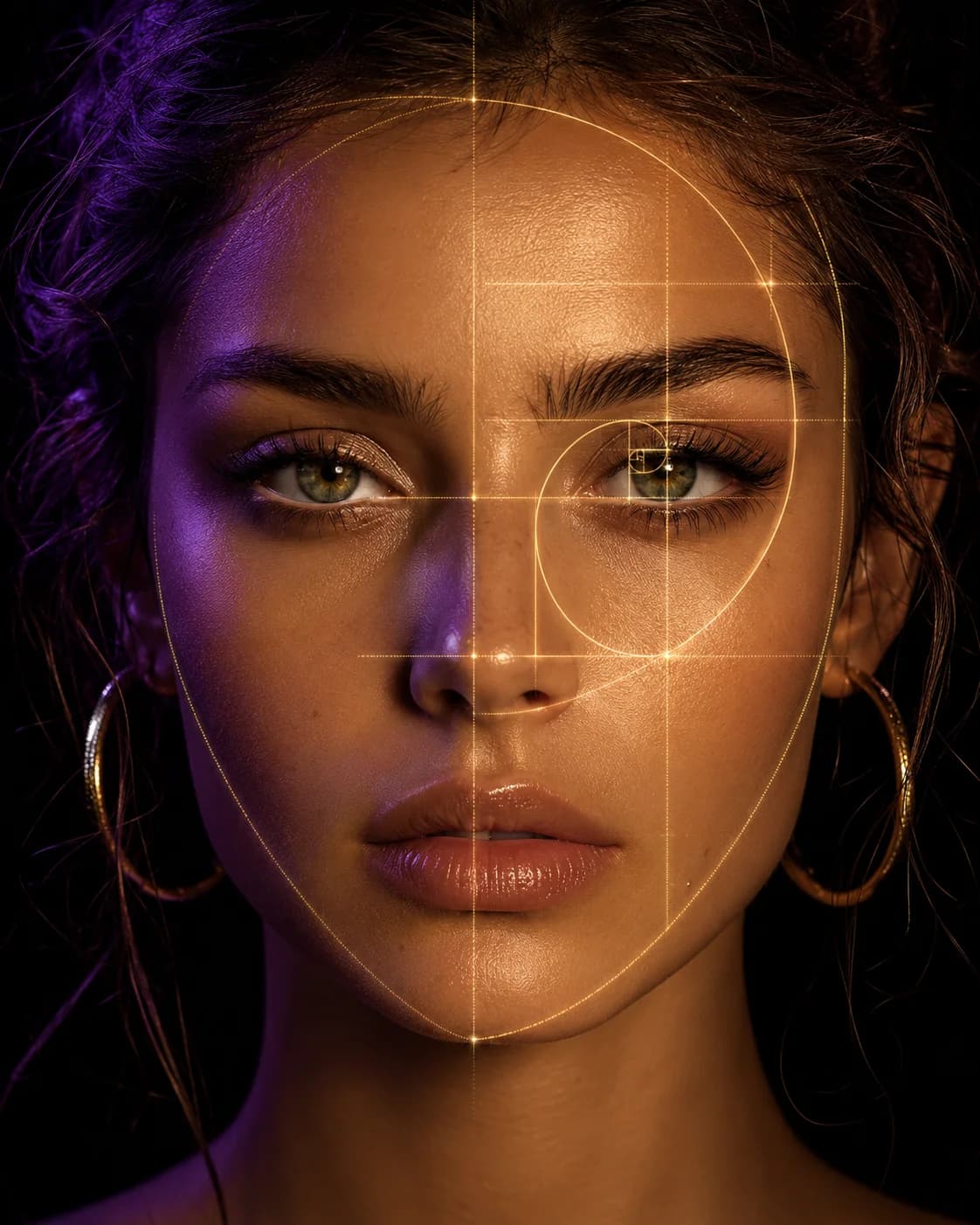
Jawline Definition and Facial Attractiveness: The Science Behind the Feature Everyone Notices
Of all the facial features that influence how a face reads as attractive, strong, or youthful, jawline definition consistently ranks among the most influential across cultures and research contexts. It affects perceived age, health, masculinity and femininity, structural definition, and overall facial harmony. Yet most people have only a vague understanding of what jawline definition actually is — and what drives it. Understanding the anatomy, the evolutionary basis, and the practical factors that affect it gives you a clear and honest picture of this often misunderstood feature.
This article is for informational and educational purposes only and does not constitute medical, dermatological, or psychological advice. Consult a qualified professional before making changes to your health or skincare routine.
What Jawline Definition Actually Is
The jawline is formed by the mandible — the lower jaw bone — and the soft tissue surrounding it. Definition refers to the visible sharpness of the boundary between the lower face and the neck. A 'defined' jawline means this boundary is visually clear and distinct. A 'soft' or undefined jawline means this boundary is gradual or obscured.
The sharpness of this boundary is determined by four factors: bone structure (the angle and projection of the mandible, which is primarily genetic), subcutaneous fat distribution (fat in the neck and lower face that can obscure the boundary), masseter muscle development (the jaw muscles that create visible width and definition at the angle of the jaw), and skin laxity (the degree to which skin remains taut along the jaw-to-neck boundary).
Each of these factors is influenced differently by age, body composition, genetics, and to a limited extent, lifestyle. Understanding which factor is most relevant to your own jawline is more useful than generic advice.
Why a Defined Jawline Reads as Attractive
The evolutionary psychology of facial attractiveness provides a clear account of why jawline definition is a cross-cultural attractiveness cue. In males, mandibular development is testosterone-dependent — stronger jaw development during puberty correlates with higher testosterone exposure. Cross-cultural research consistently finds that a defined, angular jaw is rated as more attractive in male faces across populations with no shared aesthetic tradition.
In female faces, the relationship is more nuanced. Moderate jaw definition signals youth and health without the aggressive masculinity cue. The specific shape of a feminine ideal jawline — slightly rounded at the chin, clear jaw-to-neck boundary — differs from the masculine ideal but still involves visible definition rather than softness.
Beyond the evolutionary signal, there is a structural framing effect: a visible jaw-to-neck transition creates a natural frame for the face. This framing draws the viewer's attention upward toward the eyes and expression — the features that carry the most communicative weight. A soft, undefined jaw line dissolves this frame, making the entire face read as less structured.
“Facial attractiveness is a reliable cue to biological quality — health, genetic fitness, and developmental stability — that has been consistently selected for across evolutionary history.”
Jawline Definition and Perceived Age
Jawline definition is one of the most consistent age-related changes in the face. Collagen and elastin degrade from the mid-twenties onward, reducing the skin's ability to remain taut along the jaw boundary. Facial fat gradually redistributes and descends under the influence of gravity, with the sub-mental and jowl regions accumulating soft tissue that softens the jaw-to-neck boundary over time.
Jowl formation — the descent of lower cheek fat below the jawline — is one of the most reliably recognisable aging markers. When AI age estimation systems are trained on large face datasets, jaw definition consistently emerges as a high-weight feature in apparent age prediction, often outweighing fine lines and wrinkles in predictive accuracy.
This is why the same person can look significantly younger or older depending on photo angle and lighting. An angle that emphasises the jaw-to-neck boundary — chin slightly forward and down, camera at eye level — can produce a markedly more youthful appearance than a high-angle shot that eliminates this definition entirely.
For any photo where you want to look younger: extend your chin slightly forward and downward. This tightens the jaw-to-neck boundary and is the most effective single-angle adjustment you can make.
Advertisement
How AI Measures Jawline Definition
Rate My Face measures jawline definition as one of five structural metrics, contributing 15% to the overall face score. The AI uses the 478 facial landmarks provided by Google MediaPipe Face Landmarker to measure the angular sharpness at the mandibular points — the corners of the jaw — and the clarity of the jaw-to-neck boundary as visible in the photo.
The measurement compares the detected jaw angle and definition against population-derived reference data, producing a sub-score that reflects where your jawline definition sits relative to the wider distribution. This score is combined with eye alignment (15%), facial thirds proportions (20%), eye spacing (15%), and face symmetry (35%) to produce the overall structural assessment.
Because jawline definition is highly sensitive to lighting and angle, the same face can score differently under different conditions — which is by design. The tool is measuring how your jawline actually appears in the photo, not an abstract structural ideal. Understanding this helps you optimise the photo conditions for any context where appearance matters.
What You Can Actually Change
Being honest about what is and is not modifiable is important here. Bone structure — the fundamental geometry of your mandible — is largely genetic and fixed in adulthood. No exercise changes bone geometry. But the three soft-tissue factors that overlay that structure are all variable to different degrees.
Body fat percentage is the highest-leverage variable for most people. Sub-mental and jowl-area fat responds to overall body composition change, and a reduction in body fat percentage — even modest — can produce a significant increase in visible jaw definition. Masseter development through deliberate jaw exercise (mewing posture, chewing mechanics) contributes modest additional definition, primarily at the jaw angle. Skin laxity is influenced by hydration, collagen-supporting nutrition, and the cumulative effects of sun exposure over time.
Posture and angle are zero-effort interventions with immediate effect. Forward head posture — the head tilted forward with the chin tucked — visually eliminates jaw definition by collapsing the jaw-to-neck space. Bringing the head back to neutral, chin level, produces visible definition improvement without any physiological change at all.
Check your resting head posture. If your ears are in front of your shoulders when viewed from the side, correcting this alone will improve your visible jawline definition in photos and in person.
Frequently Asked Questions
Does jawline definition really affect attractiveness?
Yes — consistently across cultures and research studies. Jawline definition is a cross-cultural attractiveness cue with an evolutionary basis. In males, it signals testosterone-dependent development; in both sexes, it creates facial framing that draws attention to the eyes and expression. AI face analysis tools including Rate My Face weight it at 15% of the overall structural score.
Can you improve jawline definition without surgery?
Soft-tissue factors are modifiable to varying degrees. Reducing body fat percentage is the highest-leverage change for most people — sub-mental fat responds to overall body composition. Masseter development through sustained jaw exercises contributes modest definition at the jaw angle. Posture correction produces immediate visible improvement with no physiological change. Bone structure is fixed in adulthood.
Why does my jawline look different in different photos?
Jawline definition is highly sensitive to angle and lighting. Camera angle below eye level eliminates jaw-to-neck definition by compressing the space. Camera at eye level with the chin slightly forward maximises definition. Overhead lighting reduces definition by casting downward shadows. Side or directional lighting enhances the jaw structure by creating contrast. The same jawline can look dramatically different across these conditions.
What is a good jawline score on Rate My Face?
Rate My Face scores jawline definition on a 0–100 scale as part of the five-metric structural assessment. A score above 65 reflects clear, well-defined jaw structure. The overall face score is a weighted combination of all five metrics, so a lower jawline score is partially offset by strong performance on the other four dimensions. No single metric determines the overall result.
Does jawline definition change with age?
Yes — it is one of the most consistent age-related facial changes. Collagen degradation reduces skin tautness along the jaw boundary from the mid-twenties onward. Sub-mental fat redistribution and jowl formation progressively soften the jaw-to-neck boundary through the thirties, forties, and beyond. AI apparent age tools detect this change as one of the primary aging signals.
Lena Whitmore
Science Writer · Facial Analysis & Appearance Psychology
Lena covers the science of smiles, facial aging, and AI-powered biometrics. She writes evidence-based guides grounded in peer-reviewed research, with a focus on making appearance science accessible and actionable. All tools on Smile Tracker run locally in your browser — your photo is never uploaded anywhere.
Put it to the test
See your results with AI
Upload a photo and get your AI facial proportion analysis, symmetry measurement, and feature breakdown — free, private, instant.
Analyse My Face Free →Advertisement
Sources
- Penton-Voak, I.S. et al. (2001) — Symmetry, sexual dimorphism in facial proportions and male facial attractiveness. Proceedings of the Royal Society B
- Fink, B. & Penton-Voak, I. (2002) — Evolutionary psychology of facial attractiveness. Current Directions in Psychological Science
- Little, A.C., Jones, B.C. & DeBruine, L.M. (2011) — Facial attractiveness: evolutionary based research. Philosophical Transactions of the Royal Society B
- Google MediaPipe Face Landmarker — Facial landmark detection for AI scoring