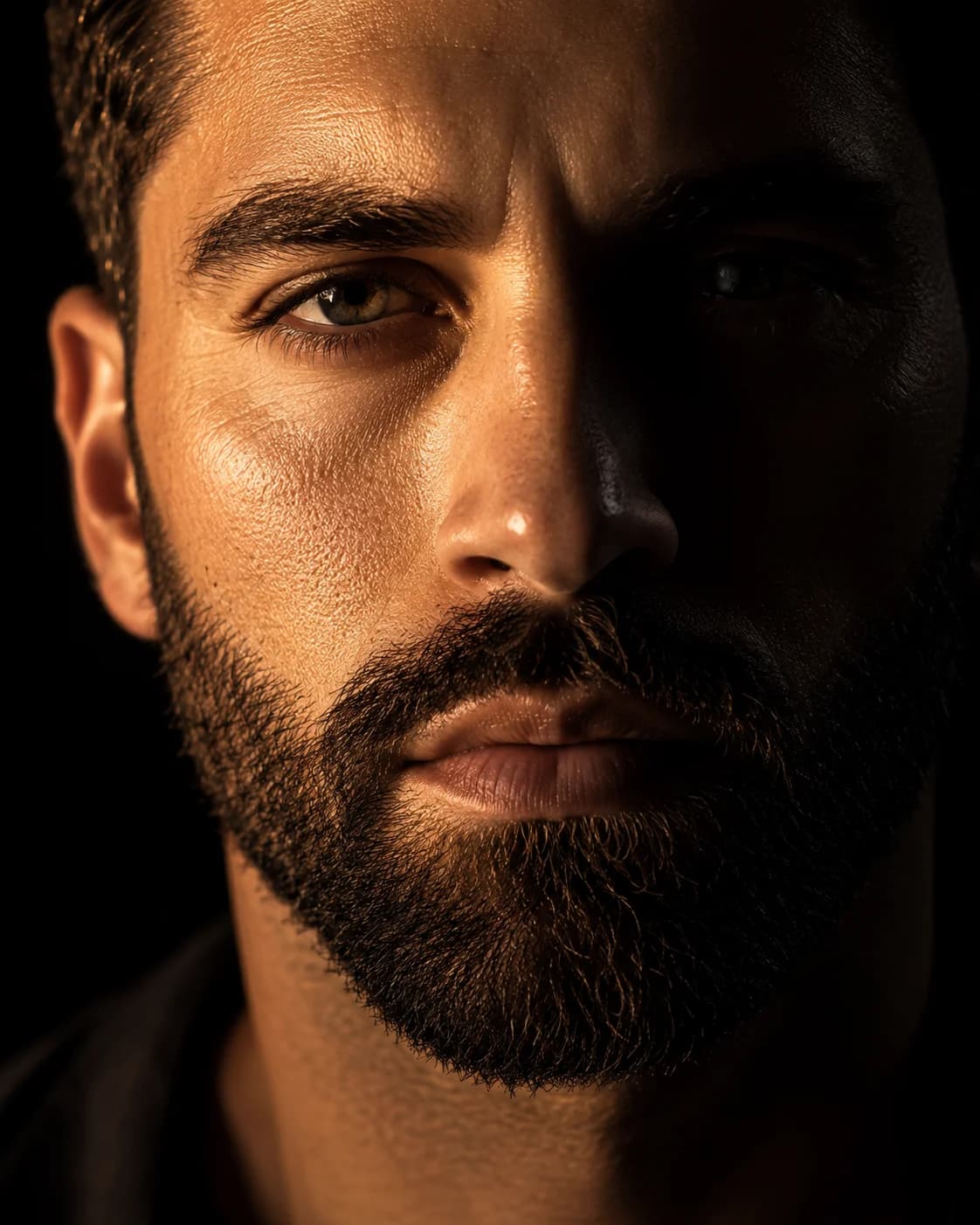
High Testosterone Facial Features: The Science of Facial Masculinity
Testosterone is the primary architect of male facial structure. From puberty onward, it drives bone growth in the jaw, brow ridge, and cheekbones — producing the angular, defined features most associated with masculine attractiveness. But the relationship between testosterone, facial structure, and attractiveness is not linear. Research reveals a paradox that most people overlook: the faces women find most attractive are rarely those with the highest masculinity signals.
How Testosterone Shapes the Face
Testosterone drives facial masculinity through two primary mechanisms: direct bone growth and fat distribution. During puberty, rising testosterone levels stimulate growth of the mandible (jaw), zygomata (cheekbones), and supraorbital ridge (brow bone). The result is the broader, more angular lower face associated with male attractiveness — the defined jaw, prominent brow, and wider cheekbones that distinguish adult male from female faces.
Testosterone also drives downward and forward growth of the nose, contributing to the typically larger, more prominent nasal structure of males. The chin becomes more projected and square, and the face becomes relatively wider in proportion to height compared to female faces.
Facial width-to-height ratio — the width of the face divided by the height from lip to brow — is one of the most studied proxies for facial masculinity. Higher ratios correlate with testosterone levels and with ratings of dominance, aggression, and physical power.
The Key High-Testosterone Facial Markers
Research identifies six primary facial features that correlate with testosterone levels: a strong, wide jaw with defined mandibular angle; a prominent brow ridge creating a deeper eye socket; larger, more angular cheekbones; a larger, more projected nose; a square or wide chin; and thicker facial skin with more prominent texture.
Of these, jaw width and brow ridge prominence have the strongest correlations with measured testosterone levels in studies. A strong jaw is consistently identified by both male and female raters as the most salient cue to masculinity — more so than height or build.
Facial hair, while androgen-dependent, is less directly linked to testosterone levels than these structural bone features. Some high-testosterone men have sparse beards; beard density correlates more with DHT sensitivity of follicle receptors than with serum testosterone per se.
The Attractiveness Paradox of Masculine Faces
The counterintuitive finding in decades of attractiveness research is that maximum facial masculinity is not maximum attractiveness. Studies consistently find that slightly-above-average masculinity — not extreme masculinity — is the most attractive male face to female raters in most contexts.
This is explained through costly signalling theory. Very high testosterone is associated with immune suppression, reduced investment in offspring, and increased aggression — all traits that reduce partner value for long-term relationships. The face that signals high genetic quality without the social costs of maximum dominance is more attractive than the face signalling maximum testosterone.
Consistent with this, preference for masculine faces is context-sensitive. When women are primed to think about short-term relationships, preference for masculine faces increases. When thinking about long-term partners, preference for slightly softer masculine faces strengthens.
Advertisement
Testosterone Faces and Perceived Trustworthiness
One of the most robust findings in the testosterone-face literature is that highly masculine faces are perceived as less trustworthy and less cooperative than moderately masculine or feminised faces. In experimental economics studies, people give less money to highly masculine-faced trustees than to less masculine ones.
This creates a real-world tension: high facial masculinity signals dominance and physical quality — advantageous in competitive contexts — but signals reduced trustworthiness, which is disadvantageous in cooperative and professional contexts. The ideal level depends heavily on the specific social situation.
For the majority of individuals, the perception is a statistical bias. But it has measurable effects: studies show highly masculine-faced men are judged as less suitable for leadership roles requiring cooperation and trust, despite being rated as more physically capable.
What Changes Facial Masculinity Without Surgery
Facial masculinity in adults is primarily determined by bone structure developed during puberty — you cannot grow a larger mandible through lifestyle changes. However, several factors meaningfully influence perceived facial masculinity within the range of your natural structure.
Body fat percentage is the most impactful lever: even modest reductions in facial fat make underlying bone structure more visible, which increases perceived jaw definition and cheekbone prominence. The same face at 12% vs 20% body fat scores measurably differently on masculinity ratings, even with identical bone structure.
Grooming choices — beard, hairstyle, eyebrow shape — all influence perceived masculinity. A clean-shaved jaw looks less masculine than the same jaw with heavy stubble. Keeping the neck and jaw edge clean accentuates the mandibular angle. These controllable variables compound with existing bone structure.
Reducing body fat percentage is the single most impactful non-surgical way to improve perceived jaw definition and facial masculinity.
How AI Reads Facial Masculinity
The Rate My Face tool measures jawline definition — the taper ratio between lower jaw width and cheekbone width — which is directly related to the structural markers of testosterone-driven facial development. A higher jawline definition score reflects a more pronounced taper from cheekbones to jaw: the classic inverted triangle structure associated with masculine facial attractiveness.
This is a geometric measurement of a proportion associated with attractiveness across multiple research frameworks — not a gendered rating of your face. Understanding which metrics drive your score helps identify the specific proportional relationships worth working on.
Frequently Asked Questions
What facial features indicate high testosterone?
The primary high-testosterone facial markers are: a wide, defined jaw with prominent mandibular angle; a pronounced brow ridge; larger, more angular cheekbones; a square or wide chin; and a larger nose. Of these, jaw width and brow ridge prominence have the strongest correlations with measured testosterone in clinical studies.
Does testosterone change your face as an adult?
The primary testosterone-driven facial development occurs during puberty when bone growth is active. In adults, testosterone influences facial fat distribution and skin texture, but structural bone changes are complete. Facial hair growth and skin oiliness continue to respond to androgen levels in adulthood, but jaw and brow bone structure is largely fixed.
Are masculine faces more attractive?
Research shows that slightly-above-average masculinity, not maximum masculinity, is the most attractive in most long-term relationship contexts. Very high facial masculinity reduces perceived trustworthiness and cooperative signals, which reduces attractiveness for long-term partners. Short-term attraction ratings tend to be higher for more masculine faces.
Can you tell testosterone levels from a face?
Only weakly. Studies find a statistically significant but modest correlation between measured salivary testosterone and facial masculinity scores rated by observers. The correlation is real but imprecise — many high-testosterone men have modest facial masculinity due to androgen receptor sensitivity differences, and vice versa.
How can I make my face look more masculine?
The most evidence-based approaches: reduce body fat percentage (makes jaw and cheekbone structure more visible), grow and maintain heavy stubble (enhances jaw appearance significantly), choose hairstyles that add width to the upper face, and maintain defined eyebrows without over-arching.
Lena Whitmore
Science Writer · Facial Analysis & Appearance Psychology
Lena covers the science of smiles, facial aging, and AI-powered biometrics. She writes evidence-based guides grounded in peer-reviewed research, with a focus on making appearance science accessible and actionable. All tools on Smile Tracker run locally in your browser — your photo is never uploaded anywhere.
Put it to the test
See your results with AI
Upload a photo and get your AI facial proportion analysis, symmetry measurement, and feature breakdown — free, private, instant.
Analyse My Face Free →Advertisement
Sources