
Age Guesser From Photo: How AI Estimates How Old You Look
An age guesser from photo sounds like a party trick — upload a selfie, get a number. Under the hood, it is a statistical model trained on hundreds of thousands of labelled faces, learning which visual patterns correlate with apparent age. The result is not arbitrary, but it is also not oracle truth. It reflects how your face reads in that specific photo under those specific conditions. Understanding what the model measures, what confounds it, and how to set up a fair test transforms a novelty into genuinely useful self-knowledge about how you present to the world.
This article is for informational and educational purposes only and does not constitute medical, dermatological, or psychological advice. Consult a qualified professional before making changes to your health or skincare routine.
How Photo-Based Age Guessing Works
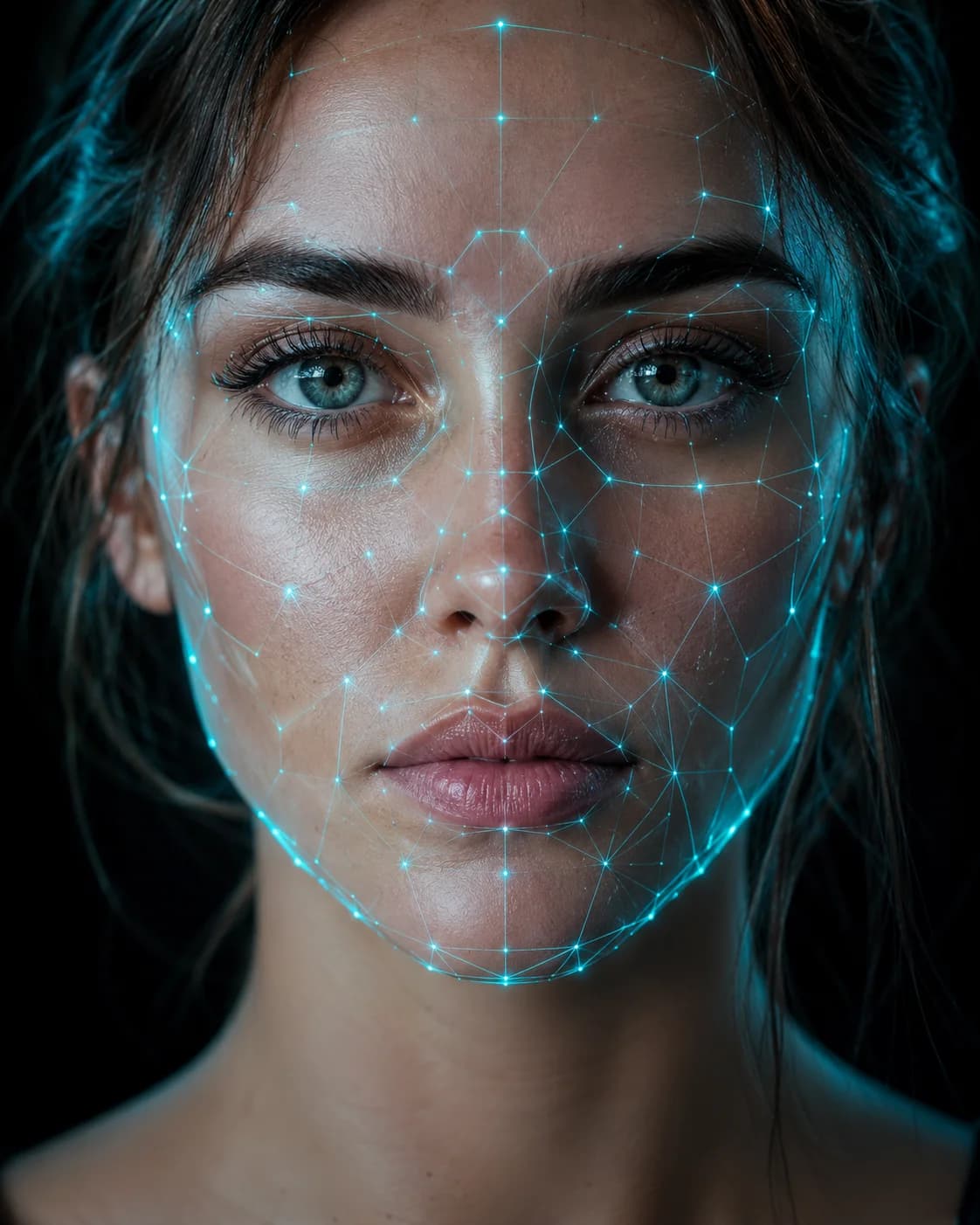
When you upload a photo to an age guesser, the pipeline typically runs face detection first — locating your face bounding box and aligning it to a standard orientation. Then a neural network extracts features: geometric ratios between landmarks, texture patterns across skin regions, and sometimes expression blendshapes. These features feed into a regression head that outputs an age estimate, often as a single number or narrow range.
Training data defines the model's worldview. face-api.js uses the IMDB-WIKI dataset — over 500,000 celebrity and public figure images with known ages. The model learns that certain fold depths, eye area configurations, and jaw contours co-occur with specific age brackets. It generalises to new faces by matching your photo's feature vector to learned patterns.
Critical distinction: the model predicts apparent age as labelled in training data, not biological age. A 30-year-old who looks 25 in photos and a 30-year-old who looks 35 both exist in training sets. The guesser outputs what your photo resembles, not what your passport says.
Why Your Photo Setup Changes the Guess by Years
Lighting direction is the dominant controllable variable. Overhead lighting casts shadows under eyes, nose, and nasolabial folds — shadows that geometrically mimic the hollows and lines associated with older faces. AI age guessers cannot distinguish shadow from structure. Switching from overhead to window light can shift estimates by five to eight years for the same person on the same day.
Camera distance and lens choice matter too. Close-range selfies with wide-angle front cameras stretch the nose, enlarge the forehead, and compress midface proportions. These distortions alter landmark ratios the model uses. Arm's-length photos with portrait mode produce more representative geometry.
Expression completes the picture. Smiling activates midface lift and eye engagement — youth signals in both human and AI perception. Neutral, tired, or tense expressions increase apparent age readings. Before trusting any age guess, ask whether the photo represents your typical presentation or an unfavourable snapshot.
For a fair age guess, use window light, arm's-length distance, and a relaxed genuine smile.
Apparent Age vs Chronological Age
Chronological age is time since birth — fixed, factual, irrelevant to a photo guesser. Apparent age is how old you look to observers, including AI trained on human judgements. Research shows apparent age predicts social outcomes — perceived health, attractiveness, trustworthiness — more strongly than chronological age in many contexts.
Two people of identical chronological age can differ by a decade in apparent age due to genetics, sleep, sun exposure, skincare, stress, and expression habits. The age guesser from photo measures this perceptual variable, which is exactly what matters for photos, video calls, and first impressions.
This is why comparative testing beats absolute interpretation. Run the guesser monthly under consistent conditions to track trends. A single number is entertainment; a series reveals whether your lifestyle changes are shifting how your face reads.
Advertisement
How Accurate Are Age Guessers?
Under controlled conditions — frontal face, even lighting, neutral expression, high resolution — state-of-the-art models achieve mean absolute error of approximately three to five years. That is comparable to untrained human raters and slightly worse than experienced clinicians estimating age from photos.
Real-world selfies rarely meet controlled conditions. Expect wider error bands. Reputable tools show ranges (e.g., 28–34) rather than false precision (31.7). If a tool always returns a single integer with no confidence context, treat it as approximate.
Smile Tracker's approach adds a Youthful Energy Score alongside the age estimate — combining eye brightness, symmetry, structural definition, and vitality signals. This contextualises the number: you might read as 38 but score high on energy markers, indicating specific features are working in your favour.
Privacy When Using Online Age Guessers
Many viral age guesser websites upload your photo to remote servers. Some retain images for training; others embed tracking pixels. Before using any tool, read the privacy policy and inspect network traffic. If the photo leaves your browser, assume it may be stored.
Browser-based age guessers download model weights locally and process images in memory. No upload means no server-side retention, no third-party access, and no account requirement. For facial photos, this should be the default requirement.
Smile Tracker runs entirely client-side — face-api.js and MediaPipe execute in your browser tab. Your photo never touches our servers because it never leaves your device.
Try It Yourself — Free Age Guesser From Photo
Ready to test how old your face reads? Upload a photo to our free Guess My Age tool. You will receive an apparent age range, a Youthful Energy Score, and a breakdown of the youth signals the AI detected — all in seconds, with zero uploads.
For best results: pull hair back, face a window, hold the camera at eye level, and smile naturally using a real memory. Compare results under different lighting to learn which conditions age or rejuvenate your specific face in photos.
Combine with our Face Analyser for symmetry and proportion scores, or the Smile Analyzer for expression authenticity — a complete picture of how your face communicates.
Frequently Asked Questions
How do I guess someone's age from a photo?
AI age guessers automate what humans do imperfectly: read facial geometry and texture patterns associated with age. Upload a clear frontal photo to a browser-based tool for the most convenient approach. Manual estimation by humans averages ±4 years accuracy.
Why did the age guesser say I'm older than I am?
Most commonly: overhead lighting creating aging shadows, tired neutral expression, close-range selfie distortion, or low resolution. Retest with window light, a genuine smile, and arm's-length distance before concluding anything about your apparent age.
Is an age guesser from photo free?
Many are free but monetise through ads and data collection. Smile Tracker's Guess My Age is free with no account required and runs entirely in your browser — no photo uploads.
Can age guessers work on group photos?
Most tools detect the largest or most central face only. For accurate individual results, use a solo photo with one clearly visible frontal face.
Do filters affect age guessing?
Yes. Beauty filters smooth texture and alter proportions, typically producing younger estimates that do not reflect unfiltered appearance. Use unfiltered photos for meaningful results.
Lena Whitmore
Science Writer · Facial Analysis & Appearance Psychology
Lena covers the science of smiles, facial aging, and AI-powered biometrics. She writes evidence-based guides grounded in peer-reviewed research, with a focus on making appearance science accessible and actionable. All tools on Smile Tracker run locally in your browser — your photo is never uploaded anywhere.
Put it to the test
See your results with AI
Upload a photo and get your AI-estimated apparent age and Youthful Energy Score — free, private, instant.
Try Guess My Age Free →Advertisement
Sources
Related reading
How to Look Younger in Photos: 8 Techniques Tested with AI
May 2026 · 6 min read
What Makes a Face Look Older? 7 Factors AI Aging Tools Detect
May 2026 · 7 min read
How AI Age Estimation Works: The Science Behind Photo-Based Apparent Age
May 2026 · 6 min read

Does Smiling Make You Look Younger? What Research and AI Data Show
May 2026 · 6 min read

Best AI Age Detectors in 2026: How They Work and Which to Trust
July 2026 · 8 min read