
Cheekbone Exercises: Do They Actually Change Your Face?
Cheekbone definition is one of the most requested beauty improvements, and cheekbone exercises are heavily promoted as a natural solution. This article examines what facial exercises can and cannot change, which exercises have the best evidence, and what other strategies actually produce visible cheekbone definition.
Can Facial Exercises Actually Change Your Cheekbones?
The honest answer is: partially, and within specific limits. Cheekbones themselves are bones — the zygomatic arch — and no exercise changes bone structure in adults. However, the appearance of cheekbones is strongly influenced by the soft tissue that sits over them: primarily the zygomaticus major and minor muscles, the malar fat pad, and the skin. Exercise can increase the volume and tone of the overlying muscles, which can modestly increase the prominence of the cheekbone area above the mid-face.
A 2018 study published in JAMA Dermatology by Murad Alam and colleagues is the most rigorous research on facial exercises to date. Middle-aged women who performed a 30-minute facial exercise programme daily for eight weeks showed measurable improvement in perceived upper and lower cheek fullness — not by building new bone, but by increasing the volume of the underlying facial muscles that fill and support the cheek area. Facial judges rated the exercised faces as appearing approximately three years younger.
The mechanism is the same as for body exercise: resistance training increases muscle fibre cross-sectional area (hypertrophy). Applied to the cheek muscles — particularly the zygomaticus major, which runs from the cheekbone to the mouth corner — targeted repetitions increase the muscle's volume, which physically lifts and fills the malar region. The effect is real but modest: visible at close range and in photographs, but not the dramatic reshaping that dramatic before-and-after posts imply.
The Best Cheekbone Exercises With Evidence
The cheek-lift exercise targets the zygomaticus major and the levator labii superioris. Smile as widely as possible without showing teeth, hold for five seconds, then release. For progression, place fingertips lightly on the cheekbone apexes while smiling against this slight resistance. The resistance variant increases the training stimulus. Three sets of fifteen repetitions, twice daily, is the protocol used in the Alam study that produced measurable results.
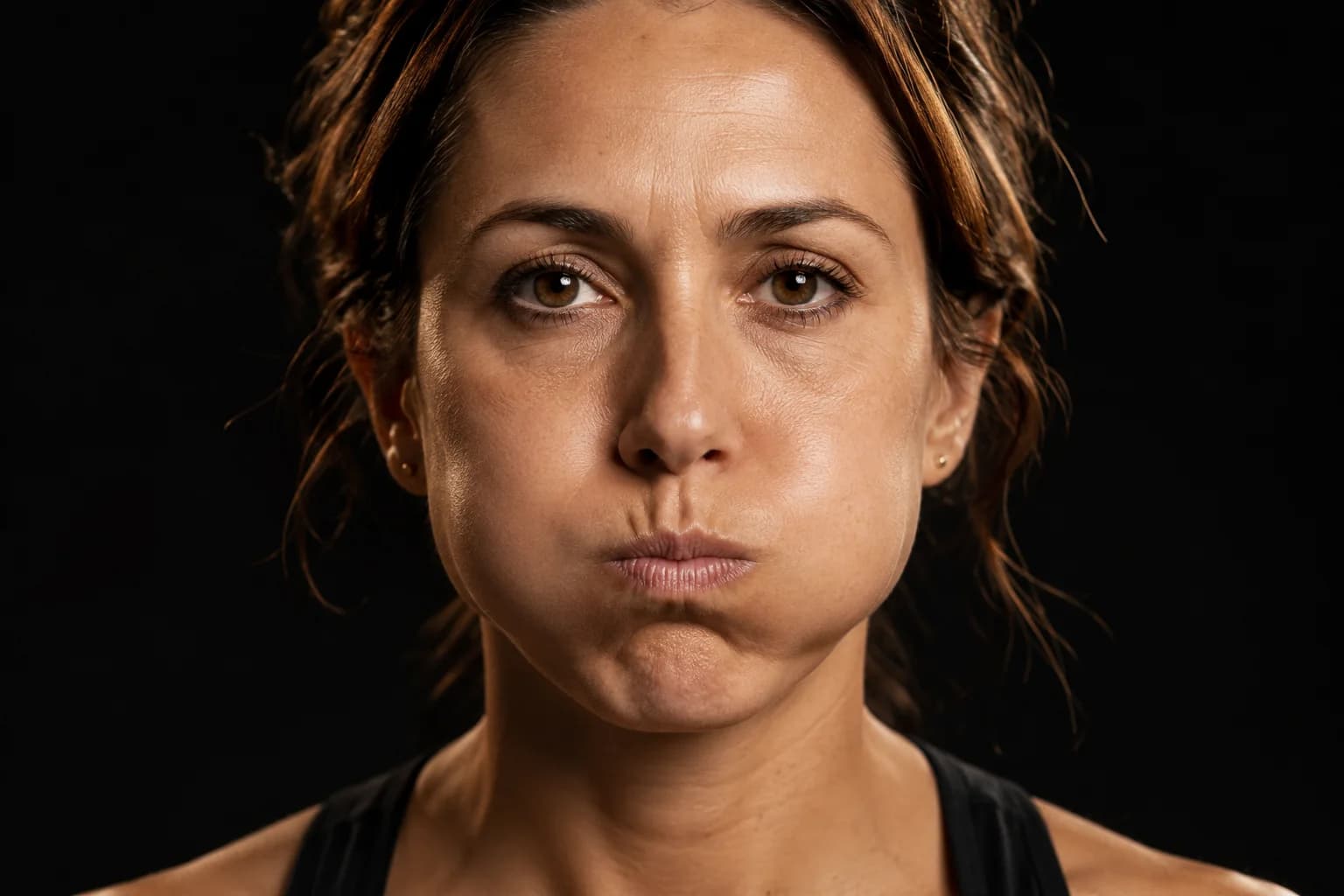
The cheek puff exercise works the buccinator — the broad cheek muscle responsible for cheek shape and definition. Fill your mouth with air and push the air into each cheek alternately, holding for three seconds on each side. Then push all the air into the upper lip area (above the teeth) and hold. This exercises the full cheek musculature from multiple angles. Ten repetitions per position is a useful starting protocol.
The fish-face exercise is the most commonly recommended and least evidence-based. Sucking the cheeks inward creates the 'fish face' — which exercises the buccinator and platysma but primarily in an isometric hold rather than through a full range of motion. If you include it, hold for five seconds and repeat fifteen times. It is a useful warm-up to the more productive exercises above but should not be the primary movement in a results-oriented routine.
Results from facial exercises appear on a similar timeline to body exercise: expect to notice early changes at four to six weeks of consistent daily practice, with more visible results emerging at eight to twelve weeks. Skipping days delays results, just as with gym training.
What Actually Causes Loss of Cheekbone Definition
The primary cause of reduced cheekbone prominence over time is not muscle weakness — it is fat pad descent and volume loss. The malar fat pad sits directly over the cheekbone and provides much of the visible fullness and definition of the upper cheek. As we age, this fat pad descends due to gravity and the progressive weakening of the ligaments that hold it in position. The cheekbone does not disappear — it is simply no longer padded from above, so the area looks flatter.
Facial volume loss is accelerated by weight loss (which depletes facial fat pads preferentially), smoking (which degrades elastin and accelerates ligament laxity), sun exposure (which damages the collagen matrix that supports facial fat pads in position), and sleep deprivation (which elevates cortisol, promoting fat breakdown and inflammation). Understanding these causes clarifies why exercise alone cannot fully restore cheekbone definition lost to fat pad descent.
Dehydration is a frequently overlooked contributor to reduced cheekbone appearance. The malar fat pad and surrounding soft tissue are partly water-dependent for their plumpness. Chronic dehydration and high-sodium diets cause visible facial deflation that can reduce cheekbone prominence within days. Adequate hydration, low sodium intake, and avoidance of alcohol (a potent diuretic) can restore some visible cheekbone definition quickly.
Advertisement
Mewing and Jaw Posture for Cheekbone Definition
Mewing — the practice of maintaining the tongue against the roof of the mouth as a resting posture — is claimed to improve cheekbone definition over time. The proposed mechanism is that sustained upward tongue pressure on the palate influences maxillary bone position, which could theoretically affect cheekbone prominence. For adults, the evidence for structural bone remodelling from tongue posture is very limited — the palatal sutures fuse in early adulthood, limiting further bone movement.
However, the indirect effect of correct jaw and tongue posture on facial appearance is real. Correct tongue posture promotes nasal breathing, which maintains positive airway pressure and prevents the forward head posture associated with mouth breathing. Forward head posture rounds the shoulders and creates a shortening of the neck that reduces the visual definition of the jawline and cheekbone area. The posture correction alone improves perceived facial structure, even without any bone remodelling.
The most visible short-term effect of practicing mewing-style jaw posture is improved definition of the mandible and a reduction in the appearance of a double chin — both of which indirectly improve how the cheekbones read by making the face appear more defined overall. Use our face rater to check your current cheekbone and jaw definition as a baseline before starting any exercise programme.
Immediate Methods for More Defined Cheekbones
While exercise works slowly, makeup contouring produces immediate results. Applying a cool-toned contour shade in the hollow below the cheekbone — angled from the ear toward (but not reaching) the corner of the mouth — creates a shadow that implies the bone structure you are working toward. A highlighter on the apex of the cheekbone above the contour zone creates the visual impression of a projecting, prominent cheekbone. Done correctly, this technique is essentially invisible as makeup and reads as natural bone structure.
Hairstyle framing is another immediate strategy. Hair that falls at or just below the cheekbone level draws the eye to that region and frames it as a focal point. A bob cut that ends at cheekbone level is particularly effective. Similarly, pushing hair behind the ears to expose the cheekbone area when desired eliminates the softening framing effect that covering hair creates.
Gua sha massage — using a smooth tool to apply firm upward strokes along the cheekbone area — temporarily reduces puffiness and promotes lymphatic drainage in the mid-face. The result is a more defined, less puffy cheek that makes the underlying bone structure more visible. The effect lasts several hours to a full day and compounds modestly over weeks of consistent practice through improved lymphatic efficiency.
Frequently Asked Questions
Do cheekbone exercises actually work?
Partially. A rigorous 2018 JAMA Dermatology study showed that consistent facial exercises produced measurable improvement in perceived cheek fullness over eight weeks. The effect comes from increased muscle volume in the cheek muscles, not from changing bone structure. The results are real but modest.
How long does it take to see results from cheekbone exercises?
Similar to body training — early changes appear at four to six weeks of daily practice, with more visible results at eight to twelve weeks. Consistency matters: daily practice produces results, intermittent practice does not.
What is the best exercise for cheekbone definition?
The cheek-lift exercise — smiling widely without teeth, holding for five seconds, with optional fingertip resistance at the cheekbone apex — directly targets the zygomaticus major. Three sets of fifteen repetitions twice daily is the evidence-based protocol. Add the cheek puff exercise for full cheek musculature coverage.
Can you get higher cheekbones without surgery?
You cannot structurally raise the zygomatic bone without surgical intervention. However, the appearance of higher, more defined cheekbones can be achieved through facial exercises (muscle volume), makeup contouring (optical illusion), gua sha (lymphatic drainage reducing puffiness), and maintaining a healthy weight and hydration level to prevent fat pad deflation.
Does mewing give you better cheekbones?
In adults, the evidence for mewing producing bone structure changes is very limited. However, correct jaw posture improves overall posture and prevents forward head posture, which indirectly improves how the jawline and cheekbones appear. The most consistent cheekbone improvement from mewing-adjacent practices comes from posture correction and nasal breathing habit rather than from bone remodelling.
Lena Whitmore
Science Writer · Facial Analysis & Appearance Psychology
Lena covers the science of smiles, facial aging, and AI-powered biometrics. She writes evidence-based guides grounded in peer-reviewed research, with a focus on making appearance science accessible and actionable. All tools on Smile Tracker run locally in your browser — your photo is never uploaded anywhere.
Put it to the test
See your results with AI
Upload a photo and get your AI facial proportion analysis, symmetry measurement, and feature breakdown — free, private, instant.
Analyse My Face Free →Advertisement
Sources
Related reading

Mewing Results: Does It Actually Change Your Face? The Science
May 2026 · 8 min read

High Cheekbones vs Low Cheekbones: Attractiveness and What They Signal
May 2026 · 6 min read
Does Face Yoga Actually Work? What the Research Says
May 2026 · 7 min read

Facial Volume Loss: How Hollow Cheeks and Fat Redistribution Age Your Face
June 1, 2026 · 7 min read

Nose Shapes: The 6 Most Common Types and How Each Photographs
June 2026 · 7 min read