
How to Boost Collagen in Your Face Naturally (7 Proven Methods)
Knowing how to boost collagen in your face naturally is the foundation of any effective anti-aging strategy — because collagen is the structural protein that gives skin its firmness, plumpness, and resistance to wrinkle formation. From the age of 25, the body produces approximately 1% less collagen per year, and this decline accelerates sharply with UV exposure, poor diet, and high cortisol levels. The good news is that collagen production is an active biological process that responds strongly to specific stimuli — seven of which have strong clinical evidence behind them.
This article is for informational and educational purposes only and does not constitute medical, dermatological, or psychological advice. Consult a qualified professional before making changes to your health or skincare routine.
Why Collagen Matters for Facial Appearance
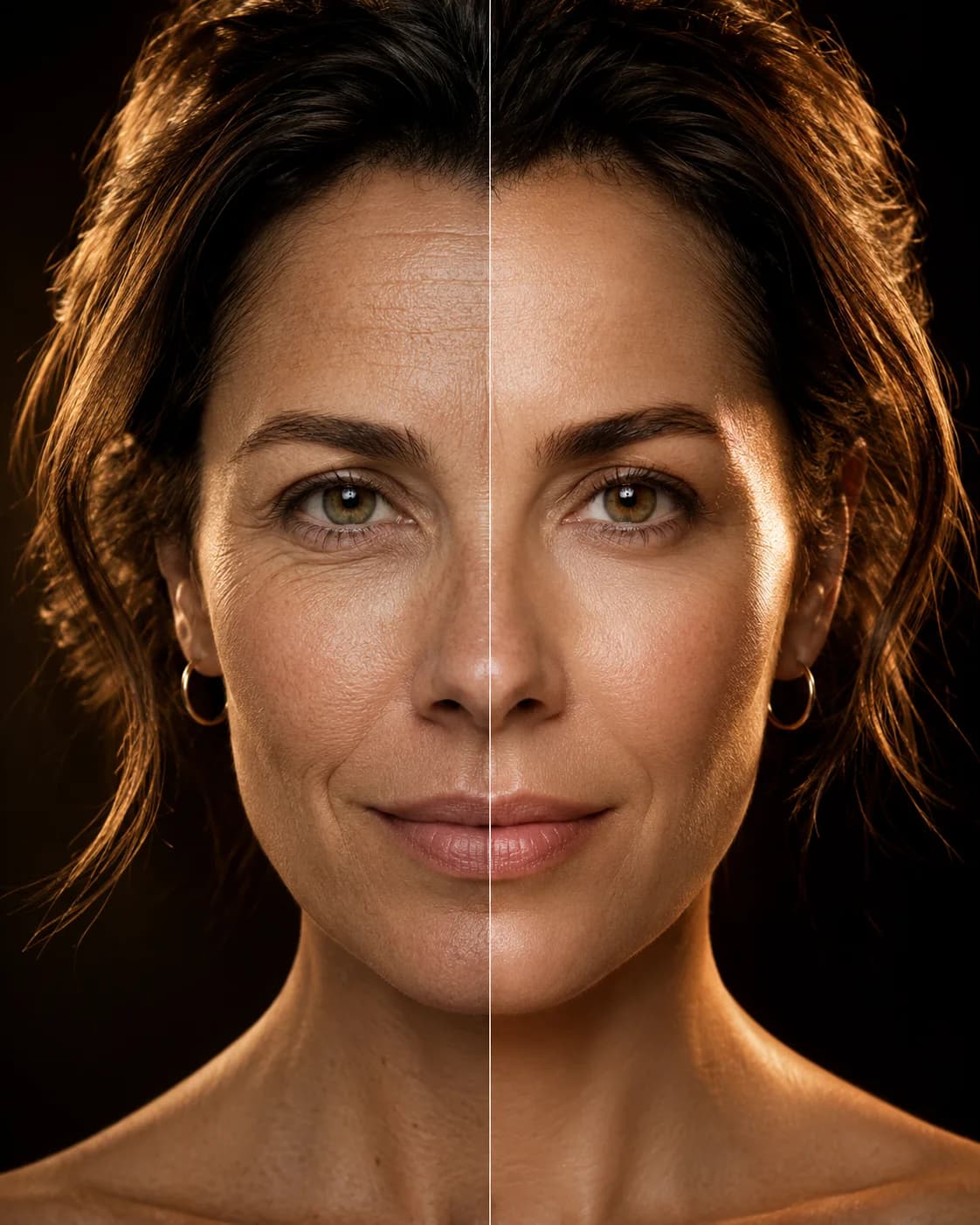
Collagen type I makes up approximately 80% of the dermal layer of skin, providing the scaffold that keeps the surface smooth, firm, and resistant to folding. As this scaffold thins, the skin loses its ability to spring back from expressions and gravitational forces — static wrinkles, hollow cheeks, and deepened nasolabial folds all reflect declining collagen density. The dermis at age 60 contains roughly 50% less collagen than it did at age 20, and this deficit is responsible for most of what we visually associate with facial aging.
Collagen in the face is produced by specialised cells called fibroblasts, which require specific signals to maintain production rates. These signals include mechanical stress (from facial muscle movement and massage), growth factors (triggered by wound-healing responses such as microneedling), and nutritional cofactors (vitamin C, glycine, proline, zinc). When these signals are present, fibroblasts upregulate collagen synthesis. When they are absent — as in UV-damaged, stressed, or nutritionally depleted skin — production declines and degradation from enzymes called MMPs (matrix metalloproteinases) outpaces production.
UV exposure is the dominant driver of premature collagen loss. UVA radiation (which penetrates glass and is present year-round) directly activates MMP enzymes that break down existing collagen while simultaneously suppressing fibroblast activity. The cumulative effect of unprotected sun exposure over years is a form of accelerated collagen depletion that compounds with age-related decline, producing significantly faster visible aging than either factor alone.
| Method | Mechanism | Timeline | Evidence Level |
|---|---|---|---|
| Topical retinoids | Upregulates fibroblast collagen synthesis | 3–6 months | Strongest (RCT evidence) |
| Vitamin C serum | Cofactor in collagen cross-linking; UV protection | 2–4 months | Strong |
| Oral collagen peptides | Provides amino acid substrate; stimulates fibroblasts | 2–4 months | Moderate-strong (RCT) |
| Red light therapy | Stimulates mitochondria in fibroblasts | 2–3 months | Moderate |
| Microneedling | Wound-healing collagen cascade | 3–4 months (3 sessions) | Strong |
| Adequate sleep | GH released at night drives collagen repair | Ongoing | Moderate |
| Diet (vitamin C, protein) | Provides synthesis cofactors | Ongoing | Strong |
Methods 1–3: Topical Retinoids, Vitamin C, and Sun Protection
Topical retinoids are the single most evidence-backed method for stimulating dermal collagen production in living skin. Tretinoin, the prescription-strength retinoid, binds nuclear retinoic acid receptors in fibroblasts and directly upregulates collagen type I gene expression. Multiple randomised controlled trials confirm significant increases in dermal collagen density after 3–12 months of consistent use. Over-the-counter retinol delivers the same mechanism with lower potency and slower timelines but remains the best accessible option. Start at 0.025–0.05% and increase gradually to minimise irritation.
Vitamin C (L-ascorbic acid) is the rate-limiting cofactor in the enzymatic cross-linking of collagen chains — without adequate vitamin C, the collagen produced by fibroblasts cannot be properly assembled. A stabilised vitamin C serum at 10–20% concentration applied daily provides two benefits: it donates electrons to the cross-linking enzymes in the dermis, and it neutralises free radicals generated by UV exposure before they can activate MMP enzymes that degrade collagen. The combination of topical vitamin C and SPF is more protective than either alone.
Daily SPF 30+ broad-spectrum sunscreen is the most impactful single habit for preserving existing collagen. A landmark 4.5-year randomised trial by Hughes et al. demonstrated that daily sunscreen users showed no detectable increase in skin aging scores over the study period, while discretionary users showed measurable deterioration. This means SPF does not just slow collagen loss — it can effectively arrest UV-driven collagen degradation for the duration of its consistent use.
Layer in order: vitamin C serum → SPF in the morning. At night: retinoid → ceramide moisturiser. These two routines address both collagen protection and collagen stimulation simultaneously.
Methods 4–5: Collagen Supplements and Diet
Hydrolysed collagen peptides (typically 2.5–10g daily) have accumulating RCT evidence for improving skin elasticity, hydration, and density. A 2014 double-blind study by Proksch et al. found that women taking 2.5g of collagen peptides daily for 8 weeks showed significant improvement in skin elasticity versus placebo. The mechanism is twofold: the peptides provide glycine, proline, and hydroxyproline — the amino acids that are rate-limiting substrates for collagen synthesis — and the peptides themselves appear to signal fibroblasts to increase collagen production, possibly by mimicking partial collagen breakdown products that normally trigger repair responses.
Dietary protein is the raw material of collagen. A diet chronically low in protein (below 0.8g per kg body weight) limits the amino acid pool available for collagen synthesis, even if all other stimulating signals are present. Animal proteins provide a complete amino acid profile including high concentrations of glycine and proline, which are preferentially used in collagen. Bone broth contains naturally hydrolysed collagen peptides and is the traditional dietary source of collagen-specific amino acids.
Vitamin C from food (citrus, strawberries, bell peppers, broccoli) provides the dietary cofactor for collagen assembly. Zinc (from red meat, legumes, seeds) and copper (from nuts, seeds, shellfish) are also enzymatic cofactors in collagen cross-linking. Silicon, found in oats and leafy greens, supports collagen stability. A diet rich in these nutrients does not replace topical collagen stimulation but creates the biological foundation that all other methods depend on.
Advertisement
Methods 6–7: Red Light Therapy and Microneedling
Red light therapy (RLT) in the 630–700nm wavelength range stimulates fibroblast activity by activating cytochrome c oxidase in the mitochondria, increasing ATP production and triggering growth factor release. Multiple clinical trials confirm increases in collagen density and skin thickness with consistent RLT use, with significant improvements visible after 8–12 weeks of 3–5 sessions per week. At-home devices (such as LED face masks) deliver lower irradiance than clinical devices but are effective with longer session duration and daily use.
Microneedling creates controlled micro-injuries in the dermis that trigger the wound-healing cascade — a process that is evolutionarily optimised to rebuild collagen and elastin. The key is that this cascade produces collagen type III (which remodels into type I over months) via platelet-derived growth factor and transforming growth factor beta — the same signalling molecules that drive scar healing. Professional microneedling (0.5–2mm needle depth) produces the strongest response; derma-rolling at home (0.2–0.5mm) provides a maintenance level of stimulation.
Facial massage improves local circulation and has some evidence for mechanically stimulating fibroblasts — cells respond to physical pressure signals. Consistent upward facial massage appears to slow the gravitational descent of soft tissue and may modestly stimulate collagen production. It is less potent than retinoids or microneedling for direct collagen synthesis but is a useful, free daily practice that compounds over years.
How Collagen Loss Shows Up in Your Apparent Age
Collagen depletion is the primary mechanism behind virtually every visible aging change in the face: wrinkle depth, skin laxity, hollow undereyes, thinning lips, and loss of cheek projection. These changes accumulate gradually and are often undetectable year-to-year but become suddenly visible when compared to photos from 5 or 10 years prior. The face appears to age in steps rather than linearly — periods of relative stability followed by threshold-crossing changes when collagen drops below a critical density.
Your apparent age (how old observers estimate you to be based on facial appearance) can diverge significantly from your chronological age depending on your cumulative UV exposure, lifestyle, and skincare history. Two people of the same chronological age can have apparent ages that differ by 10–15 years based purely on their collagen maintenance history. This is why investing in the seven methods above from the mid-twenties onward produces dramatically better outcomes than starting in the 40s when significant loss has already occurred.
Use our age estimator at /guess-my-age to get a real-time read on your current apparent age versus chronological age. The estimator assesses the same visual collagen-depletion signals that human observers use — skin texture, nasolabial depth, eye area laxity, and overall skin quality — and gives you a calibrated score that shows where your collagen maintenance efforts are currently landing.
Frequently Asked Questions
How long does it take to see results from collagen-boosting methods?
Topical vitamin C and hydration improvements can be visible within 2–4 weeks. Retinoids typically show visible improvement in skin texture after 8–12 weeks and in wrinkle depth after 3–6 months. Collagen supplements show elasticity and hydration improvements in 2–4 months in clinical trials. Microneedling results peak 3–6 months after a course of 3 sessions. Consistent multi-method approaches produce the fastest cumulative results.
Do collagen supplements actually work?
Yes, with caveats. Hydrolysed collagen peptides at 2.5–10g daily have multiple randomised controlled trials showing improvements in skin elasticity and hydration. They work by providing substrate amino acids and by signalling fibroblasts to increase collagen production. They do not work by delivering intact collagen to the skin — the peptides are digested, absorbed, and then used as signals and building blocks.
Can you rebuild lost collagen?
Yes — the face retains the capacity to produce new collagen throughout life, and this production responds to specific stimuli. Retinoids, microneedling, and red light therapy have clinical evidence for measurably increasing dermal collagen density in older skin. The new collagen produced is functionally equivalent to native collagen. The challenge is that production rates at 50+ cannot fully compensate for the decades of natural decline, making earlier prevention more effective than later reversal.
What destroys collagen fastest?
UV radiation (UVA) is the single biggest destroyer of collagen, activating MMP enzymes that degrade the collagen matrix. Smoking follows closely — it both reduces collagen synthesis and increases MMP activity through its oxidative stress effects. High sugar intake causes glycation, a process that cross-links collagen fibers in a way that makes them rigid and dysfunctional. Chronic high cortisol (from stress) directly suppresses collagen production.
Is collagen cream effective?
Topical collagen creams do not deliver intact collagen molecules to the dermis — the collagen protein is too large to penetrate the skin barrier. They provide surface-level hydration (as collagen is a humectant) but do not stimulate endogenous collagen production. Products that stimulate collagen production (retinoids, vitamin C, peptides) are far more effective than products that simply contain collagen.
Lena Whitmore
Science Writer · Facial Analysis & Appearance Psychology
Lena covers the science of smiles, facial aging, and AI-powered biometrics. She writes evidence-based guides grounded in peer-reviewed research, with a focus on making appearance science accessible and actionable. All tools on Smile Tracker run locally in your browser — your photo is never uploaded anywhere.
Put it to the test
See your results with AI
Upload a photo and get your AI-estimated apparent age and Youthful Energy Score — free, private, instant.
Try Guess My Age Free →Advertisement
Sources
Related reading
How to Look Younger: 8 Science-Backed Changes That Actually Work
May 2026 · 8 min read

Nasolabial Folds: What Causes Smile Lines and How to Reduce Them
June 2026 · 9 min read

Tech Neck Lines: How Your Phone Is Aging Your Neck Faster
June 2026 · 8 min read

How to Improve Skin Texture: The Science-Backed Guide
June 2026 · 9 min read

Under Eye Wrinkles: Causes, Prevention, and How to Reduce Them
June 2026 · 8 min read

Facial Massage for Lifting and Glow: Benefits and Techniques
June 2026 · 8 min read