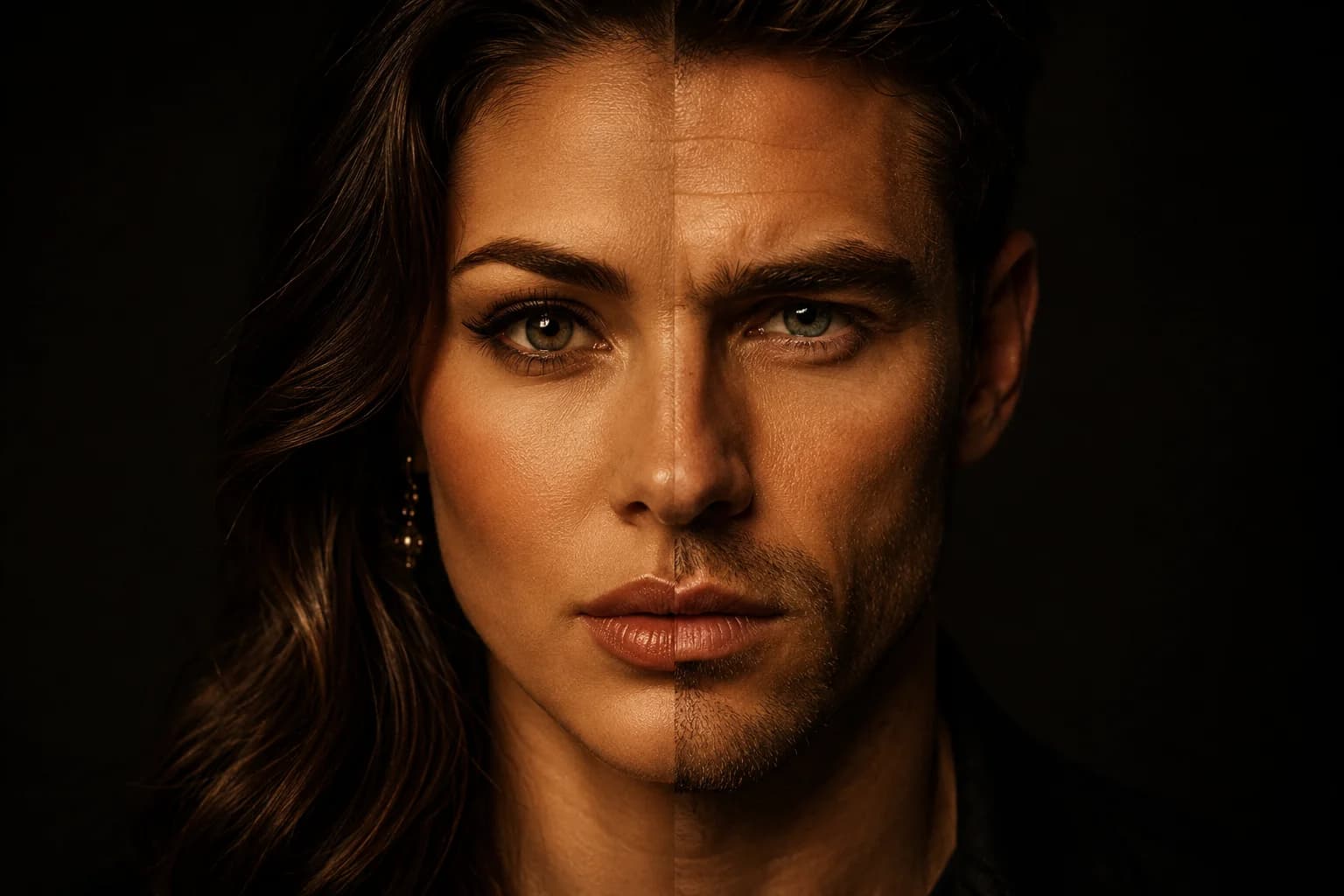
Masculine vs Feminine Facial Features Explained
Facial masculinity and femininity are not binary categories but dimensions of sexual dimorphism — the biological divergence in facial structure between males and females driven by sex hormone exposure during development. Understanding exactly which facial signals convey masculinity or femininity, and how those signals interact with attractiveness perceptions, is one of the most replicated areas of evolutionary psychology.
The Biological Signals of Facial Masculinity
Masculine facial features develop primarily in response to testosterone exposure during puberty. The key structural changes testosterone drives include: increased supraorbital ridge (brow bone prominence), greater jawline width and squareness, increased cheekbone flare, narrower eyes relative to face width, longer midface, and more prominent chin. Skin texture also diverges: testosterone produces thicker, oilier skin with visible pores — a reliable masculinity signal.
The facial width-to-height ratio (fWHR) — the ratio of bizygomatic width to upper face height — is one of the most studied masculinity signals. Higher fWHR correlates with testosterone levels in men and with observer ratings of dominance, aggression, and physical strength. Research published in Proceedings of the Royal Society B linked high fWHR in male faces to both higher testosterone and higher aggression scores.
Hunter eyes — deep-set eyes with a defined orbital rim — are another consistent masculinity marker, as opposed to round, large, protruding eyes which read as more feminine. The canthal tilt (angle of the eye corners) also varies by sex: a slight positive canthal tilt (outer corner higher than inner) is associated with masculinity and dominance.
The Biological Signals of Facial Femininity
Feminine facial features develop in response to oestrogen, which drives a different set of structural characteristics: larger eyes relative to face size, higher arched brows, fuller lips, narrower jaw, higher cheekbones relative to face height, smaller nose relative to face, and a more rounded, tapered chin. Skin texture is softer, thinner, and typically more even-toned with fewer visible pores.
Oestrogen promotes subcutaneous fat distribution in the periorbital and cheek regions, producing the orbital fat padding that makes feminine eyes appear larger and the cheek softness that characterises feminine facial contour. Research in Evolution and Human Behavior found that the degree of facial femininity in women (measured by these structural cues) correlates with oestrogen levels and is perceived as a health and fertility signal by male observers.
Facial symmetry — the degree of mirror-image correspondence between the left and right sides — is often discussed alongside dimorphism but is actually a separate signal. High symmetry is associated with developmental stability and genetic health in both sexes; it contributes to attractiveness ratings independently of masculinity or femininity level.
Does More Masculine or Feminine Always Mean More Attractive?
The relationship between sexual dimorphism and attractiveness is more complex than 'more is better'. For women, research finds a clear positive relationship between facial femininity and attractiveness ratings from men — more oestrogen-influenced features are rated more attractive across cultures. However, for men, the relationship is curvilinear: moderately masculine faces often score higher than extremely masculine ones.
High facial masculinity signals dominance and strength but also correlates with perceived aggressiveness, unfaithfulness, and low parental investment — traits that reduce long-term partner attractiveness for many women. Studies consistently find that women's preference for facial masculinity varies by context (menstrual cycle phase, perceived relationship type, cultural context) in ways that women's ratings of feminine female faces do not.
This helps explain why many of the faces rated most attractive in large-scale studies are not the most sexually dimorphic but occupy a moderate position — distinctive enough to signal sex clearly, but not so extreme as to trigger negative social inferences.
“Women do not consistently prefer the most masculine male faces — moderate masculinity, combined with other cues of health and status, often outperforms facial extremes.”
Can You Increase Facial Masculinity or Femininity?
Within limits, yes. For masculinity, the most evidence-backed approach is body composition — lower body fat percentage sharpens jaw definition, reduces facial fat, and enhances the structural features testosterone built. Resistance training increases neck and jaw muscle prominence. Mewing (tongue posture correction) may modestly improve jawline definition over years.
For femininity, makeup can strongly simulate oestrogen-influenced facial features — enlarging eye appearance, raising brow arch, adding lip volume, and evening skin tone. Subtle cosmetic procedures (lip filler, brow lift) can enhance these signals more durably. Skincare that improves skin texture and tone contributes to perceived femininity.
What cannot be changed through lifestyle are the underlying bone dimensions set during development. Facial osteotomy (jaw surgery) can alter these but is a significant clinical undertaking. For most people, the optimal approach is enhancing the features you have rather than attempting to structurally oppose genetic bone architecture.
Frequently Asked Questions
What makes a face look masculine?
The key structural markers of facial masculinity are: prominent brow ridge, square and wide jaw, high facial width-to-height ratio, deep-set eyes, visible cheekbone flare, prominent chin, and thicker skin texture. These features develop in response to testosterone exposure during puberty and signal androgens, physical strength, and dominance to observers.
What makes a face look feminine?
Key feminine facial markers include: large eyes relative to face size, high arched brows, full lips, high cheekbones, narrow jaw with a rounded chin, smaller nose, and even skin texture. These features reflect oestrogen influence during development and are associated with hormonal health and fertility signals.
Are more masculine male faces always more attractive?
No — research finds a curvilinear relationship for men. Moderately masculine faces often score higher attractiveness ratings than extremely masculine faces because very high masculinity also signals negative social traits (aggression, low investment). Women's preferences for male facial masculinity also shift depending on context and relationship type. The most attractive male faces typically combine moderate masculinity with symmetry and health signals.
Can you change your facial masculinity without surgery?
Partially. Reducing body fat percentage sharpens jaw and cheekbone definition, enhancing the structural masculinity that bone structure provides. Resistance training builds neck and jaw muscle volume. These changes are real but work within the limits of your genetic bone architecture. Surgical jaw procedures can change bone dimensions, but this is a major intervention with significant recovery.
Smile Tracker Research Team
Our team combines expertise in facial neuroscience, AI-powered image analysis, and portrait photography to produce research-backed guides on smile science and appearance optimization. All analysis on Smile Tracker is powered by Google MediaPipe Face Landmarker — running locally in your browser, never uploaded.
Put it to the test
See your results with AI
Upload a photo and get your AI face attractiveness rating, symmetry analysis, and feature breakdown — free, private, instant.
Rate My Face Free →Sources
Related reading
What Makes a Face Attractive? The Science Behind Facial Attractiveness
May 2026 · 7 min read

Jawline Definition and Facial Attractiveness: The Science Behind the Feature Everyone Notices
May 2026 · 7 min read
What Is Canthal Tilt and Does It Affect How Attractive Your Eyes Look?
May 2026 · 6 min read

Hunter Eyes vs Prey Eyes: What Is the Difference and Which Is More Attractive?
May 2026 · 6 min read