
Why Your Eyes Look Dead in Photos (And How to Fix It)
Smizing — smiling with your eyes — is what separates warm, magnetic photos from stiff, lifeless ones. It is not a trick or a pose. It is a trainable muscle skill rooted in the same science that defines a genuine Duchenne smile. This guide covers exactly which muscles control smizing, why it matters, and how to practise it until it becomes automatic.
What Smizing Actually Means
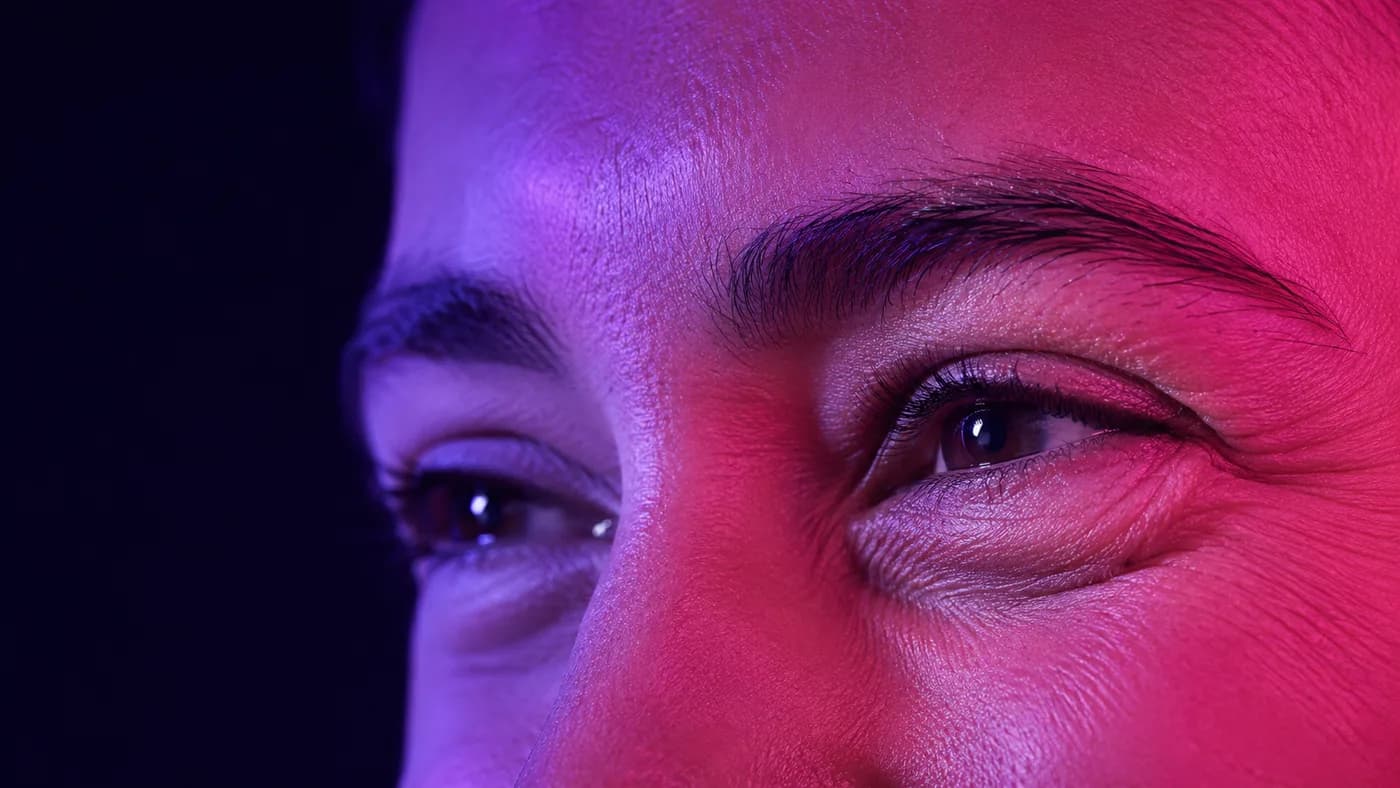
The word smize was popularised by Tyra Banks on America's Next Top Model, but the underlying concept goes back to 19th-century neuroscience. A smize is the activation of the orbicularis oculi — the ring-shaped muscle surrounding each eye — in a way that creates a subtle squint, raises the lower eyelid, and produces small crinkles at the outer eye corners. Without this muscle firing, a smile stays in the mouth and reads as polite at best, cold at worst.
Researchers Paul Ekman and Wallace Friesen formally distinguished mouth-only smiles from full Duchenne smiles in 1982, showing that observers could reliably detect the difference. The orbicularis oculi crinkle is the key discriminating signal: its presence makes a smile feel genuine, its absence makes it feel performed. When you smize, you are producing the eye component of a Duchenne smile — which is exactly what photos and video calls most need.
Cameras flatten depth and reduce colour contrast, so a mouth smile alone can look pasted-on in a still image. The eye squint adds dimensionality and life, which is why photographers and casting directors consistently tell subjects to smile with their eyes rather than their mouths. A smize turns a tolerable headshot into a compelling one.
The Muscles You Need to Train
Two muscles govern the smize. The orbicularis oculi pars orbitalis is the outer ring responsible for the crinkle lines at the outer eye corners. The orbicularis oculi pars palpebralis is the inner ring that raises the lower eyelid, creating the warm half-lid look. Both need to activate together. When only one fires, the result looks either squinted or vaguely tired rather than warm.
The challenge is that the orbicularis oculi is partly involuntary. Most people cannot consciously control it on command — it fires naturally with genuine amusement or affection, but resists direct instruction. This is why forced smiles look forced: the zygomatic major (mouth corners) fires readily on command, but the eye muscle lags. Training smizing means learning to access this muscle voluntarily through a mix of motor learning and emotional priming.
A third muscle, the zygomaticus minor, runs from the cheekbone to the upper lip and slightly lifts the cheek pad when activated — adding to the full-face compression effect that makes a smize look warm rather than blank. Top smizers tend to show a slight mid-cheek lift that further compresses the lower eyelid from below, amplifying the eye engagement.
Stand in front of a mirror and think of something that genuinely makes you laugh. Notice how your lower eyelid rises and outer corners crinkle. That sensation — not the muscular effort — is what you are training to recreate on demand.
Step-by-Step Smize Practice
Start with the squint drill. Looking in a mirror, keep your face neutral and slowly squint just your eyes as if bright sun is in them — not a grimace, but a soft, half-lidded compression. Hold for three seconds, release, repeat ten times. The goal is to isolate the orbicularis oculi without recruiting the corrugator (which pulls brows inward and looks angry) or the frontalis (which raises brows and looks surprised).
Once you can produce a clean squint, add the emotional component. Think of a person or memory that makes you feel warm. Notice that genuine positive emotion makes the squint feel different — softer and lifted from beneath rather than pressed from above. This soft quality distinguishes a smize from a suspicious squint. Practise holding that emotional sensation with your mouth relaxed. Take photos to compare.
In the final phase, practise arriving at the smize from a neutral face in under two seconds — the window you have in most spontaneous photos. Record yourself on video. The smize should feel like a warm thought landing in your face, not a muscular effort. Most people need two to three weeks of daily five-minute sessions before it becomes reliable.
Advertisement
Smizing in Photos: Angles and Light
Camera angle changes how a smize reads. Shooting from slightly above — camera above eye level — opens the eye area so the squint looks soft and warm rather than heavy. Shooting from below compresses the brow toward the eye and makes a squint look tired or suspicious. A slight chin tuck combined with a camera-above angle is the standard fix for anyone whose smize photographs poorly.
Lighting matters for one specific reason: the catchlight. A catchlight is the small white reflection of a light source visible in the iris and pupil. Without it, eyes look flat and lifeless even when the orbicularis oculi is engaged. Position yourself so a window or light source sits at roughly 45 degrees to one side — this guarantees a natural catchlight and makes the smize visible and alive in the final image.
Indoors on video calls, the smize is even more important because compression artefacts and small screen sizes reduce facial expression detail. A strong smize compensates — it reads clearly even at low resolution. Many people find their video presence improves dramatically after just a few weeks of smize training.
What a Smize Communicates to Others
Eye-region expression is the primary signal of emotional sincerity across cultures. Eye-tracking studies show that when people judge warmth or trustworthiness, they spend disproportionate fixation time on the eye region. The smize directly targets this high-attention zone, making every first impression register differently — from a date to a job interview.
Socially, a practised smize changes how people experience you in real-time conversation. The orbicularis oculi squint sends a continuous low-level signal of positive regard to whoever you are speaking with. Conversations feel warmer, people open up faster, and observers describe you as more engaged and present. This is part of why charismatic speakers and skilled communicators tend to smize naturally.
If your photos consistently look stiff or your smile never quite reaches your eyes, smize training is one of the highest-leverage changes you can make. Use our smile analyzer to score your current eye engagement and track improvement over weeks of practice.
Frequently Asked Questions
What does smize mean?
Smize means smiling with your eyes — activating the orbicularis oculi muscle around the eye to produce a genuine-looking squint and outer-corner crinkle, even with a relaxed mouth. The term was coined by Tyra Banks.
Can anyone learn to smize?
Yes. The orbicularis oculi is partly involuntary but trainable. Most people can learn to activate it on command with daily mirror practice. Expect two to four weeks before it becomes reliable and natural-looking.
Why do my eyes look dead in photos even when I smile?
A dead-eye smile means the zygomatic major (mouth corners) fired but the orbicularis oculi (eye ring) did not. This is common in posed photos because the eye muscle resists voluntary command. Smize training combined with thinking a genuinely happy thought just before the shutter fires is the fix.
Does smizing make you look more attractive?
Research consistently shows that full Duchenne smiles — which include eye engagement — are rated as more attractive and trustworthy than mouth-only smiles. Smizing brings genuine-smile warmth to your expression, which most people perceive as significantly more appealing.
What is the difference between a smize and a Duchenne smile?
A Duchenne smile involves both the orbicularis oculi (eyes) and the zygomatic major (mouth corners) firing together. A smize isolates just the eye component and can be performed with a relaxed or lightly smiling mouth. The smize is effectively the eye half of a Duchenne smile.
Lena Whitmore
Science Writer · Facial Analysis & Appearance Psychology
Lena covers the science of smiles, facial aging, and AI-powered biometrics. She writes evidence-based guides grounded in peer-reviewed research, with a focus on making appearance science accessible and actionable. All tools on Smile Tracker run locally in your browser — your photo is never uploaded anywhere.
Put it to the test
See your results with AI
Upload a photo and get your personalized Smile Score, smile type, and eye engagement reading — free, private, instant.
Analyze My Smile Free →Advertisement
Sources
Related reading
What Is a Duchenne Smile? The Science Behind a Real Smile
May 2026 · 6 min read
How to Smile Naturally in Photos: 7 Techniques That Actually Work
May 2026 · 6 min read

How to Smile with Your Eyes: The Smize Technique Explained
May 2026 · 6 min read

Types of Smiles and What They Mean: A Science-Backed Guide
June 2026 · 12 min read