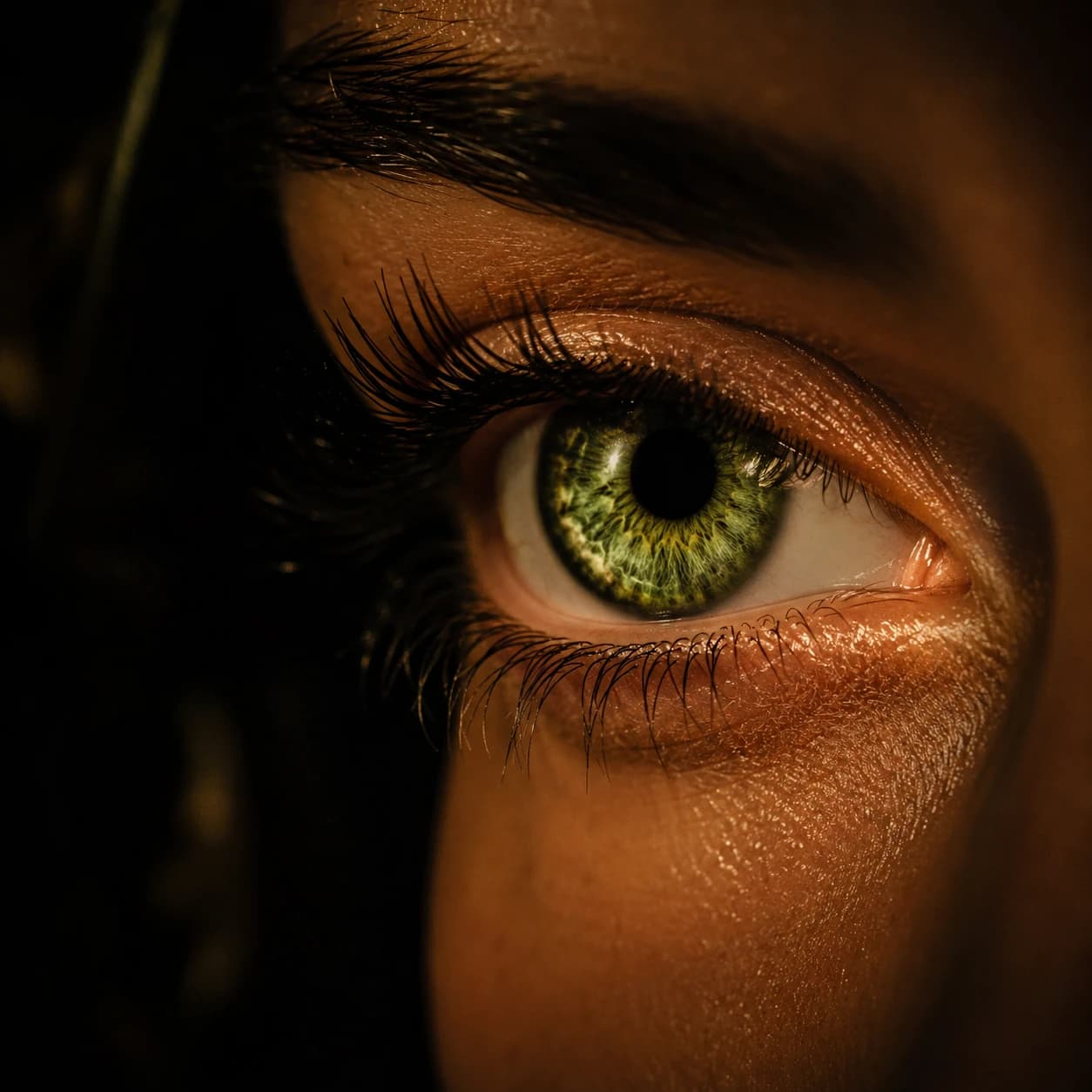
Eye Colour and Perceived Attractiveness: What Research Actually Shows
Eye colour has been studied as an attractiveness variable through evolutionary psychology, population genetics, and perception science — and the findings are more nuanced than any simple ranking. Colour preferences vary by cultural context, rarity within a population, and crucially by the structural features of the iris itself: limbal ring prominence, iris texture, and contrast with the sclera all shape how observers respond to eye colour, often more powerfully than the hue alone.
Why Eye Colour Preferences Vary Across Populations
Population genetics research by Larsson et al. (2007) established that eye colour is a polygenic trait controlled primarily by variation in the OCA2 and HERC2 genes, with blue eyes representing a relatively recent mutation originating in a single ancestral population around 6,000–10,000 years ago. The rarity distribution of eye colours follows from this genetic history: brown eyes are present in approximately 55–79% of people globally, blue in 8–10% concentrated in Northern European populations, green in roughly 2%, and amber and grey in less than 1% each.
Evolutionary psychologist Christopher Conway and colleagues demonstrated in 2008 that attractiveness ratings for eye colour show consistent frequency-dependent effects across cultures: rare eye colours in a given population tend to attract higher ratings from members of that population. This is consistent with negative frequency-dependent selection, where rare phenotypic variants are novel and therefore attention-capturing. Blue eyes score highest in regions where brown eyes predominate and lower in Northern European samples where blue is common.
This frequency-dependence matters for interpreting any attractiveness ranking: no eye colour is universally most attractive. The ratings reflect rarity, novelty, and cultural context as much as any inherent quality of the colour itself. Surveys that report a single ranking hierarchy typically reflect the demographics of the survey respondents, not a universal biological hierarchy.
Limbal Rings: The Overlooked Attractiveness Signal
Independent of hue, research by Peshek et al. (2011) demonstrated that the limbal ring — the dark annular band at the outer edge of the iris where it meets the sclera — is a significant and consistent attractiveness signal. Faces with prominently defined limbal rings were rated as significantly more attractive and younger than identical faces with faded or absent limbal rings. The effect held across both male and female faces and multiple rater populations.
The biological logic of the limbal ring as a health signal is straightforward: limbal rings are most vivid in youth and early adulthood, fading progressively with age due to accumulation of lipid deposits in the corneal periphery (arcus senilis). A well-defined limbal ring therefore reliably signals developmental youth and current health in a way that iris hue does not. A deep brown eye with a vivid limbal ring will be rated as more attractive than a pale blue eye with a faded limbal ring — a finding that directly challenges simplistic colour-ranking frameworks.
Iris texture is a related structural factor. Irises with visible crypts (pits), furrows, contraction lines, and pigment variation are perceived as more complex, vibrant, and visually engaging than flat, monochrome irises of the same hue. This explains the consistent high attractiveness ratings for hazel eyes — which combine brown, green, and gold pigment in a complex mosaic pattern — despite being less rare than green. The complexity creates sustained visual interest that a flat monocolor iris cannot replicate.
Sclera health is as important as iris colour. Redness or yellowing significantly reduces perceived attractiveness regardless of hue. Adequate sleep, hydration, and limiting alcohol are the most evidence-backed approaches to sclera clarity.
Iris Contrast and the Sclera Relationship
The visual impact of any iris colour depends on the contrast it creates against the surrounding sclera. Blue and green irises produce high luminance contrast against white sclera, making the eye visually prominent at social distances and in photographs. Brown irises have lower contrast against white sclera in standard photographic conditions — a factor that contributes to the perception that brown eyes are less vivid, though this is an artefact of photographic contrast rather than an inherent property of the colour.
Research on facial attractiveness consistently identifies the sclera-to-iris contrast ratio as independently correlated with attractiveness ratings: eyes where the iris boundary is crisp and well-defined against a white sclera score higher than eyes with poor sclera-iris contrast, regardless of iris colour. This means that sclera health — the whiteness, clarity, and lack of redness — is as important to overall eye attractiveness as iris hue.
Cultural variation in sclera salience exists: some East Asian aesthetic traditions historically valorised dark irises with dark limbal rings that create a dramatically deep, absorbing eye appearance, while Northern European traditions have historically valorised the high contrast of light irises against white sclera. Neither preference is more biologically fundamental — both reflect genuine perceptual responses shaped by the distribution of eye phenotypes in each population.
Advertisement
Eye Colour and Perceived Personality: What the Evidence Shows
Several studies have examined whether eye colour influences personality inferences. Brown eyes are consistently associated with higher trustworthiness ratings in European samples — a finding that requires careful interpretation. Researchers including Karel Kleisner and colleagues (2013) demonstrated that this effect is largely mediated by face shape rather than eye colour per se: faces with more neotenous or rounded features (which are more common in brown-eyed individuals in the samples studied) receive higher trustworthiness ratings, and when face shape is statistically controlled, the eye colour effect substantially diminishes.
Blue eyes have been associated with competence and intelligence ratings in some Western survey populations, but this again reflects cultural status associations rather than any biological signal. These perceived personality differences are social constructs built on cultural familiarity patterns — they are real as social phenomena but should not be mistaken for evidence that eye colour carries inherent personality information.
What observers do reliably extract from the eye region is health and vitality signals that are genuinely meaningful: limbal ring prominence, sclera clarity, iris texture richness, and the moisture and reflectivity of the eye surface. These signals track real biological states — youth, health, hydration, sleep quality — and are the informational content that evolution has calibrated attractiveness responses to detect.
What Actually Maximises Eye Attractiveness
Given that structural and health factors outweigh hue in determining perceived eye attractiveness, the most evidence-aligned approach to improving eye appeal focuses on these modifiable variables. Sclera health responds to sleep quality, hydration, and reducing alcohol and smoke exposure. Limbal ring definition cannot be directly enhanced without contact lenses, but limbal-enhancement contact lenses — which darken and sharpen the iris border without altering the hue — consistently produce measurable attractiveness gains in research.
Contrast enhancement through colour-complementary makeup is the most reliable short-term approach for any iris colour. The perceptual logic is straightforward: colours on the opposite side of the colour wheel intensify the apparent saturation of the iris colour. Orange-adjacent tones intensify blue; purple-adjacent tones intensify green and hazel; warm copper tones intensify the warmth within brown irises. These techniques exploit the same iris-contrast principle that makes limbal rings attractive.
In all cases, the surrounding context — eye shape, skin quality, under-eye appearance — substantially modifies how the iris colour reads. A technically unremarkable iris colour embedded in a well-rested, symmetrical face with strong skin quality will be perceived as more attractive than a rare iris colour surrounded by visible fatigue, puffiness, or poor skin quality. The eye colour effect is real but contextually dependent.
Frequently Asked Questions
What is the most attractive eye colour according to research?
Research does not identify a single universally most attractive eye colour. Preferences show consistent frequency-dependent effects: rare colours in a population attract higher ratings, so blue eyes score highest in predominantly brown-eyed regions and lower in Northern European samples. Iris structure factors — limbal ring definition, iris texture complexity, and sclera clarity — predict attractiveness ratings more reliably than hue alone.
What are limbal rings and why do they affect attractiveness?
The limbal ring is the dark annular band at the outer edge of the iris. Research by Peshek et al. (2011) showed that prominently defined limbal rings significantly increase attractiveness and perceived youth ratings. They are most vivid in young adults and fade with age, making them a reliable biological signal of developmental youth.
Is green the rarest eye colour?
True green eyes are present in roughly 2% of the global population, making green among the rarest naturally occurring eye colours. Amber and grey are similarly rare. Blue eyes, while uncommon globally, occur in 8–10% of people, concentrated in Northern and Eastern European populations due to a specific genetic variant that originated around 6,000–10,000 years ago.
Do brown eyes photograph less attractively?
Brown irises have lower luminance contrast against white sclera compared to blue or green, which reduces their visual impact in standard photography. This is a photographic artefact rather than an inherent property of the colour — warm lighting, complementary makeup, and high sclera clarity all substantially improve how brown eyes appear in images.
Can I change how attractive my eye colour looks without coloured contacts?
Yes. Sclera clarity (sleep, hydration, alcohol reduction) and complementary makeup (colours on the opposite side of the colour wheel to the iris hue) both reliably increase perceived iris vibrancy. Limbal-enhancement contact lenses that darken and sharpen the iris border without changing the hue are the most evidence-backed optical intervention for eye attractiveness.
Lena Whitmore
Science Writer · Facial Analysis & Appearance Psychology
Lena covers the science of smiles, facial aging, and AI-powered biometrics. She writes evidence-based guides grounded in peer-reviewed research, with a focus on making appearance science accessible and actionable. All tools on Smile Tracker run locally in your browser — your photo is never uploaded anywhere.
Put it to the test
See your results with AI
Upload a photo and get your AI facial proportion analysis, symmetry measurement, and feature breakdown — free, private, instant.
Analyse My Face Free →Advertisement
Sources
- Peshek et al. (2011) — Preliminary evidence that the limbal ring influences facial attractiveness. Evolutionary Psychology.
- Larsson et al. (2007) — Iris colour and its genetic architecture. European Journal of Human Genetics.
- Fink et al. (2006) — Visible skin colour distribution plays a role in the perception of age, sex, and attractiveness. Evolution and Human Behavior.
- Conway et al. (2008) — Cross-cultural agreement and sex differences in attractiveness judgements. Evolution and Human Behavior.
Related reading
What Makes a Face Attractive? The Science Behind Facial Attractiveness
May 2026 · 7 min read
What Causes Eye Bags and How Do They Make You Look Older?
May 2026 · 6 min read
Are Dark Circles Genetic? What Science Says
May 2026 · 6 min read
The Halo Effect: How Your Looks Affect How People See You
May 2026 · 6 min read
What Makes a Face Look Feminine: The Science of Feminine Facial Features
June 2026 · 9 min read
Types of Eye Shapes: Which Is Most Attractive?
June 2026 · 9 min read