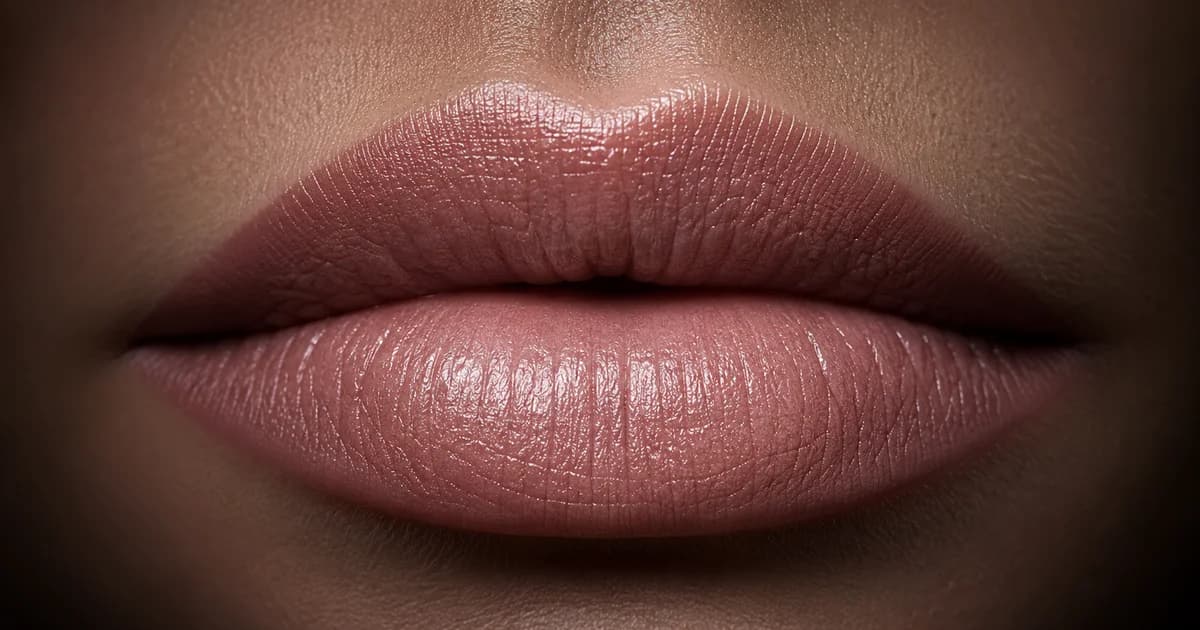
Most Attractive Lip Shape: The Science Behind Cupid's Bow and Lip Proportions
The most attractive lip shape is defined by specific, measurable proportions — and the research findings are more actionable than most people realise. Studies have identified the ideal upper-to-lower volume ratio, the optimal vertical height, the role of the Cupid's bow, and the specific proportional relationships between lip width and face width. These are not arbitrary beauty standards — they reflect evolved signals of hormonal health and developmental quality that observers respond to pre-consciously, in fractions of a second.
The Ideal Upper-to-Lower Lip Ratio
The most consistently cited finding in lip attractiveness research is the ideal upper-to-lower lip volume ratio. A 2017 study by Popenko et al. in JAMA Facial Plastic Surgery surveyed observer preferences systematically and found that an upper-to-lower lip volume ratio of approximately 1:1.6 was rated most attractive — meaning the lower lip should be moderately fuller than the upper lip.
This specific ratio has direct implications for the common aesthetic desire to 'increase' upper lip volume. Popenko et al. also found that when the upper lip volume equalled or exceeded the lower lip, attractiveness ratings declined sharply — observers consistently preferred the proportional relationship to the absolute size. This explains the 'duck lip' effect that occurs when upper lip augmentation is performed without reference to the lower lip volume.
The golden proportion (1:1.618) for overall lip height relative to specific facial measurements has also been described, relating the combined lip height to the distance from the base of the nose to the chin. Lips that are proportionally taller relative to this measurement produce a more prominent, expressive lower face; lips that are proportionally shorter can appear compressed or thin.
Why the Cupid's Bow Matters
The Cupid's bow — the double-curved upper lip margin that creates two peaks at the lip's highest points — is one of the most defining features of attractive lips across cultures and both genders. Its attractiveness is driven by both aesthetic and biological signalling. Aesthetically, a well-defined Cupid's bow creates light-and-shadow contrast at the upper lip border that enhances the perceived definition and three-dimensionality of the lips.
Biologically, Cupid's bow definition is associated with normal hormonal development. The shape is formed during foetal development and reflects the precise patterning of the philtrum columns (the two ridges running from the nose base to the lip peaks). Well-defined Cupid's bow architecture indicates normal morphological development — which functions as a health signal in facial attractiveness perception.
Lip filler techniques that overfill the upper lip or place filler directly into the cupid's bow without respect for its architecture are among the most common causes of 'overfilled' appearance — the bow definition is lost and replaced with a rounded, undefined upper lip border. This consistently reduces attractiveness ratings compared to the same volume placed in ways that preserve or enhance the bow structure.
The Cupid's bow creates shadow contrast that enhances lip definition — a key reason lip liner applied along the natural bow definition improves lip appearance without adding volume.
Lip Width-to-Face-Width Proportion
Beyond the lip shape itself, the relationship between lip width and face width is a key proportion. Research suggests the most attractive lip width corresponds to the distance between the medial limbi of the eyes (the inner edges of the iris) — or approximately 50–60% of the nose width to the face width ratio. Lips that are narrower than this appear thin and pursed; lips that extend beyond the outer pupils appear disproportionately wide.
This proportional relationship is one of the factors that makes lip augmentation complex: increasing lip volume without respecting the width relationship can produce lips that look mismatched with the surrounding face. The ideal augmentation respects both the upper-to-lower ratio and the width relationship simultaneously.
Lip projection — how far the lips protrude from the facial plane in profile — also affects attractiveness. The Ricketts E-line reference places ideal upper lip projection 2–4 mm behind the nose-to-chin line, with the lower lip at 1–2 mm behind. This profile proportion affects both the lip's own appearance and how it reads in context with the nose and chin.
Advertisement
Cultural Variation in Lip Attractiveness
While the upper-to-lower volume ratio preference is fairly consistent across Western populations studied, cross-cultural data shows variation in preferred lip size and prominence. East Asian populations show preferences for slightly smaller, more delicate lip volumes compared to Western preferences, while the Cupid's bow definition preference appears more consistent across groups.
The trend toward larger lips in Western beauty standards, strongly reinforced by celebrity and social media influence from the early 2010s, represents a culturally-driven shift rather than a universal biological preference. The research on what observers rate as attractive is not fully aligned with trends in lip augmentation — the scientific ideal (moderate volume, strong bow definition, preserved ratio) differs from the trend aesthetic (maximum volume, exaggerated projection).
This divergence means that the most research-aligned lip outcome — moderate, proportioned volume with defined Cupid's bow — also tends to age better and look more natural across contexts than trend-driven augmentation.
How AI Face Rating Scores Lip Shape
Rate My Face uses facial landmarks to identify the upper and lower lip margins, compute the vermilion border shape, and assess the lip-to-face proportional relationships described above. The scoring incorporates lip width relative to face width, the upper-to-lower volume ratio (inferred from landmark geometry), and the overall lip vertical proportion.
Lip attractiveness is one component of the overall face score — it interacts with other features rather than operating independently. Full lips in a face with otherwise strong proportions score well; the same lips in a face with very different proportions may score differently because the overall facial balance is what the model ultimately reads.
For the most accurate lip scoring, a relaxed, neutral expression with mouth closed and lips gently touching provides the cleanest read of the natural lip geometry. Exaggerated expressions, dry or chapped lips, or heavy lipstick that obscures the natural border all reduce the accuracy of the measurement.
Frequently Asked Questions
What is the most attractive lip shape?
Research identifies two key features of attractive lips: a well-defined Cupid's bow on the upper lip and an upper-to-lower volume ratio of approximately 1:1.6 (lower lip moderately fuller). A moderate lip width proportional to the face width and good lip projection per the E-line ratio round out the ideal. Cupid's bow definition is the single most consistent cross-cultural attractiveness marker for lips.
Are thin lips attractive?
Thinner lips are generally rated lower in attractiveness compared to fuller, well-defined lips in most attractiveness research — consistent with the biological signalling that fuller lips carry (hormonal health markers). However, thin lips with excellent Cupid's bow definition consistently outperform fuller lips with poor definition in attractiveness ratings, suggesting shape matters more than absolute volume.
Do bigger lips always look better?
No. Research consistently shows that proportional relationships matter more than absolute volume. The upper-to-lower ratio (approximately 1:1.6) is more important than overall size. When upper lip volume equals or exceeds lower lip volume — regardless of overall size — attractiveness ratings decline. Lip augmentation that prioritises volume over proportional relationships tends to produce results that are rated lower than proportionally smaller lips.
What is a Cupid's bow and why is it attractive?
The Cupid's bow is the double-curved upper lip margin forming two peaks at the highest points of the upper lip. It is attractive because it creates light-and-shadow definition that enhances lip prominence, and because it reflects normal morphological development (a biological quality signal). Well-defined Cupid's bow architecture is consistently preferred over a flat or undefined upper lip border.
Lena Whitmore
Science Writer · Facial Analysis & Appearance Psychology
Lena covers the science of smiles, facial aging, and AI-powered biometrics. She writes evidence-based guides grounded in peer-reviewed research, with a focus on making appearance science accessible and actionable. All tools on Smile Tracker run locally in your browser — your photo is never uploaded anywhere.
Put it to the test
See your results with AI
Upload a photo and get your AI facial proportion analysis, symmetry measurement, and feature breakdown — free, private, instant.
Analyse My Face Free →Advertisement
Sources
Related reading
What Makes a Face Attractive? The Science Behind Facial Attractiveness
May 2026 · 7 min read
Golden Ratio Face: How to Measure Yours and What It Actually Means
May 2026 · 7 min read

Teeth and Attractiveness: Does Your Smile Really Matter?
May 2026 · 6 min read
What Makes Lips Attractive? The Science of Lip Shape
May 2026 · 5 min read

What Is Facial Harmony? The Science of Features That Work Together
May 2026 · 6 min read