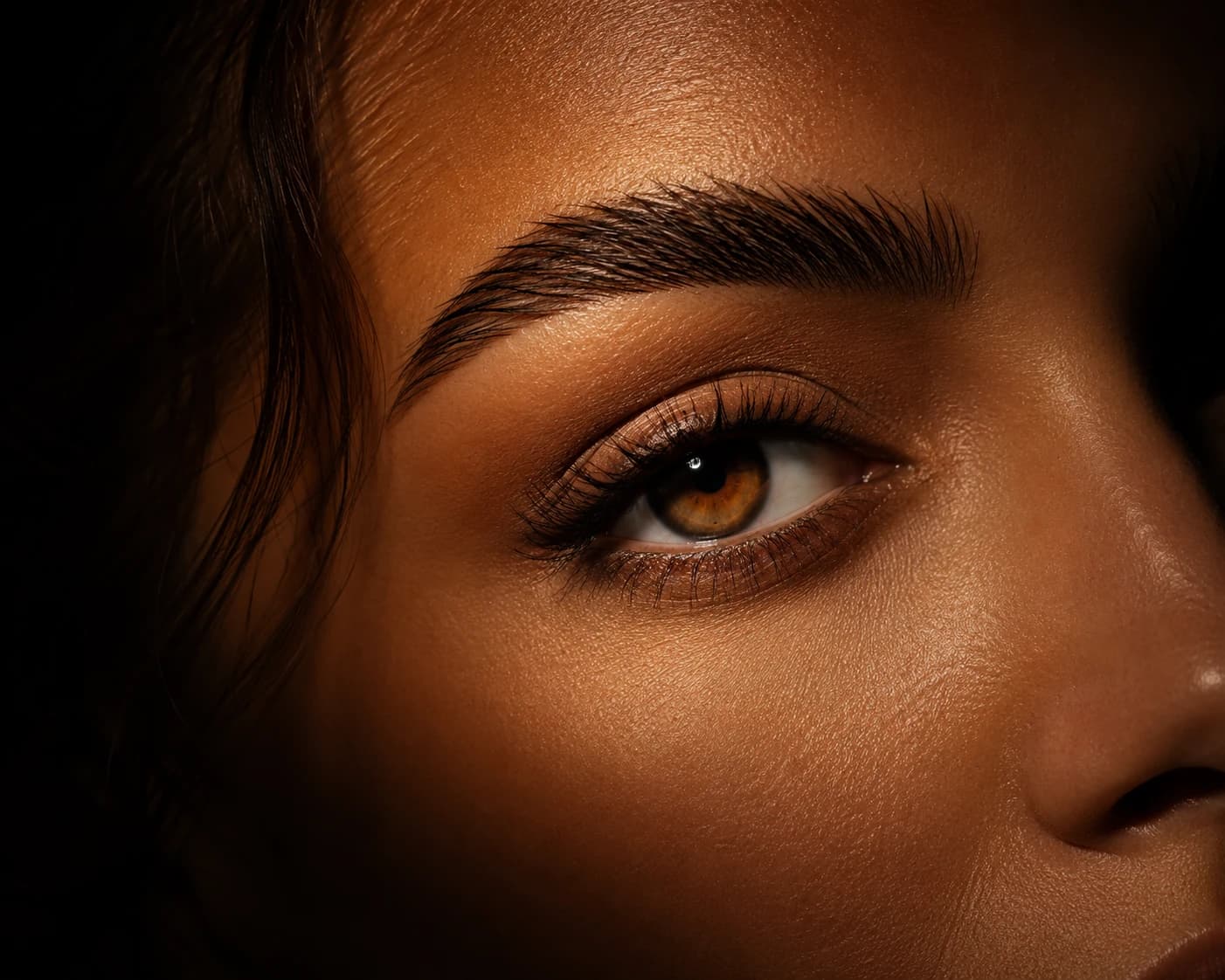
Best Eyebrow Shape for Your Face: The Complete Guide
Finding the best eyebrow shape for your face shape is one of the most impactful and underestimated changes you can make to your appearance — research published in Frontiers in Psychology found that eyebrow-to-face-shape matching significantly affected observer ratings of facial attractiveness and harmony. Unlike many beauty interventions, brow shaping requires no product and no money: it simply requires knowing what shape of brow complements your specific facial geometry and how to maintain that shape. This guide gives you exactly that, face shape by face shape.
How Eyebrows Affect Facial Balance and Attractiveness
Eyebrows function as the architectural frame of the upper face. They define the boundary between the upper third and middle third of the face, direct the observer's gaze toward the eyes, and contribute to the face's apparent width-to-height ratio. A brow that sits too high creates an expression of permanent surprise and adds apparent length to the face. A brow that sits too low creates a heavy, closed-off appearance. A brow that is too thin loses its framing power; a brow that is too thick dominates the face. The goal is a brow that is proportionate to, and in harmony with, the specific geometry of your face.
Research by Feser et al. found that fuller brows were consistently rated as making faces appear younger and more attractive — a finding consistent across multiple populations. This has been replicated in the cultural shift toward thicker, more natural brows that reversed the thin-plucked trend of the late 1990s and 2000s. The reason fuller brows read as youthful is that brow hair density naturally decreases with age, particularly at the tail — so a full, dense brow is an involuntary youth signal.
The arch position — where the highest point of the brow sits — is the most powerful architectural variable. An arch over the outer third of the brow (classic arch) lifts the face and creates an elegant, alert expression. An arch directly over the iris (centre arch) creates a more dramatic, surprised look. A flat brow with minimal arch creates a calm, approachable, but sometimes heavy appearance. The optimal arch position for any individual depends primarily on their face shape and the effect they want to create.
| Face Shape | Best Brow Shape | Arch Position | Avoid |
|---|---|---|---|
| Oval | Soft, slightly arched (most shapes work) | Outer third of iris | Over-plucking — oval faces can carry natural fullness |
| Round | High arch, angular | Above outer iris | Flat or rounded brow — amplifies roundness |
| Square | Soft curve, full | Outer third, gentle | Sharp angles — emphasises square jaw |
| Heart | Low arch, rounded, longer tail | Centre to slightly outer | Very high arch — exaggerates narrow chin |
| Oblong/Long | Flat, minimal arch, extended horizontally | Minimal arch | High arch — adds apparent length |
| Diamond | Curved, moderate arch, softened angles | Outer third | Very angular brow — sharp brow on sharp bone structure |
Brow Shape by Face Shape: Detailed Guide
Oval faces have balanced proportions that suit almost any brow shape, making them the most versatile canvas. The one principle that applies: avoid over-thinning, which removes the natural fullness that complements the face's balanced geometry. A softly arched brow with the peak above the outer third of the iris, at a thickness roughly matching the distance from the iris to the lash line (approximately 6–8mm at its fullest point), suits an oval face in most contexts. This is the 'default' brow that most tutorials are built around.
Round faces benefit most from a high, defined arch that creates vertical elongation and counteracts the face's horizontal emphasis. The arch should sit above the outer edge of the iris — never directly over the pupil, which makes the face appear wider. Extending the brow tail slightly longer than the natural endpoint elongates the eye and implicitly stretches the face shape. Fuller brows are better than thin on a round face: thin brows on a round face emphasise the lack of angularity, whereas fuller brows create their own structural interest.
Square faces have a strong horizontal jaw line that needs to be balanced by softness above. A soft curved brow — avoiding sharp or angular arches — creates this balance. The arch should be gentle and the transition from body to tail should be smooth and rounded. The tail can be slightly longer and lower than on other face shapes, directing the gaze outward and downward to soften the squareness of the jaw. Filling in with a soft, hair-like strokes using a brow pencil rather than block colour maintains the softer, more rounded feeling appropriate to the face shape.
The universal 'golden rule' of brow mapping: your brow should start directly above the inner corner of the eye (or slightly inward), arch above the outer edge of the iris, and end at a diagonal line from your nostril through the outer corner of the eye. This mapping works across all face shapes as a starting point.
Brow Thickness, Density, and the Youth Signal
Brow thickness is the variable with the strongest evidence for an attractiveness and youthfulness signal. Studies consistently show that people with fuller brows are rated as younger and more attractive. This is partly because high brow density is a biological marker of youth — brow hair production declines with age and certain health conditions — and partly because thick brows provide stronger framing of the eye, which increases the visual impact of what is often the most expressive facial feature.
The optimal thickness varies by face scale — a broader face can carry more brow thickness without looking overpowering, while a smaller, narrower face needs proportional scaling. As a rough guideline, the brow at its fullest point (the body, not the arch or tail) should have a thickness of approximately 4–8mm in women. Below 4mm reads as sparse and dated; above 10mm can feel overwhelming depending on the face. The tail should taper naturally to a fine point or be deliberately squared for a bold editorial look.
Brow hair density is as important as thickness. A brow that appears full but has gaps and sparse patches reads differently to a dense, uniform brow. Modern brow techniques — tinting, lamination, microblading, or powder brow tattooing — all address density. At home, a brow gel with fibres or a fine-tipped brow pen can create the appearance of density without requiring permanent commitment. Start with wherever your natural brow is sparsest — usually the head (inner end) and the tail.
Advertisement
How to Shape Your Brows at Home
Mapping is the most important step that most people skip. Before removing any hair, draw the three reference points with a brow pencil: the start point (above the inner corner), the arch point (above the outer iris edge), and the end point (on the diagonal from nostril through outer corner). Connect these with a light line to create the target shape. Only then remove hairs outside this mapped shape — this prevents the incremental over-plucking that most people regret.
Tweezing below the brow body is the safest approach for beginners — removing stray hairs under the lower edge of the brow, which is where stray hairs are most visually distracting. Avoid tweezing above the brow arch — hairs above the brow are rarely problematic and removing them can create an unnatural, shaved-looking upper brow edge. Threading and waxing are more efficient for the overall shape but remove more hairs per session, making over-removal more likely without experience.
For filling, match the product to the brow effect you want: a brow pencil in micro-strokes replicates individual hairs (most natural); a brow powder gives soft, diffuse fullness (good for sparse brows); a brow pomade delivers bold, sharp, long-lasting definition (best for bold or dramatic brow looks). Always choose a colour one shade lighter than your natural brow hair — a product matching or darker than the natural colour reads as drawn-on rather than enhanced.
Identify Your Face Shape and Ideal Brow With Our AI Tool
Identifying your face shape is the prerequisite for choosing the ideal brow architecture — and it is not always as obvious as people assume. Many faces are between shapes or have proportions that don't map cleanly onto the standard categories. The forehead width versus jaw width ratio, the cheekbone prominence, and the face length are all variables that need to be assessed together, not in isolation.
Our AI face rater at /rate-my-face analyses your facial geometry, identifies your face shape and proportions, and assesses your existing brow-to-face-shape harmony as part of its overall attractiveness score. This gives you a calibrated reading of whether your current brow is working for your specific face or whether a shape adjustment would meaningfully improve your facial balance.
The analysis takes approximately 30 seconds from a well-lit, straight-on photo. Natural light at eye level gives the most accurate geometry reading — avoid overhead lighting, which creates shadows that alter apparent brow height and thickness in the analysis. The face rater also assesses canthal tilt, eye spacing, and overall symmetry, so you get a complete picture of how all your upper-face features are currently performing together.
Frequently Asked Questions
What eyebrow shape is most attractive?
Research consistently shows that fuller, softly arched brows rate as most attractive across populations. The specific shape (high arch vs. flat, thick vs. medium) depends on the face shape it complements — the most attractive brow is the one in greatest harmony with the individual's facial geometry, not a single universal template.
How do I know what face shape I have?
Measure your face at four points: forehead width, cheekbone width, jawline width, and face length (forehead hairline to chin). Oval: length > width, cheekbones widest, jaw rounded. Round: similar length and width, rounded jaw. Square: similar width measurements, angular jaw. Heart: forehead wider than jaw, narrow chin. Long/oblong: length significantly greater than width.
Are thick or thin eyebrows more attractive?
Research shows fuller brows are consistently rated as more attractive and younger-appearing. Studies by Feser et al. found that fuller brows made faces appear significantly younger. The trend toward thicker, more natural brows in the 2010s–2020s is backed by data: sparse brows remove a youth signal that fuller brows preserve.
Should eyebrows be darker than hair?
No — for the most natural result, brow product should be one shade lighter than your natural hair colour. Brow product that matches or is darker than your hair reads as drawn-on and heavy. Exceptions exist for editorial or bold looks where a defined, graphic brow is deliberately part of the aesthetic.
How often should I shape my eyebrows?
Most people find that threading or waxing every 3–4 weeks maintains their brow shape. Tweezing can be done as needed when stray hairs appear. If you are growing out your brows (increasing thickness), avoid all hair removal for a minimum of 8–12 weeks to see the full growth that your follicles can produce, then shape from that new baseline.
Lena Whitmore
Science Writer · Facial Analysis & Appearance Psychology
Lena covers the science of smiles, facial aging, and AI-powered biometrics. She writes evidence-based guides grounded in peer-reviewed research, with a focus on making appearance science accessible and actionable. All tools on Smile Tracker run locally in your browser — your photo is never uploaded anywhere.
Put it to the test
See your results with AI
Upload a photo and get your AI facial proportion analysis, symmetry measurement, and feature breakdown — free, private, instant.
Analyse My Face Free →Advertisement
Sources
Related reading
What Face Shape Do I Have? How to Find Out and What It Means
May 2026 · 7 min read
High Cheekbones vs Low Cheekbones: Attractiveness and What They Signal
May 2026 · 6 min read
Eyebrow Shape and Attractiveness: What the Research Shows
May 2026 · 6 min read
What Is Facial Harmony? The Science of Features That Work Together
May 2026 · 6 min read
What Makes a Face Look Feminine: The Science of Feminine Facial Features
June 2026 · 9 min read
Types of Eye Shapes: Which Is Most Attractive?
June 2026 · 9 min read