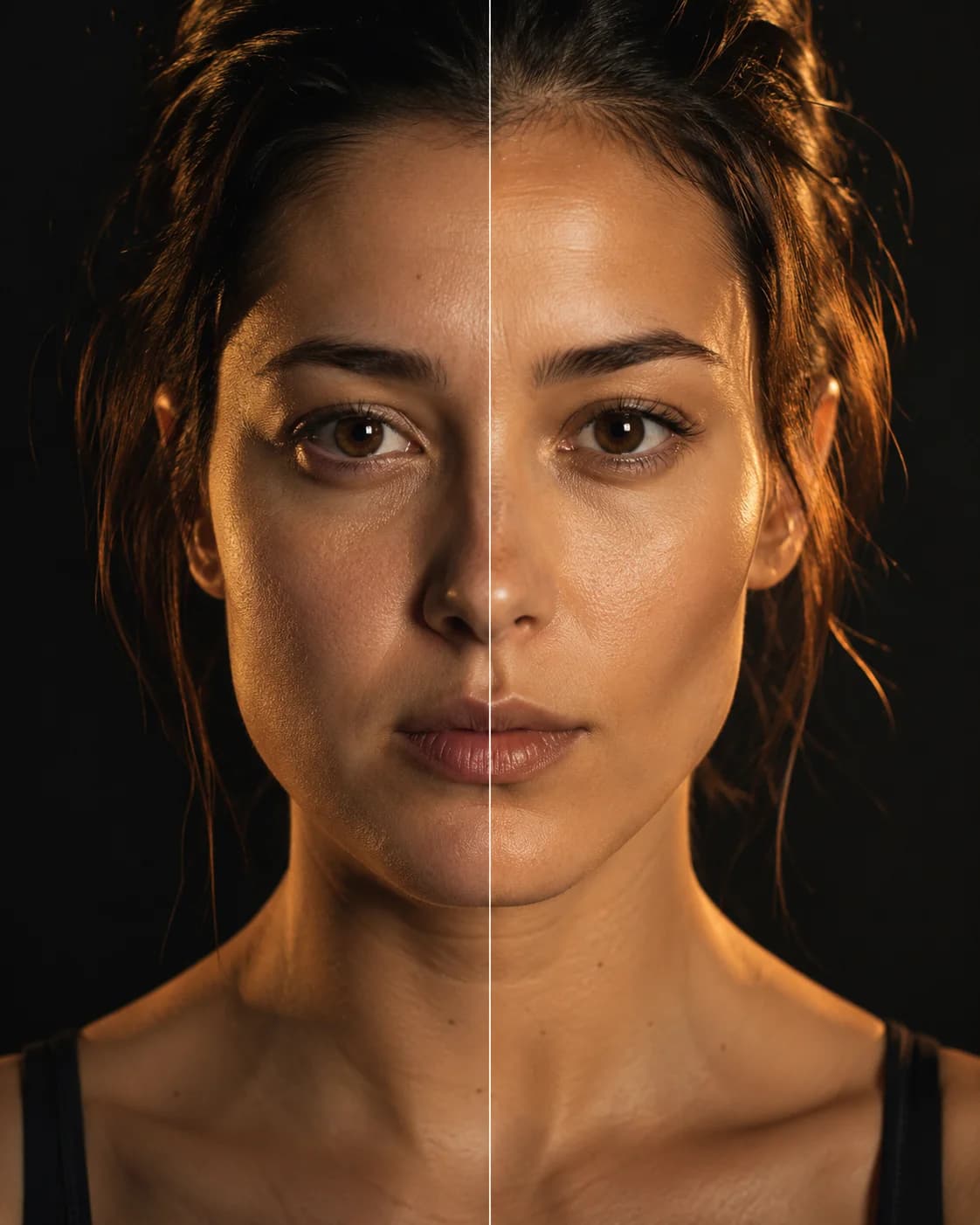
Cortisol Face: Why Chronic Stress Makes Your Face Look Puffy
You may have noticed that prolonged periods of high stress coincide with your face looking rounder, puffier, or heavier than usual — even if your weight has not changed significantly. This is not imagination. Chronic stress activates a specific hormonal pathway that physically redistributes fat toward the face and trunk, and produces inflammation-driven fluid retention that changes your facial appearance in measurable ways. The viral cortisol face trend on TikTok in 2024 had real clinical backing.
This article is for informational and educational purposes only and does not constitute medical, dermatological, or psychological advice. Consult a qualified professional before making changes to your health or skincare routine.
The HPA Axis: How Stress Reaches Your Face
When you perceive a stressor — whether a deadline, an argument, financial pressure, or sleep deprivation — your hypothalamus activates the HPA (hypothalamic-pituitary-adrenal) axis, signalling the adrenal glands to release cortisol. Cortisol is a glucocorticoid hormone: its primary role is to mobilise energy in a short-term emergency by suppressing digestion, immune function, and repair processes while elevating blood glucose and blood pressure.
This system was designed for brief, acute stress events. When the stressor resolves, cortisol levels return to baseline and the body returns to normal metabolic function. The problem is chronic stress — sustained activation of the HPA axis over weeks or months — which keeps cortisol chronically elevated. This is when the physical effects on appearance become visible.
Chronically elevated cortisol produces several facial changes through distinct mechanisms: fat redistribution (driven directly by glucocorticoid effects on adipose tissue), fluid retention (driven by cortisol's effect on aldosterone and sodium retention), and inflammatory changes to skin quality. All three operate simultaneously and all three affect how the face looks.
Glucocorticoid Fat Redistribution: The Mechanism Behind Round Face
Glucocorticoids (of which cortisol is the primary one) act directly on fat cells through glucocorticoid receptors. Critically, these receptors are not evenly distributed: facial fat and truncal fat (abdomen, upper back) have higher glucocorticoid receptor density than peripheral fat (arms, legs). This means chronically elevated cortisol preferentially drives fat deposition to the face and torso while simultaneously triggering fat breakdown in the extremities.
The clinical version of this effect — seen in its extreme form in Cushing's syndrome (a condition of severely elevated cortisol) — produces what physicians call a moon face: a visibly rounded, full face with fat deposits at the temples, cheeks, and under the jaw. The cortisol face phenomenon is a subclinical version of the same mechanism, operating at a lower intensity over a longer period.
Research by Epel and colleagues confirmed that chronically stressed individuals showed significantly higher abdominal fat deposition compared to low-stress controls, even controlling for total caloric intake — demonstrating that cortisol-driven fat redistribution is a real metabolic effect, not simply a result of stress eating. The same redistribution pattern applies to facial fat.
“Glucocorticoids directly regulate lipid metabolism in a depot-specific manner — and the face is among the most sensitive depots.”
Moon Face vs Stress Puffiness: What Is the Difference?
Moon face in the clinical sense refers specifically to the fat redistribution pattern seen in Cushing's syndrome or as a side effect of high-dose corticosteroid medications (such as prednisone). It involves actual fat deposition to the temporal, buccal, and sub-mandibular areas that takes weeks to months to develop and weeks to months to reverse after cortisol normalises.
Stress puffiness — the more common cortisol face presentation — involves two additional mechanisms beyond fat redistribution. First, cortisol drives aldosterone production, which causes the kidneys to retain sodium and water. This fluid retention contributes to facial puffiness that can appear more rapidly (days rather than weeks) and resolves more quickly when cortisol drops. Second, chronic cortisol elevation drives low-grade systemic inflammation, which contributes to puffiness and skin quality changes.
The viral cortisol face trend on TikTok in 2024 was largely describing the stress puffiness variant — particularly the fluid retention component — which can appear and resolve relatively quickly in response to sleep, stress reduction, and dietary sodium changes. Both real mechanisms operate in people under chronic stress; the relative contribution varies by individual.
If your face looks puffy primarily in the morning and improves by midday, fluid retention (often sodium and cortisol-driven) is the main factor. If facial roundness is consistent throughout the day, fat redistribution is more likely involved.
Advertisement
The Ozempic Face Connection
The discussion around Ozempic face — the gaunt, sunken appearance reported in some GLP-1 agonist users who lose weight rapidly — is in some ways the opposite side of the cortisol face coin. Rapid weight loss depletes facial fat deposits, including the buccal (cheek) fat that provides volume and youthful fullness. The face can look aged and hollow after significant weight loss in a way that does not match the body.
What both phenomena illustrate is the same underlying principle: facial fat distribution is hormonally and metabolically regulated, and changes to that regulation — whether toward fat gain from cortisol or fat loss from caloric restriction and GLP-1 activity — change facial appearance in ways that are not simply cosmetic but are physiologically driven.
This is relevant for cortisol face because it confirms that the facial changes are real and measurable, not psychological. It also suggests that approaches that normalise cortisol and reduce systemic inflammation — rather than caloric restriction alone — are the most relevant interventions for stress-driven facial puffiness.
What Actually Reduces Cortisol Face
The most direct intervention is addressing the cortisol elevation itself. Sleep is the single highest-leverage input: cortisol follows a diurnal rhythm that is calibrated by sleep, and sleep deprivation is one of the most potent drivers of sustained cortisol elevation. Research consistently shows that even modest sleep improvements produce measurable cortisol reductions within days. If stress puffiness worsens during periods of poor sleep, sleep restoration is the first and most impactful change to make.
Dietary sodium affects the fluid retention component specifically. Cortisol sensitises the kidneys to sodium retention; a high-sodium diet amplifies this effect significantly. Reducing processed food intake (which accounts for approximately 70% of dietary sodium in Western diets) and increasing water intake can reduce the fluid-retention component of cortisol face within 48–72 hours. This is not about water weight loss in a general sense — it is specifically about reversing cortisol-amplified sodium-driven retention.
For the fat redistribution component, the approach is fundamentally about reducing chronic cortisol burden: stress management practices with consistent research support (exercise — particularly zone 2 aerobic exercise, which acutely reduces cortisol — mindfulness, and social connection) reduce HPA axis reactivity over time. These produce gradual rather than rapid changes to facial fat distribution, but the changes are real and sustained when the practices are consistent.
Prioritise sleep first, reduce processed food sodium second, and add daily movement (even a 20-minute walk) third — these three changes target all three mechanisms behind cortisol face simultaneously.
Frequently Asked Questions
What does cortisol face look like?
Cortisol face typically presents as a rounder, fuller, or puffier face than usual — particularly in the cheeks, temples, and jaw area. It may also involve puffiness under the eyes and a general loss of facial definition. In its more pronounced clinical form (as in Cushing's syndrome), it is called moon face. In the stress context, the changes are more subtle and variable.
How quickly does stress cause facial puffiness?
The fluid retention component can appear within days of elevated cortisol and stress, particularly when combined with high sodium intake and poor sleep. Fat redistribution is slower — developing over weeks to months of chronic elevation. Most people notice the fluid component first, which is also the most rapidly reversible.
Is cortisol face permanent?
No — in the absence of a medical condition causing cortisol excess (like Cushing's syndrome), cortisol face is reversible. The fluid retention component reverses within days to weeks of reducing cortisol and sodium. The fat redistribution component takes longer — typically weeks to months after cortisol normalises — but is also reversible.
Can I have cortisol face without Cushing's syndrome?
Yes. Cushing's syndrome is a clinical condition of severely elevated cortisol from a tumour or high-dose steroid medication. Cortisol face in the stress context is a subclinical effect of chronically elevated but not pathologically elevated cortisol. If you suspect Cushing's, see a doctor — but the common cortisol face experience is driven by normal stress physiology, not disease.
Does cortisol face make you look older?
Yes, by multiple mechanisms. Facial puffiness and fat redistribution change the face's structural proportions in ways that can add apparent age. Additionally, chronic cortisol elevation degrades collagen, accelerates skin thinning, and contributes to dark circles and reduced skin quality — all of which are perceived age signals. Reducing chronic stress load has measurable positive effects on apparent age.
Lena Whitmore
Science Writer · Facial Analysis & Appearance Psychology
Lena covers the science of smiles, facial aging, and AI-powered biometrics. She writes evidence-based guides grounded in peer-reviewed research, with a focus on making appearance science accessible and actionable. All tools on Smile Tracker run locally in your browser — your photo is never uploaded anywhere.
Put it to the test
See your results with AI
Upload a photo and get your AI-estimated apparent age and Youthful Energy Score — free, private, instant.
Try Guess My Age Free →Advertisement
Sources
- Tsigos & Chrousos (2002) — HPA axis and stress, Journal of Psychosomatic Research
- Geer et al. (1980) — Glucocorticoid-induced fat redistribution, Clinical Endocrinology
- Epel et al. (2000) — Stress and body fat distribution, Psychosomatic Medicine
- Charmandari, Tsigos & Chrousos (2005) — Endocrinology of the stress response, Annual Review of Physiology
Related reading

What Makes a Face Look Older? 7 Factors AI Aging Tools Detect
May 2026 · 7 min read

How Stress Ages Your Face: The Biology and What You Can Do
May 2026 · 7 min read
What Causes Eye Bags and How Do They Make You Look Older?
May 2026 · 6 min read

Are Dark Circles Genetic? What Science Says
May 2026 · 6 min read
How to Look Younger: 8 Science-Backed Changes That Actually Work
May 2026 · 8 min read

Why Do I Always Look Tired? The Anatomy Behind a Permanently Fatigued Face
May 30, 2026 · 7 min read