Filter Dysmorphia: When Beauty Filters Distort How You See Yourself
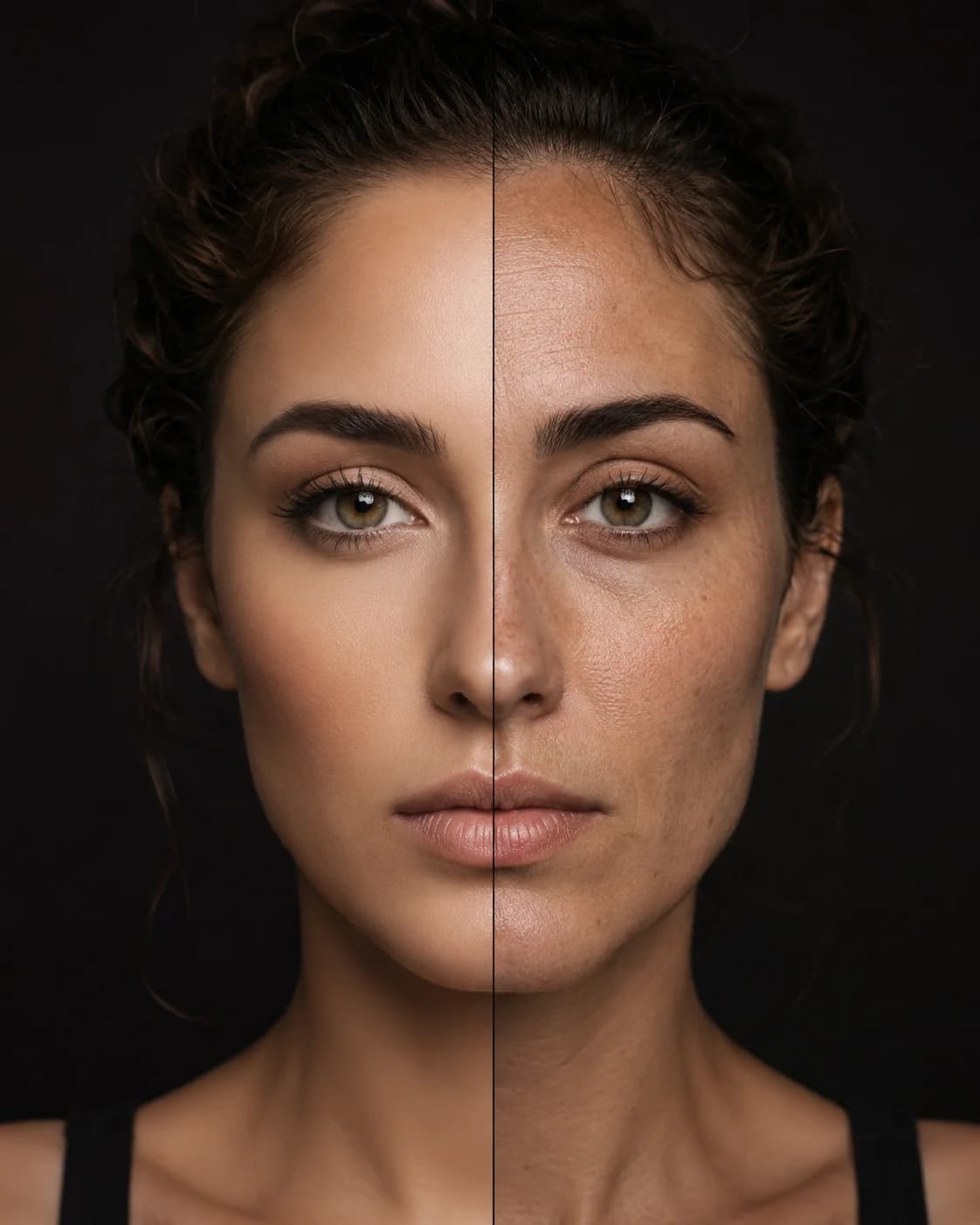
A beauty filter does something that no mirror or camera has ever done before: it shows you a version of your face with smoother skin, larger eyes, a narrower nose, and more symmetrical features — and it does it in real time, overlaid on your own reflection. The brain, which has been building its model of your face from the mirror for your entire life, begins to absorb this altered version as a reference point. For a growing number of people, the unfiltered face starts to look wrong. This is filter dysmorphia — and it is now well-documented enough to have appeared in clinical plastic surgery literature.
What Is Filter Dysmorphia?
The term 'Snapchat dysmorphia' was coined in a 2018 letter to JAMA Facial Plastic Surgery by dermatologist Tijion Esho and later elaborated on by Rajanala, Maymone, and Vashi. It described a new clinical pattern: patients arriving at cosmetic surgeons not with celebrity photos as reference images, but with filtered selfies of themselves — requesting procedures to make their real face match their filtered one.
Filter dysmorphia is a broader, subsequent term that describes the perceptual and psychological distress arising from repeated exposure to beauty-filtered versions of one's own face. It sits on a spectrum — at the mild end, people simply feel vaguely unsatisfied with unfiltered photos. At the more severe end, there is persistent distress about unfiltered appearance and preoccupation with perceived flaws that are either absent or minor in person.
It is important to note that filter dysmorphia is not formally a diagnostic category in the DSM-5. However, it overlaps with body dysmorphic disorder (BDD) — a recognised anxiety disorder characterised by preoccupation with perceived appearance flaws. The concern among clinicians is that filter culture is lowering the threshold at which subclinical appearance preoccupation transitions into clinically significant distress.
“We are not just seeing an increase in patients requesting surgery. We are seeing patients request procedures based on a version of themselves that does not exist outside a phone screen.”
The 2022 AAFPRS Survey: The Clinical Picture
The American Academy of Facial Plastic and Reconstructive Surgery (AAFPRS) surveys its members annually on practice trends. In its 2022 survey, 79% of responding surgeons reported seeing patients who referenced their appearance in social media filters or apps as a motivation for seeking a procedure. This was a substantial increase from previous years and represented a significant shift in the referential baseline that patients were using to evaluate their faces.
The same survey found that social media was cited as a driver of cosmetic procedure interest by more than two-thirds of respondents' patient populations. The filter influence was notable not just for its prevalence but for the nature of the requests it generated: unlike requests based on celebrity photos (which have always been a feature of cosmetic consultations), filter-based requests often involved features that are intrinsic to healthy, normal facial anatomy — pore size, skin texture, the natural asymmetry present in every human face.
Experienced surgeons responding to the survey noted the counselling challenge this created: patients were distressed by features that are normal, having internalised an algorithmic standard of smoothness and symmetry that is not biologically achievable and does not exist in any unfiltered human face.
The Psychology: How Filters Shift Your Baseline
The brain builds its model of your appearance from repeated exposure. Over years of daily mirror use, it constructs a stable reference image — the face you expect to see when you look at yourself. This reference is used to interpret every subsequent image of your face as either consistent or deviant from normal.
Beauty filters interfere with this process by repeatedly presenting a systematically altered version of your face as if it were a realistic image. Unlike celebrity photos (which the brain codes as images of someone else), filtered selfies are coded as images of you. Repeated exposure to these images gradually shifts the internal reference point — the 'normal' face — toward the filtered version.
Research by Choukas-Bradley and colleagues (2022) on social media and body image found that appearance-related social media exposure is associated with increased appearance comparison activity, decreased appearance satisfaction, and increased consideration of cosmetic procedures, even when controlling for pre-existing body image concerns. The mechanism is not simply negative comparison with others — it is the systematic raising of one's own baseline expectation for what one's face should look like.
Advertisement
What Beauty Filters Actually Do to Your Face
Beauty filters use real-time AI face detection to locate facial landmarks and apply geometric and colour transformations. The most common operations are: skin smoothing (averaging pixel colour values over the skin region to eliminate texture variation), eye enlargement (scaling the eye region upward by 5–15%), nose narrowing (scaling the nasal width inward by 10–20%), and jaw slimming (scaling the lower face proportions inward). Symmetry correction nudges both halves of the face toward their average, reducing the natural asymmetry present in every human face.
The resulting image shares your overall face shape and identity but presents a version that is simultaneously smoother, more symmetrical, more proportionally idealised, and free of the texture, pigmentation variation, and subtle asymmetries that define every real human face. It is not a more accurate photo of you. It is a procedurally idealised avatar that happens to use your facial geometry as a template.
The gap between the filter version and the camera version becomes the source of distress in filter dysmorphia. The wider that gap, the more distress — which partly explains why filters have become progressively more transformative over time, as users push toward increasingly dramatic alterations to reach an appearance they find satisfying.
A quick self-check: if looking at an unfiltered photo triggers meaningfully more distress than looking in a mirror, the filter may be functioning as a distorting reference point rather than a neutral enhancement.
Filter Dependency and the Cycle of Escalation
Filter use can become self-reinforcing. As the filtered version becomes the internal reference for acceptable appearance, unfiltered images produce increasing dissatisfaction. This dissatisfaction motivates further filter use and often drives users toward progressively stronger filters — a cycle documented in qualitative research on social media and appearance anxiety.
This pattern is functionally similar to the accommodation effect in anxiety: avoidance of the feared stimulus (unfiltered photos, unfiltered mirrors) temporarily reduces distress but maintains and gradually worsens the sensitivity. Exposure to unfiltered images, by contrast, is part of the recalibration process.
The escalation also explains the migration to increasingly extreme filters. A subtle skin-smoothing filter that once produced satisfaction no longer does so after months of use, because the brain has adapted to it as the new baseline. A stronger, more transformative filter is required to produce the same relative improvement over the current reference point. This is escalation — a feature of the psychology of comparison, not a property of filters per se.
How to Recalibrate Your Self-Perception
Recalibration begins with restoring unfiltered exposure. This does not mean forcing yourself to post unfiltered photos publicly — it means deliberately viewing unfiltered photos of yourself regularly enough that the brain re-establishes an accurate baseline. Over time (typically weeks, not days), the unfiltered face begins to feel normal again rather than deviant.
A second useful practice is comparative reality-checking: looking at unfiltered photos of people you find genuinely attractive in person. Real human faces have texture, asymmetry, pores, and variation. Recognising that these properties are universal — and that the filter aesthetic represents a deviation from all human biology, not a standard some people meet and others fail — reduces the distress attached to unfiltered self-perception.
For people who notice that filter-related appearance concerns are significantly affecting their quality of life — persistent preoccupation, avoidance of photos or social situations, meaningful distress — this warrants a conversation with a mental health professional familiar with body image concerns. The experience is real, increasingly common, and well within the scope of effective psychological support.
Frequently Asked Questions
What is filter dysmorphia?
Filter dysmorphia describes perceptual distress arising from repeated exposure to beauty-filtered selfies. When you see a smoother, more symmetrical, algorithmically idealised version of your face regularly, the brain gradually shifts its internal reference point toward that version — making the unfiltered face feel increasingly unsatisfactory or distressing, even if it looks completely normal to others.
What is Snapchat dysmorphia?
Snapchat dysmorphia is the earlier term, coined in a 2018 JAMA Facial Plastic Surgery paper, describing patients requesting cosmetic procedures to make their real face match their filtered selfies. Filter dysmorphia is the broader term that includes the psychological experience of distress from filter use, beyond just the clinical/surgical context.
Are beauty filters genuinely harmful?
At moderate use, filters are generally harmless. The harm emerges with habitual use that shifts internal reference points for what the face should look like. The 2022 AAFPRS survey found that 79% of plastic surgeons were seeing filter-referencing patients — a clinical signal that filter use is producing measurable appearance dissatisfaction at a population level. Whether any individual's filter use is harmful depends largely on how much distress their unfiltered appearance generates.
How do I know if I have filter dysmorphia?
Some indicators: you feel meaningfully worse about your appearance in unfiltered photos than you did before regular filter use; you avoid posting or sharing unfiltered images; you feel distressed comparing your face to the filtered version; or you are considering cosmetic procedures primarily motivated by wanting to look like your filtered self. If these apply and are affecting your daily life, speaking with a mental health professional is worthwhile.
Can using AI face tools worsen filter dysmorphia?
Face analysis tools that provide objective feedback on structure and symmetry are different from beauty filters: they analyse what is there rather than replacing it with an idealised version. That said, any tool that increases preoccupation with appearance can amplify existing anxieties. The goal of good face analysis is understanding and context — if using any tool (including this one) increases rather than decreases your distress about your appearance, taking a break is the right move.
Lena Whitmore
Science Writer · Facial Analysis & Appearance Psychology
Lena covers the science of smiles, facial aging, and AI-powered biometrics. She writes evidence-based guides grounded in peer-reviewed research, with a focus on making appearance science accessible and actionable. All tools on Smile Tracker run locally in your browser — your photo is never uploaded anywhere.
Put it to the test
See your results with AI
Upload a photo and get your AI facial proportion analysis, symmetry measurement, and feature breakdown — free, private, instant.
Analyse My Face Free →Advertisement
Sources
Related reading
Why Do I Look Different in Photos vs the Mirror? The Science Explained
May 2026 · 7 min read
The Halo Effect: How Your Looks Affect How People See You
May 2026 · 6 min read
What Is Facial Harmony? The Science of Features That Work Together
May 2026 · 6 min read
Why Does My Nose Look Big in Selfies? The Camera Science Explained
May 30, 2026 · 6 min read
Why Does My Face Look Fat in Pictures?
May 30, 2026 · 7 min read
Why Do I Look Different in Every Photo? The Real Explanation
May 29, 2026 · 6 min read