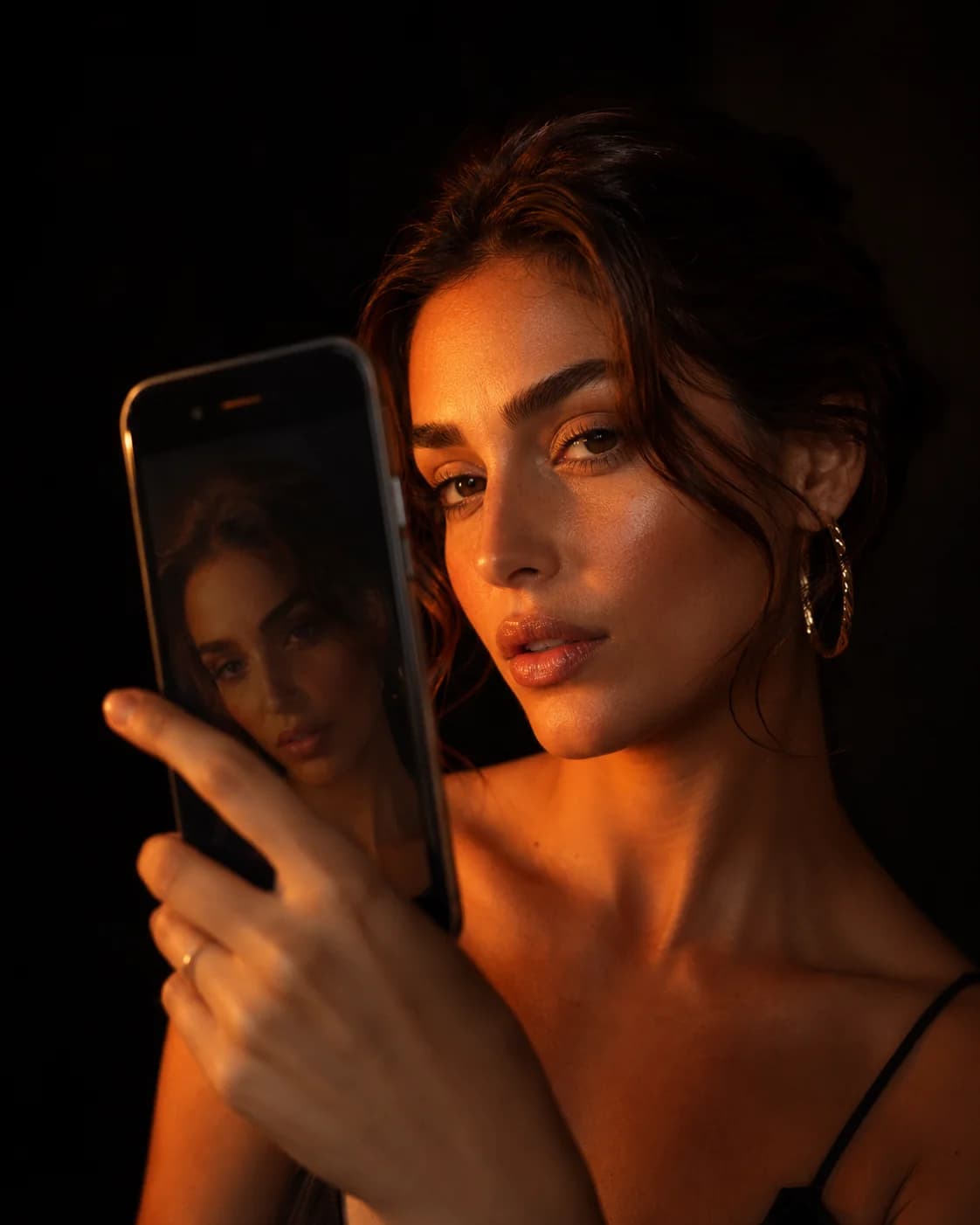
Why Does My Nose Look Big in Selfies? The Camera Science Explained
You look in the mirror and your nose seems completely normal. Then you take a selfie and suddenly it dominates your entire face. You are not imagining it — the physics of short-distance photography is doing something measurable and well-documented to your nasal proportions. A landmark 2018 study published in JAMA Facial Plastic Surgery quantified exactly how much distortion a standard front camera at arm's length produces, and the number is startling. Understanding this one principle will completely change how you interpret every photo you have ever taken of yourself.
The 2018 JAMA Study That Quantified the Distortion
In 2018, researchers Boris Paskhover and colleagues at Rutgers New Jersey Medical School published a study in JAMA Facial Plastic Surgery that used mathematical modelling to calculate how much a standard selfie camera distorts the nose. At a distance of 12 inches — roughly arm's length — the camera inflated perceived nasal width by approximately 30% and nasal tip size by approximately 7% compared to a professional portrait taken at 5 feet.
The researchers were motivated by a clinical observation: patients were arriving at plastic surgeons' offices with selfies as reference photos, requesting rhinoplasties to correct a nasal profile that was in fact a camera artefact. The nose they wanted to fix did not exist in real life. It existed only in the geometry of close-distance photography.
The study used geometric modelling rather than a photographic sample, which means the distortion values are based on optical physics rather than subjective rating — making the finding hard to dispute. The numbers represent what a lens at 12 inches physically does to a three-dimensional face projected onto a flat sensor.
“With the increasing use of social media and the rise in "selfie" culture, there is a need to educate the public and physicians about how standard focal length cameras can distort the nose.”
Save this study as a mental anchor: every selfie at arm's length is adding approximately 30% to your perceived nasal width. That is not your nose.
Why Focal Length Changes Your Face
Every camera lens has a focal length, measured in millimetres. Wide-angle lenses — like the front-facing camera on most smartphones, which typically sits between 24 mm and 28 mm equivalent — capture a wide field of view by bending the incoming light more aggressively. This bending is what creates barrel distortion: objects at the centre of the frame, closest to the lens, are magnified relative to objects at the edges.
Your nose is the part of your face that protrudes furthest toward the camera. It is, quite literally, the part of your face closest to the lens. Wide-angle optics treat that extra few centimetres of proximity as a significant proportional distance, enlarging the nose relative to the ears, eyes, and jaw — which sit further back.
A standard portrait lens used by professional photographers typically falls between 85 mm and 135 mm equivalent. At this focal length, the geometric compression is much closer to what the human eye actually perceives when standing 5–8 feet from a subject. It is not that portrait lenses are flattering — it is that they are accurate. Selfie cameras are simply producing a measurably distorted representation.
Barrel Distortion: The Geometry of the Problem
Barrel distortion is a type of lens aberration in which magnification decreases from the centre of the image toward the edges, causing straight lines near the edges to appear to bow outward. On a flat surface like a wall, barrel distortion is subtle and often corrected in software. On a three-dimensional face, the effect is more complex.
Because your face is not flat, the wide-angle lens is essentially applying different magnification values to different depths within the same image. Your nose — sitting 2–3 cm closer to the lens than your cheeks — gets a slightly higher magnification than the rest of your face. The result looks less like a photograph and more like a mild caricature, where central features are enlarged relative to peripheral ones.
Modern phones apply computational correction to reduce barrel distortion, but this correction is optimised for straight architectural lines, not for the organic curves of a human face. Some nose distortion persists even after digital correction — and the correction itself can introduce its own artefacts around curved surfaces.
Advertisement
How Distance Solves the Problem
The fix is elegantly simple: distance. As the camera moves further from the face, the relative depth difference between the nose tip and the rest of the face becomes proportionally smaller. At five feet, the few centimetres of nasal projection are geometrically insignificant. At 12 inches, they are not.
The Paskhover study modelled the distortion across multiple distances. At 2 feet (roughly 60 cm), distortion dropped substantially compared to 12 inches. At 5 feet, nasal proportions in the photograph matched real-life proportions to within clinical significance. This is why professional headshots are taken from several feet away with a telephoto lens, not from arm's length with a wide-angle.
If you want a selfie that accurately represents your nose, the simplest solution is to take the photo with your rear camera at arm's length extended with a tripod or propped phone, or to have someone else take the photo from 4–5 feet away. No editing required — just distance.
Use your rear camera at 2–3x zoom from about 4 feet away. This approximates a portrait focal length and produces a far more accurate image of your actual nose.
Front Camera vs Rear Camera vs Mirror
There is a meaningful difference between the camera systems on most smartphones. The front-facing camera — used for selfies — has a shorter focal length and a wider field of view than the rear camera. This is by design: a wider field of view makes it easier to fit multiple people into a group selfie. The side effect is more pronounced wide-angle distortion.
The rear camera, particularly when used at 1x or 2x zoom from 3–5 feet, produces results much closer to a 50–85 mm portrait lens. The 2x zoom setting on most modern phones approximates a standard to short-telephoto focal length that is traditionally considered the most accurate for portraits.
A mirror is different from both. Your mirror image is a real-time, binocular, three-dimensional perception at a distance typically between 2 and 5 feet. Your brain processes it with full depth cues, familiar symmetry, and no lens distortion. This is partly why you often prefer how you look in a mirror to how you look in photos — and why that preference is not vanity, but accurate perception.
What This Means for AI Face Analysis
When you use a face analysis tool — including the Rate My Face tool here — the quality of the input image matters. A selfie taken at 12 inches will present a nose that appears proportionally wider than your actual nose. Any facial proportion analysis will reflect the distorted image, not your real-world appearance.
For the most accurate analysis, take your photo from 3–5 feet using your rear camera at 1x or 2x zoom, with natural forward-facing light and a neutral expression. This gives the AI the same geometric information a professional portrait photographer would capture.
Understanding camera distortion also reframes how you interpret your AI analysis results. If your nose scores differently than you expect, consider whether the photo was taken at close range with a front camera before drawing any conclusions about your real-world proportions.
Frequently Asked Questions
Why does my nose look so big in selfies but normal in the mirror?
The 2018 JAMA Facial Plastic Surgery study found that a front camera at 12 inches (arm's length) inflates perceived nasal width by approximately 30% due to wide-angle barrel distortion. Your mirror reflection involves no lens — it is a direct optical reflection at normal viewing distance — so it is far more geometrically accurate than a close-distance selfie.
What focal length is most accurate for portraits?
Professional photographers generally use 85 mm to 135 mm (full-frame equivalent) for portraits because these focal lengths closely match human eye perspective at normal viewing distances. Smartphone front cameras typically sit around 24–28 mm equivalent — far wider than ideal for accurate face photography.
Does the rear camera distort your nose too?
Less so. Rear cameras on most modern smartphones have a longer effective focal length than the front camera, and using the 2x zoom setting brings you closer to portrait-lens territory. The key factor is distance: rear camera at 4–5 feet produces far less distortion than front camera at 12 inches.
Can I fix selfie nose distortion in editing?
Editing tools can reduce barrel distortion somewhat, but they introduce their own artefacts when applied to organic curves like a face. The most reliable fix is distance — taking the photo further away with the rear camera eliminates the distortion at the source rather than attempting to correct it after the fact.
Should I get rhinoplasty based on how my nose looks in selfies?
Basing a surgical decision on selfie photos is a documented clinical concern — the Paskhover study was explicitly motivated by patients requesting rhinoplasties to correct nose shapes that were camera artefacts. Consult a qualified surgeon who evaluates your face in person at normal viewing distance, not from a close-range selfie.
Lena Whitmore
Science Writer · Facial Analysis & Appearance Psychology
Lena covers the science of smiles, facial aging, and AI-powered biometrics. She writes evidence-based guides grounded in peer-reviewed research, with a focus on making appearance science accessible and actionable. All tools on Smile Tracker run locally in your browser — your photo is never uploaded anywhere.
Put it to the test
See your results with AI
Upload a photo and get your AI facial proportion analysis, symmetry measurement, and feature breakdown — free, private, instant.
Analyse My Face Free →Advertisement
Sources
Related reading
Am I Photogenic? The Science Behind Why Some Faces Photograph Better
May 2026 · 6 min read
Why Do I Look Different in Photos vs the Mirror? The Science Explained
May 2026 · 7 min read
Why Do I Look Bad on Camera? The Real Reasons (and How to Fix Them)
May 2026 · 7 min read
How Lighting Affects Your Appearance: The Complete Science Guide
May 29, 2026 · 7 min read
Filter Dysmorphia: When Beauty Filters Distort How You See Yourself
May 29, 2026 · 8 min read
Why Do I Look Different in Every Photo? The Real Explanation
May 29, 2026 · 6 min read