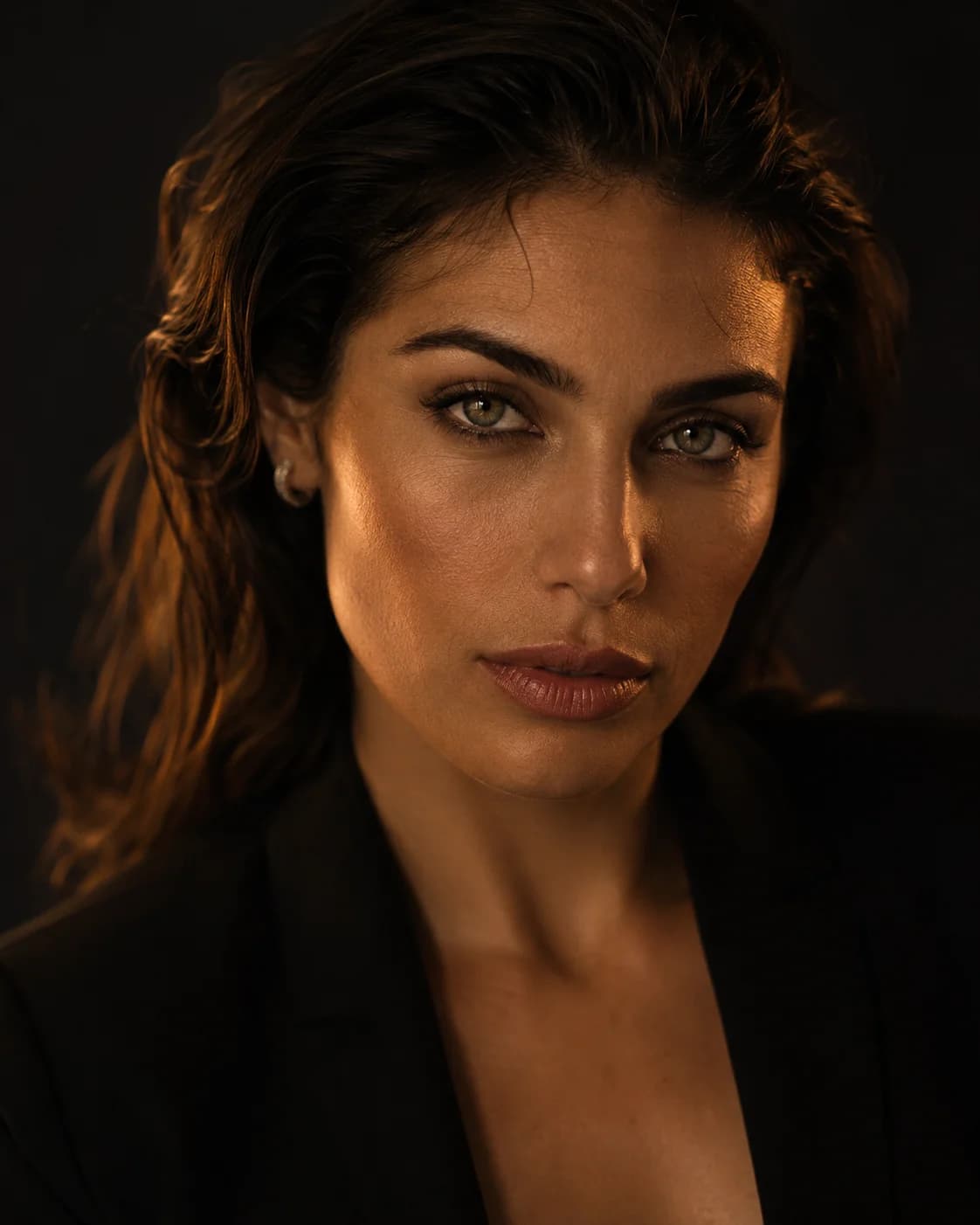
Why Does My Face Look Fat in Pictures?
Your face looks fatter in pictures because the camera is too close. A phone at arm's length stretches the nose and cheeks. Step back and zoom in, and the same face looks like the mirror. The photo is a close-up lens effect, not a change in your weight.
3D to 2D: The Root Cause of Camera Weight Gain
Your body exists in three dimensions. When you stand in front of someone, their visual system receives depth cues from both eyes working together (binocular parallax), from the way objects at different distances move relative to each other (motion parallax), and from subtle shadows and gradients that reveal your body's actual contours. All of these cues communicate volume, shape, and — critically — the depth that distinguishes a slim profile from a wide one.
A camera sensor is flat. It collapses everything in the frame into a single two-dimensional plane, eliminating every depth cue that your brain normally uses to perceive three-dimensional form. The result is that the camera cannot record the depth of your waist pulling inward, the three-dimensional projection of your shoulders that creates the silhouette, or the real distance between your near side and your far side. What it records is width — the outermost boundary of your form projected onto a flat surface.
This is why cameras systematically add apparent width. It is not an illusion or a bad photo — it is the mathematical consequence of converting a 3D object to a 2D representation. The slimming cues that real-world perception relies on simply do not survive the projection.
Barrel Distortion and Wide-Angle Lenses
The wide-angle lenses used in phone cameras — both front and rear at standard 1x zoom — introduce barrel distortion, which expands objects near the centre of the frame. When you stand directly in front of a wide-angle lens, the centre of your body (your torso) receives slightly more magnification than the edges. This tends to increase apparent body width.
The effect is compounded when the camera is angled slightly upward from below. Most casual photos are taken by someone holding their phone at chest or waist height and pointing it up at the subject. This low angle captures a perspective that makes the body appear broader and shorter — the optical equivalent of looking up at a building from its base.
Professional photographers and cinematographers are taught to keep the camera at the subject's eye level and use a longer focal length from further away. The reason for both rules is the same: eliminate the wide-angle barrel expansion and the distorting effects of a low angle. Neither of these practices is common in casual smartphone photography.
Ask photographers to keep the camera at your eye level or above, never below the waist — this single change reduces apparent body width significantly.
Posture and the Photograph
In person, your natural movement and posture constantly shifts to its most comfortable position. In front of a camera, most people unconsciously freeze — and the frozen posture is rarely the most flattering one. Shoulders drop forward slightly under the mild social anxiety of being photographed, the chin comes in, and the core relaxes. These micro-adjustments collectively push the body into a position that reads as heavier than standing height.
The most photographically flattering posture is not a natural resting posture — it is a consciously held one: chin slightly forward and down, shoulders back and down (not up), core lightly engaged, weight shifted to one leg to create a slight hip angle. This posture exaggerates the body's depth cues in the two-dimensional image, partially compensating for what the camera's flat sensor cannot record.
The people who consistently photograph well have usually learned this posture through repetition — in modelling, acting, or simply taking a lot of photos. It is a learned skill, not a physical attribute.
Chin forward and slightly down, shoulders rolled back — practice this posture in a mirror before the next time you know photos will be taken.
Advertisement
Clothing, Contrast, and Visual Weight
Dark colours absorb light and reduce the contrast between your body and the background, which makes the edges of your silhouette less distinct in a photograph. This reduced edge contrast is one reason dark clothing is traditionally associated with a slimming effect in photos — it is an optical trick that partially compensates for the 2D projection problem.
High-contrast patterns — bold stripes, large prints — draw attention to the pattern itself and emphasise the outline of the body, increasing apparent size. Vertical lines draw the eye up and down, which tends to increase the apparent height-to-width ratio. These are not myths: they reflect the actual way the visual system parses edges and shapes in a two-dimensional image.
Fit is arguably more important than colour. Clothing that fits the actual body produces a cleaner silhouette. Loose clothing adds visual volume because the fabric falls away from the body and the camera cannot distinguish body shape from fabric shape — both are recorded as solid, flat form.
Why You Look Better in the Mirror Than in Photos
Several factors make the mirror systematically more flattering than a photograph. First, your mirror reflection is viewed in real time with full three-dimensional depth perception and binocular vision — your brain receives all the depth cues that cameras eliminate. Second, you see yourself in motion, which provides additional depth information through motion parallax. Third, you are looking at your own face at a distance of typically 2–5 feet, without wide-angle lens compression.
Additionally, you have become habituated to your mirrored self over years of daily observation. The mirrored image is the version of your face you consider 'normal.' Photographs — particularly front-facing selfies — show you in a slightly different orientation and with different proportions than your mirror self, which is why many people find photos of themselves surprising or off-putting even when others think the photos look fine.
Research on self-perception bias suggests that familiarity drives preference: people consistently rate the mirrored version of their face as more attractive than the camera version, while friends and partners tend to prefer the camera version (which is the one they see in real life). Neither version is fully accurate — they are two different representations of the same complex three-dimensional object.
Practical Steps to Look More Accurate in Photos
The goal is not to look thinner than you are — it is to look as accurate in photos as you do in real life. The main adjustments are: (1) camera at eye level or above, never below the waist; (2) rear camera at 2x zoom from 4–5 feet rather than front camera at arm's length; (3) natural light from the front rather than harsh overhead light; (4) deliberate posture — chin forward, shoulders back, weight shifted.
Lighting deserves specific attention. Overhead lighting — especially in offices, gyms, and indoor venues — casts strong downward shadows that flatten facial and body contours and increase apparent volume. Natural window light from the front fills in these shadows and restores some of the depth contrast that makes bodies look more three-dimensional.
Finally, consider context: most people look meaningfully different across photos taken in different conditions. A photo taken at a poorly-lit indoor party with a wide-angle phone camera at chest height will look very different from one taken in natural light from a portrait distance. Neither is more 'true' than the other — they are simply different optical conditions producing different representations of the same person.
Frequently Asked Questions
Why does my face look fat in pictures but not in the mirror?
The camera is too close. A phone at arm's length uses a wide lens that stretches the nose and cheeks, so the face looks wider than it does in the mirror. Step back about 4–5 feet and zoom in. The mirror is the closer match to how you look in person.
Does the camera really add 10 pounds?
The '10 pounds' figure is a cultural shorthand rather than a precise measurement, but the underlying effect is real. 2D projection eliminates depth cues, wide-angle distortion expands central form, and unflattering angles reduce the height-to-width ratio. Together these effects can meaningfully increase apparent body weight in photos compared to real-life perception.
How do I look slimmer in photos without editing?
Keep the camera at eye level or above, use the rear camera at 2x zoom from 4–5 feet, use front-facing natural light, hold deliberate posture (chin forward and down, shoulders back), and wear well-fitting clothing in darker or solid colours. These adjustments compensate for the optical effects that add apparent weight.
Why do I look wider in selfies specifically?
Front-facing cameras use very wide-angle lenses (around 24–28 mm equivalent) which produce more barrel distortion than rear cameras. At arm's length, barrel distortion expands the centre of the frame — which is where your face and upper body sit. Switching to the rear camera at 2x zoom from a greater distance reduces this distortion significantly.
Is it normal to hate photos of yourself?
Very common — research consistently shows that people rate their own photos less favourably than friends rate the same photos. Part of this is mere exposure: you are habituated to your mirror image and find the camera version unfamiliar. Part of it is that photos genuinely do capture you less flatteringly than real-life perception in many conditions. Both factors are normal and well-documented.
Lena Whitmore
Science Writer · Facial Analysis & Appearance Psychology
Lena covers the science of smiles, facial aging, and AI-powered biometrics. She writes evidence-based guides grounded in peer-reviewed research, with a focus on making appearance science accessible and actionable. All tools on Smile Tracker run locally in your browser — your photo is never uploaded anywhere.
Put it to the test
See your results with AI
Upload a photo and get your AI facial proportion analysis, symmetry measurement, and feature breakdown — free, private, instant.
Analyse My Face Free →Advertisement
Sources
Related reading
Am I Photogenic? The Science Behind Why Some Faces Photograph Better
May 2026 · 6 min read
Why Do I Look Different in Photos vs the Mirror? The Science Explained
May 2026 · 7 min read
Why Do I Look Bad on Camera? The Real Reasons (and How to Fix Them)
May 2026 · 7 min read
Why Does My Nose Look Big in Selfies? The Camera Science Explained
May 30, 2026 · 6 min read
How Lighting Affects Your Appearance: The Complete Science Guide
May 29, 2026 · 7 min read
Filter Dysmorphia: When Beauty Filters Distort How You See Yourself
May 29, 2026 · 8 min read