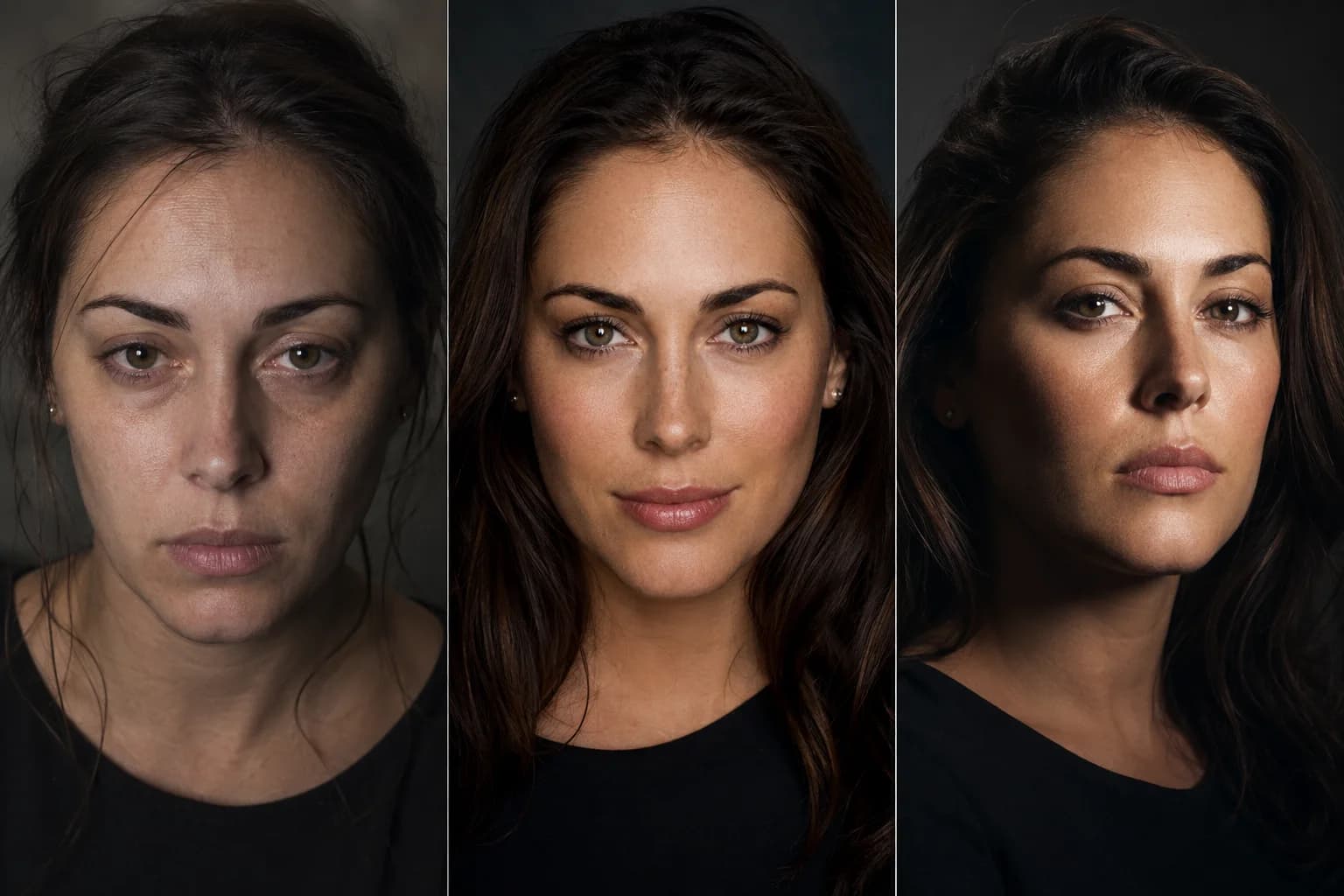
Why Do I Look Different in Every Photo? The Real Explanation
If you look like a completely different person in almost every photo taken of you, you are experiencing something almost universal — and it is not a problem with your face. It is a collision between the mirror familiarity effect, micro-expression timing, lighting physics, and camera optics, all of which change faster than you realise between frames. Understanding each factor makes the variation entirely predictable and much less distressing.
The Mirror Familiarity Effect: You Only Know One Version of Your Face
The version of your face you are most familiar with is the mirror image — a horizontally flipped reflection of what everyone else actually sees. This matters enormously because your face is not symmetric: your two sides differ in subtle but meaningful ways in terms of muscle position, fat distribution, eye size, and facial contour. The mirror shows you one version; cameras show you the other.
Research by Mita, Dermer and Knight tested this directly: when subjects were shown pairs of their own face — one mirror-image, one true photo — they consistently preferred the mirror version. Their partners and friends consistently preferred the true photo version. Each person preferred the version they had seen most often. This is the mere exposure effect (Zajonc, 1968): familiarity breeds preference, entirely independently of which version is objectively more attractive.
This means your own reaction to your photos is systematically biased. You are comparing unfamiliar versions of your face (true photos from different angles and lighting conditions) against the mental standard you have built up from thousands of mirror exposures. The comparison is not fair — and it consistently makes photos feel worse than they are.
“We do not just like what is beautiful. We find beautiful what we are most familiar with — and for our own face, that is the mirror reflection.”
Micro-Expression Timing: The Shutter Catches What You Cannot See
Human facial expressions are not static — they move through onset, apex, and offset phases in fractions of a second. Micro-expressions, which are involuntary emotional leakage expressions, last between 1/25 and 1/5 of a second. Even standard expressions like smiles have transitional phases — a midway point between neutral and full expression — that look very different from the apex.
A camera shutter at 1/60 second freezes whichever phase of an expression happens to coincide with the capture moment. Sometimes it captures the apex of a genuine smile; sometimes it captures the transition in or out of a smile. Sometimes it captures a micro-expression of concentration or self-consciousness that passed through your face in a fifth of a second while you were waiting for the shutter.
This is why even professional photographers with experienced subjects shoot in burst mode: the face changes between frames at a rate too fast for conscious control. Most photos catch transitional or off-peak expressions — not because your face looks bad, but because the shutter is freezing a moving target at a random point in its motion.
Use burst mode (5–10 frames) and choose the best frame rather than trying to hold a single expression perfectly. The best frame is almost always 1–2 frames into a genuine laugh or smile, not the fully posed peak.
How Angle Completely Changes Your Facial Proportions
Camera angle has a dramatic and often underestimated effect on how facial proportions appear in a photo. The same face photographed from directly in front, from 15 degrees to one side, from slightly above, or from slightly below will appear to have meaningfully different nose width, jawline definition, eye spacing, and face length — even with identical lighting and expression.
This is geometry, not appearance. The nose, which protrudes from the face further than any other feature, is particularly sensitive to angle: even a 5-degree horizontal rotation changes the apparent width of the nose substantially. The jawline appears sharper from slightly above and slightly to the side than it does from front-on. Eye spacing appears wider from front-on than from the side.
Since most photos are taken from whatever angle the photographer happens to be at — rather than a carefully chosen flattering angle — you are getting a sample of your face across a large range of perspectives, most of which are not optimised for your specific features. The variation in how you look is, in significant part, a sampling of different geometric projections of the same face.
Advertisement
What Lighting Does to Your Face Between Photos
Lighting direction, intensity, and colour temperature all change the apparent structure of the face dramatically. Hard overhead lighting — common in offices, restaurants, and public spaces — creates strong downward shadows under the eye sockets, nose, and jaw. These shadows can make the under-eye area look darker and more hollow, deepen nasolabial folds, and suppress the apparent volume of the midface.
Soft frontal lighting fills in shadows and makes the face appear more evenly toned and three-dimensional. Window light from the side creates dimensional shadow that defines the nose bridge and cheekbones flatteringly. Camera flash at close range creates flat, even overexposure that eliminates the shadow depth that gives the face visual structure.
Since lighting varies enormously between photos — indoors vs outdoors, natural vs artificial, flash vs ambient — the structural reading of your face changes substantially with each photo. This is why you look dramatically different at a well-lit outdoor event versus a flash-lit indoor party, even wearing the same expression.
What You Actually Look Like to Other People
Given all of the above, what do you actually look like to others? The answer is: a moving, expressive, three-dimensional face that is almost never captured accurately by a static photo in non-optimal conditions. Other people's live experience of your face includes motion, expression sequence, voice, and context — all of which fill in the gaps that a frozen photo frame cannot convey.
Research by Epley and Whitchurch found that people consistently judge their own photos as less attractive than they actually are (relative to objective ratings by strangers), and attribute this in part to the mirror familiarity effect — photos look wrong simply because they are unfamiliar, not because they are unflattering. The gap between how you perceive your photos and how others perceive them is real and systematically biased in the negative direction.
The practical implication: your reaction to a photo of yourself is not a reliable guide to how you look in that photo to anyone else. The photo that makes you cringe often registers as perfectly fine — or better than fine — to someone who does not carry the mirror-image standard you have built up over years.
Frequently Asked Questions
Why do I look completely different in every photo?
Because micro-expression timing, camera angle, lighting direction, and the mirror familiarity effect all combine to produce a different reading of your face in each shot. Each photo is a geometric projection from a unique angle under unique lighting, frozen at a specific moment in moving expression — which is why consistent results require controlling all of those variables deliberately.
Do I look like my photos or my mirror?
Neither is a complete representation. Your mirror shows a reversed image you are very familiar with; photos show the unreversed version from specific angles. Other people see your true (unreversed) face in three dimensions with motion and expression — which is neither the mirror nor any single photo. An AI face tool can analyse your face from photos and provide a more objective reading than your mirror-based self-assessment.
Why do I look good in some photos but bad in others?
Primarily because angle, lighting, and expression timing vary between shots. From a flattering angle with soft frontal lighting and a genuine expression, most faces photograph very well. From an unflattering angle with harsh overhead lighting and an off-peak transitional expression, the same face photographs poorly. The variation is about conditions, not your actual appearance.
Is my selfie what I actually look like?
Not quite. Selfies are taken at close range with a wide-angle front camera that distorts nose width and face proportions. They are also taken from your preferred angle in your preferred lighting — which is more flattering than average but less representative than photos taken by others. The truth is somewhere between your selfie, photos taken by others, and the mirror.
Why do I look worse in photos than in real life?
The mirror familiarity effect is the main reason — you are comparing your photos to a mental standard built from your mirror reflection, which is the most familiar version of your face. Research by Epley and Whitchurch found people consistently rate their own photos as less attractive than strangers do, specifically because of this familiarity bias.
Lena Whitmore
Science Writer · Facial Analysis & Appearance Psychology
Lena covers the science of smiles, facial aging, and AI-powered biometrics. She writes evidence-based guides grounded in peer-reviewed research, with a focus on making appearance science accessible and actionable. All tools on Smile Tracker run locally in your browser — your photo is never uploaded anywhere.
Put it to the test
See your results with AI
Upload a photo and get your AI facial proportion analysis, symmetry measurement, and feature breakdown — free, private, instant.
Analyse My Face Free →Advertisement
Sources
- Zajonc (1968) — Mere exposure effect, Journal of Personality and Social Psychology
- Mita, Dermer & Knight (1977) — Reversed facial images and the mere-exposure hypothesis
- Todorov et al. (2008) — Understanding face perception by computer modelling
- Epley & Whitchurch (2008) — Mirror, Mirror: Seeing Yourself as Others Do
Related reading
Am I Photogenic? The Science Behind Why Some Faces Photograph Better
May 2026 · 6 min read
Why Do I Look Different in Photos vs the Mirror? The Science Explained
May 2026 · 7 min read
Why Do I Look Bad on Camera? The Real Reasons (and How to Fix Them)
May 2026 · 7 min read
Why Does My Nose Look Big in Selfies? The Camera Science Explained
May 30, 2026 · 6 min read
How Lighting Affects Your Appearance: The Complete Science Guide
May 29, 2026 · 7 min read
Filter Dysmorphia: When Beauty Filters Distort How You See Yourself
May 29, 2026 · 8 min read