Fox Eyes: The Science Behind the Lifted, Almond Eye Look
Fox eyes are characterised by an upward sweep at the outer corner of the eye, creating a sharp, elongated almond shape. The trend exploded in mainstream beauty around 2020, but the underlying facial geometry has been studied long before social media. This article covers the anatomy, the science of why fox eyes read as attractive, and what to look for on your own face.
What Are Fox Eyes?
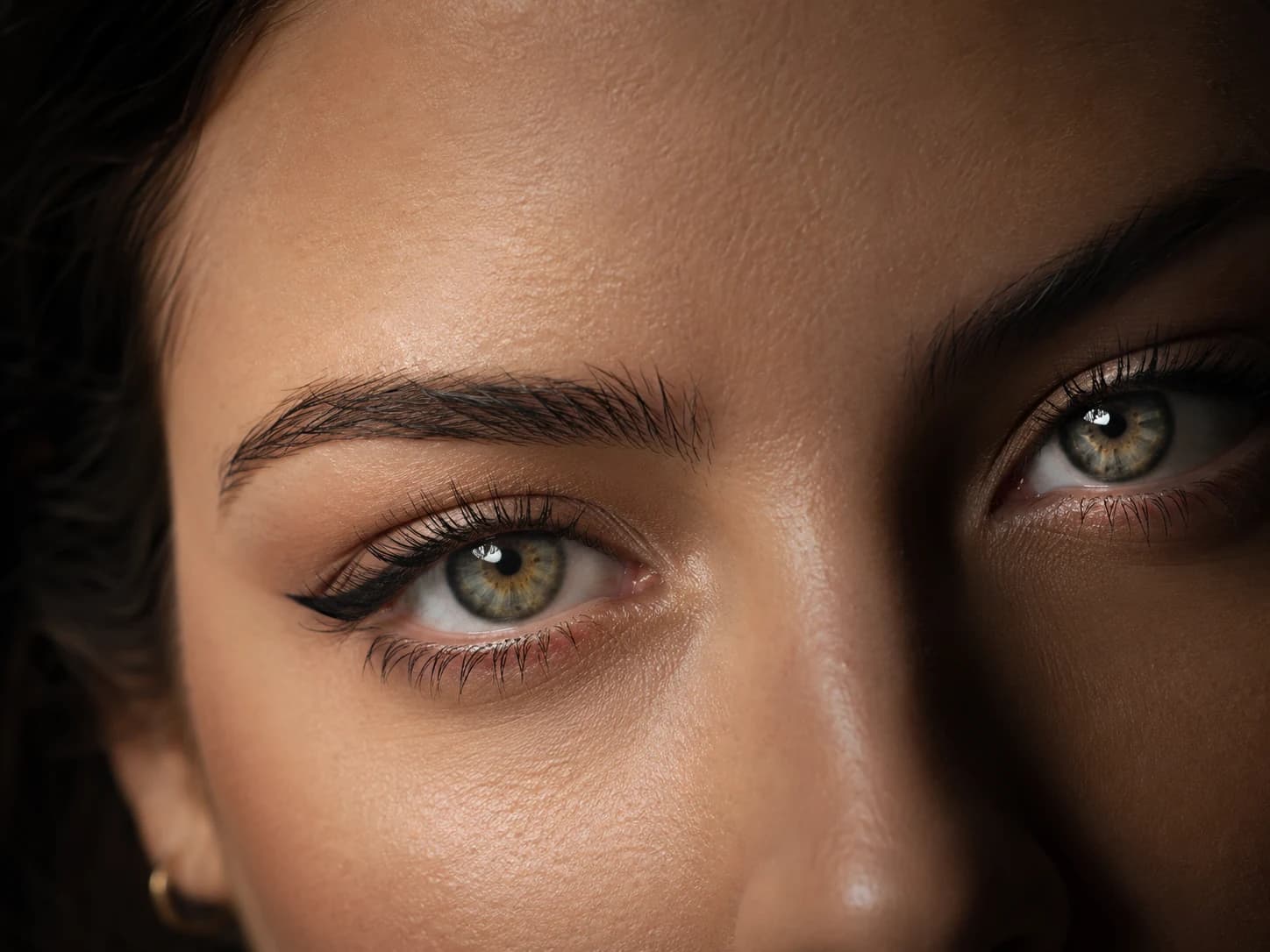
Fox eyes describe an eye shape where the outer corner (lateral canthus) sits higher than the inner corner (medial canthus) — a configuration called a positive canthal tilt. The result is a swept-up almond shape that tapers at both ends but angles visibly upward toward the temples. Combined with a relatively narrow eye opening and elongated lid, this creates a sharp, intense appearance that many find striking.
The term became mainstream beauty shorthand around 2019–2020, popularised through celebrity discourse and a corresponding makeup technique involving lifted liner and flicked-out tails. However, the eye shape itself is a natural structural variation — the angle is set by the positions of the medial and lateral canthi, which are determined by underlying orbital bones and canthal tendon tension.
Fox eyes are often contrasted with doe eyes, which feature a flat or slightly negative canthal tilt — producing a wide, rounded, softer look. The two represent opposite ends of a spectrum: fox eyes read as intense and dominant, doe eyes as soft and approachable. Both are widely considered attractive in different social contexts.
The Canthal Tilt: The Key Measurement
Canthal tilt is measured as the angle formed by a line connecting the inner and outer corners of the eye relative to a horizontal reference. A positive canthal tilt means the outer corner sits higher than the inner corner. Most research considers a positive tilt of +3 to +5 degrees to be the attractiveness sweet spot: enough upswept angle to appear sharp and defined without veering into extreme severity.
A 2006 study by Mounir Bashour examining facial attractiveness found that canthal tilt was one of the more consistent predictors of perceived eye attractiveness in both male and female faces, with positive tilts rated as more aesthetically pleasing across evaluators. The effect was particularly pronounced for female faces, where a mild positive tilt correlated with both beauty and femininity ratings.
The canthal tilt interacts with eyebrow angle. When the tail of the eyebrow also sweeps upward in alignment with the lateral canthus, the eye region forms a coherent upward line that intensifies the fox-eye effect. Conversely, flat or downward-angling brows reduce the fox-eye appearance even in people with a genuine positive canthal tilt — which is why eyebrow shaping is central to makeup-based fox-eye enhancement.
Why Fox Eyes Read as Attractive
Several factors explain the fox-eye attractiveness effect. First, a positive canthal tilt gives the eye a sharper geometry that implies structural definition — tight skin, well-supported orbital fat, and high cheekbone scaffolding beneath. These are all proxies for health and youth. A drooping or hooded outer corner, by contrast, is associated with skin laxity that reads as age-related change.
Second, the elongated almond shape creates the impression of larger-looking eyes through a different mechanism than round eyes. Wide round eyes signal youth through resemblance to infant proportions. Fox eyes signal a different kind of appeal: intensity, definition, and presence. Research on gaze dominance shows that people with sharper, more defined eye geometry tend to be rated as more confident and socially assertive — traits that are independently attractive.
Third, there is cultural amplification at play. Fox eyes have been associated with high-fashion modelling — where elongated, unconventional features are prized — as well as with specific celebrity faces that carry strong aspiration associations. This signal-loading is real and measurable: people rate the same face differently after exposure to celebrity association, a well-documented halo-effect mechanism.
Advertisement
Fox Eyes vs Doe Eyes: Key Differences
Fox eyes and doe eyes represent structurally opposite eye configurations and communicate different things socially. Fox eyes — positive canthal tilt, elongated narrow shape — read as intense, confident, and sharp. Doe eyes — flat or negative canthal tilt, wide rounded shape — read as soft, innocent, and approachable. Studies on face perception show that observers reliably assign these trait clusters to each eye shape type across cultures.
Neither is universally more attractive. Different contexts favour different signals. High-fashion modelling has historically preferred fox-eye sharpness; commercial advertising more often selects wide, approachable doe-eye features. In mate preference research, the preferred eye shape varies by what trait the evaluator is prioritising — people rating for trustworthiness tend to prefer softer doe-eye features, while those rating for confidence tend to prefer fox-eye geometry.
Many faces fall between the extremes — a slight positive tilt with moderate eye width reads as neither purely fox nor purely doe, which may explain why it scores well across the widest range of evaluators. If you want to know where your eyes sit on this spectrum, our face rating tool maps your eye geometry precisely.
Enhancing Fox Eyes With Makeup
The makeup fox-eye technique works by extending the impression of the outer canthus upward and outward. The core move: apply eyeliner starting from the outer third of the upper lash line and extend it in a thin upward flick toward the tail of the brow. This flick mimics the upswept outer corner of a naturally positive canthal tilt. The effect is amplified by keeping the inner corner clean and minimal.
Tight-lining the upper waterline with a dark pencil closes the gap between lashes and the eye, making the eye look more almond-shaped and defined without adding obvious width. On the lower lid, extending a thin smudged liner from the outer corner in a slight V pulls the lower corner outward, completing the elongated frame. Avoid applying lower liner all the way to the inner corner — that rounds the eye and cancels the effect.
For brows, sweeping the tail slightly upward and keeping it sharp rather than rounded enhances the fox-eye geometry by aligning the brow direction with the eye's upswept line. A sparse, slightly arched inner brow with a defined, upswept tail is the brow architecture that most consistently complements fox eyes — whether natural or makeup-enhanced.
To test whether you have a natural positive canthal tilt, hold a pencil horizontally across both eye corners. If the outer corner sits clearly above the pencil line, you have fox-eye geometry already built in.
Frequently Asked Questions
What are fox eyes?
Fox eyes describe an eye shape with a positive canthal tilt — where the outer corner sits higher than the inner corner — creating a swept-up, elongated almond appearance. The shape is named for its resemblance to the sharp, upswept eye of a fox.
Are fox eyes attractive?
Research consistently rates a mild positive canthal tilt as attractive, particularly in female faces. The sharpness implies structural definition, youth, and presence. Fox eyes score highest for intensity and confidence, though sometimes lower for approachability compared to softer eye shapes.
Can you get fox eyes naturally?
Canthal tilt is largely set by bone structure and canthal tendon tension, which are genetic. However, the appearance of fox eyes can be significantly enhanced through makeup technique (upswept liner flick), hairstyle, and lighting. Some aesthetic procedures such as canthoplasty can alter the tilt more permanently.
What is the difference between fox eyes and hunter eyes?
Fox eyes specifically refer to the upswept canthal tilt and elongated almond shape. Hunter eyes more broadly describe a deep-set, slightly hooded appearance with a low brow-to-lid distance that creates an intense, focused look. They often co-occur but are distinct features — you can have hunter eyes without a positive canthal tilt.
Do fox eyes look better in photos or in person?
Both. The defined upswept geometry photographs sharply and holds contrast well. In person, the eye shape creates a striking first impression — particularly notable in direct eye contact. Many models naturally have fox-eye geometry, which may partly explain its association with photogenic faces.
Lena Whitmore
Science Writer · Facial Analysis & Appearance Psychology
Lena covers the science of smiles, facial aging, and AI-powered biometrics. She writes evidence-based guides grounded in peer-reviewed research, with a focus on making appearance science accessible and actionable. All tools on Smile Tracker run locally in your browser — your photo is never uploaded anywhere.
Put it to the test
See your results with AI
Upload a photo and get your AI facial proportion analysis, symmetry measurement, and feature breakdown — free, private, instant.
Analyse My Face Free →Advertisement
Sources
Related reading

Hooded Eyes: Are They Attractive and What Do They Communicate?
May 2026 · 6 min read
What Is Canthal Tilt and Does It Affect How Attractive Your Eyes Look?
May 2026 · 6 min read

Hunter Eyes vs Prey Eyes: What Is the Difference and Which Is More Attractive?
May 2026 · 6 min read

Eyebrow Shape and Attractiveness: What the Research Shows
May 2026 · 6 min read

Doe Eyes: What Makes Eyes Look Wide, Soft, and Feminine
June 2026 · 7 min read